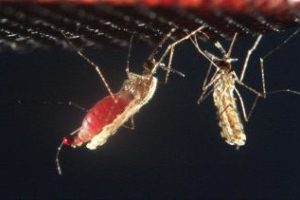

Malaria-carrying mosquitos appear to be manipulated by the parasites they carry, but this manipulation may simply be part of the mosquitos’ immune response, according to Penn State entomologists. “Normally, after a female mosquito ingests a [...]
Tag Archives | malaria

Mosquito genetic complexity makes them harder to control
A surprising research discovery in mosquitoes could affect future prospects for malaria control. A team of scientists from West Africa, the United States and the United Kingdom found that the mosquito, Anopheles gambiae, which was [...]

Drug may be major advance against malaria
Scientists at Oregon Health & Science University and the Portland VA Medical Center have developed a drug that may represent one of the world’s best hopes for treating and preventing malaria — a disease that [...]

Ultrasound shows effect of malaria on fetal growth
A study of almost 3800 pregnancies has provided the most accurate and direct evidence to date that malaria infection reduces early fetal growth. Low birth weight is the most important risk factor for neonatal mortality [...]

2,000-year-old herb regulates autoimmunity and inflammation
For roughly two thousand years, Chinese herbalists have treated Malaria using a root extract, commonly known as Chang Shan, from a type of hydrangea that grows in Tibet and Nepal. More recent studies suggest that [...]

New candidate malaria vaccine neutralises parasite strains
A new candidate malaria vaccine with the potential to neutralise all strains of the most deadly species of malaria parasite has been developed by a team led by scientists at the University of Oxford. This [...]
Drug Wipes Out Deadliest Malaria Parasite Through Starvation
An antimalarial agent developed by researchers at Albert Einstein College of Medicine of Yeshiva University proved effective at clearing infections caused by the malaria parasite most lethal to humans – by literally starving the parasites [...]
New study shows ability of transgenic fungi to combat malaria and other bug-borne diseases
COLLEGE PARK, Md. – New findings by a University of Maryland-led team of scientists indicate that a genetically engineered fungus carrying genes for a human anti-malarial antibody or a scorpion anti-malarial toxin could be a highly effective, speci…
Antifungal compound found on tropical seaweed has promising antimalarial properties
A group of chemical compounds used by a species of tropical seaweed to ward off fungus attacks may have promising antimalarial properties for humans. The compounds are part of a unique chemical signaling system that seaweeds use to battle enemies …
Malaria-infected cells stiffen, block blood flow
PROVIDENCE, R.I. [Brown University] — Although the incidence of malaria has declined in all but a few countries worldwide, according to a World Health Organization report earlier this month, malaria remains a global threat. Nearly 800,000 p…
Researchers link cerebral malaria to epilepsy, behavior disorders
EAST LANSING, Mich. — Almost a third of cerebral malaria survivors developed epilepsy or other behavioral disorders in the most comprehensive study to date of the disease in African children, solidifying the link between malaria and neurops…
Genetic markers offer new clues about how malaria mosquitoes evade eradication
CHESTNUT HILL, Mass. (10/25/2010) — The development and first use of a high-density SNP array for the malaria vector mosquito have established 400,000 genetic markers capable of revealing new insights into how the insect adapts to outsmart i…
Rip Van Winkle, Hibernating Fish and Malaria Control
When I think of hibernation, my first thought is my high school English literature class on Washington Irving’s tale of a Dutch settler named Rip Van Winkle. The story’s setting is New York’s Catskills Mountains [...]

