

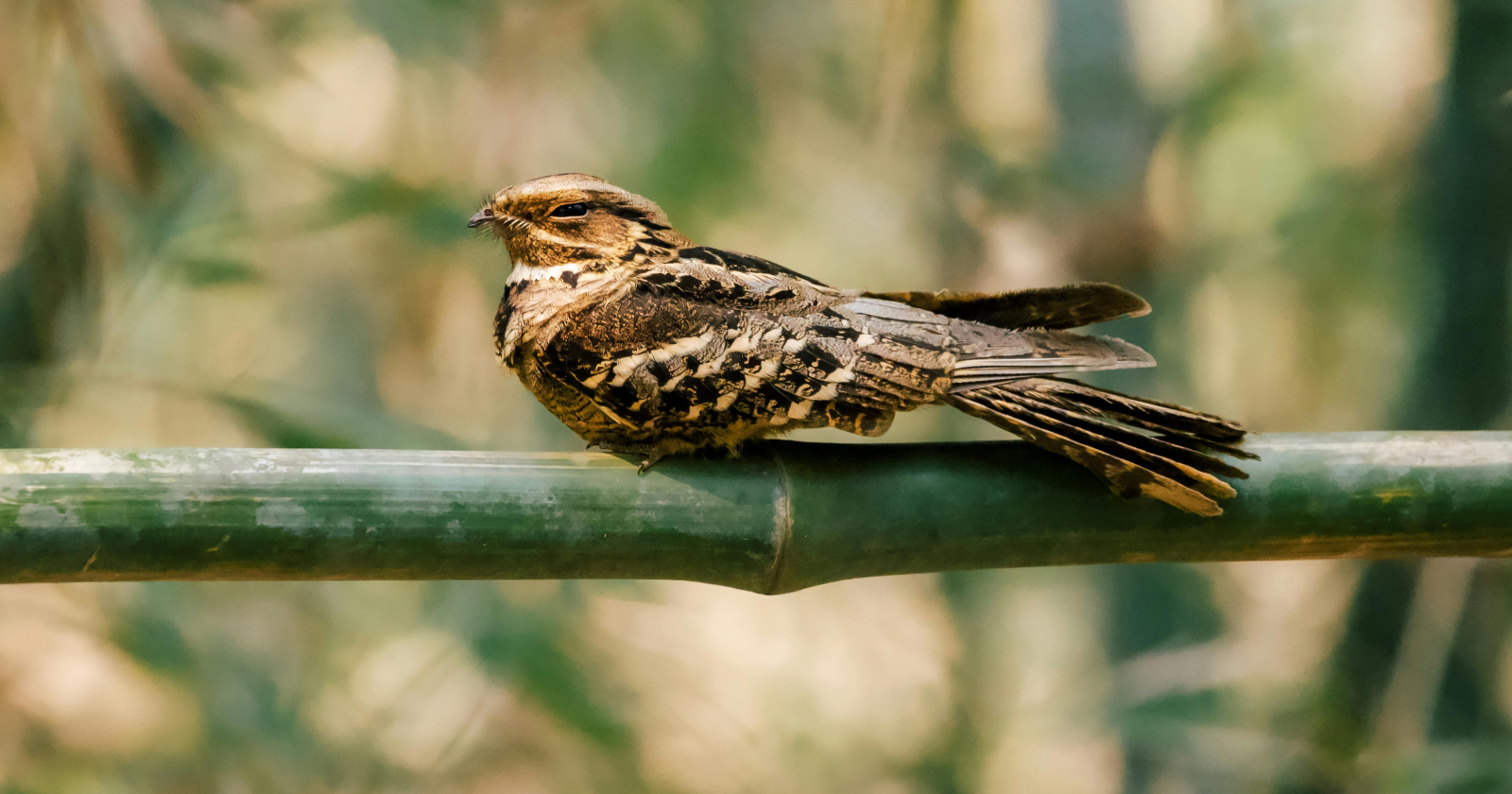
The red-necked nightjar has a problem most predators don’t: it hunts by a light it cannot control.
A nocturnal bird that catches moths and other flying insects on the wing over southern Spain, it needs to see its prey against the night sky — and unlike a bat, it has no echolocation to hunt in the dark. Its eyes are the whole toolkit. Which means the single most important variable in a red-necked nightjar’s life is not temperature, not weather, not season. It is how much moon is out.
A decade of field observations, including five years of biologging, linked moonlight with the birds’ nightly flight activity, skin temperature and the timing of migration across the Sahara.
Ten years, 74 logger deployments, one question
The study, led by Anders Hedenström at Sweden’s Lund University and published in Science Advances in 2026, combined field records of breeding and molt from Doñana National Park from 2011 to 2020 with custom miniaturized loggers deployed from 2016 to 2020. Researchers used 74 multi-sensor logger deployments on 56 adult nightjars; after recovery and quality exclusions, the analyses drew on 34 logger records and five GPS records from 30 individuals.
These were not simple GPS tags. The multi-sensor loggers sampled wingbeat-related vertical acceleration to estimate flight activity and recorded skin temperature through breeding, migration and the West African winter. Ten birds received GPS units; five GPS records were recovered and retained for analysis. The researchers then modeled energy balance from the activity and temperature data rather than measuring each bird’s daily energy balance directly. The distinction between deployments and analyzed birds matters because biologging fieldwork loses data at several stages. A device has to remain attached, the bird has to return, researchers have to recapture it, and the record has to pass quality checks. Some birds can also be tagged in more than one year. Reporting all 74 deployments as 74 adults therefore inflated the number of independent birds and hid the smaller sample behind the statistical analysis. The paper’s methods give both numbers, so readers can see the scale of the field effort and the scale of the evidence separately.
Every data stream was then laid against one external clock: the 29-day lunar cycle.
Living off the moonlight
The daily pattern was stark. On bright moonlit nights the nightjars stayed airborne and hunting for much of the night — activity holding above 60 percent — because there was enough light to spot insects on the wing. On dark nights, around the new moon, that hunting window collapsed; the birds could only feed in the brief twilight at dusk and dawn, when residual sky-glow gave them just enough to see by, and spent the black hours grounded.
That monthly rhythm created an energy problem the birds could partly offset by lowering body temperature. On darker nights the logger data showed lower skin temperature, a pattern the researchers discuss in connection with torpor and reduced energy use. Their energy-balance output was a model based on the recorded activity and temperature, not a direct measurement of each bird’s actual daily balance. An independent 2011 study of freckled nightjars had also linked moonlight, foraging opportunity and torpor; that earlier work involved a different species and does not independently replicate the new red-necked nightjar results.
The calendar in the sky
The genuinely surprising part is how far up the moon’s influence reaches — past the single night, into the shape of the whole year.
Because a nightjar can build reserves for a big effort during brighter parts of the lunar month, some major life events lined up with the moon. Spring migration out of West Africa, the study found, typically began 11 to 13 days after a full moon, after birds had a brighter foraging period. Breeding showed lunar timing too: egg-laying was aligned so that a demanding stage of chick-rearing fell during moonlit nights. Feather molt was the exception; the study did not find the same lunar synchronization for molt.
Hunting activity, migration and reproduction tracked the lunar cycle in the study, while molt did not show the same synchronization. The result is broad, but it does not mean every part of the bird’s life was pinned to the moon.
The animal as instrument, and what threatens it
There is a nice doubling in how the finding was made. To study how a bird lives by light, researchers combined long-running field observations with activity and skin-temperature sensors carried by the birds themselves.
The findings also raise a question about artificial light. A CSIC summary of the research identifies light pollution as an open issue for future work, rather than reporting that this study tested its effects. How artificial light changes the nightjar’s moon-linked behavior remains unresolved.
Correction, 15 September 2026: The headline and methods section were revised to distinguish 74 logger deployments from 56 tagged birds and the 30 individuals represented in the analyzed logger/GPS data; the text now describes activity sampling, skin temperature and modeled energy balance accurately, and it no longer says molt was synchronized to the moon.