

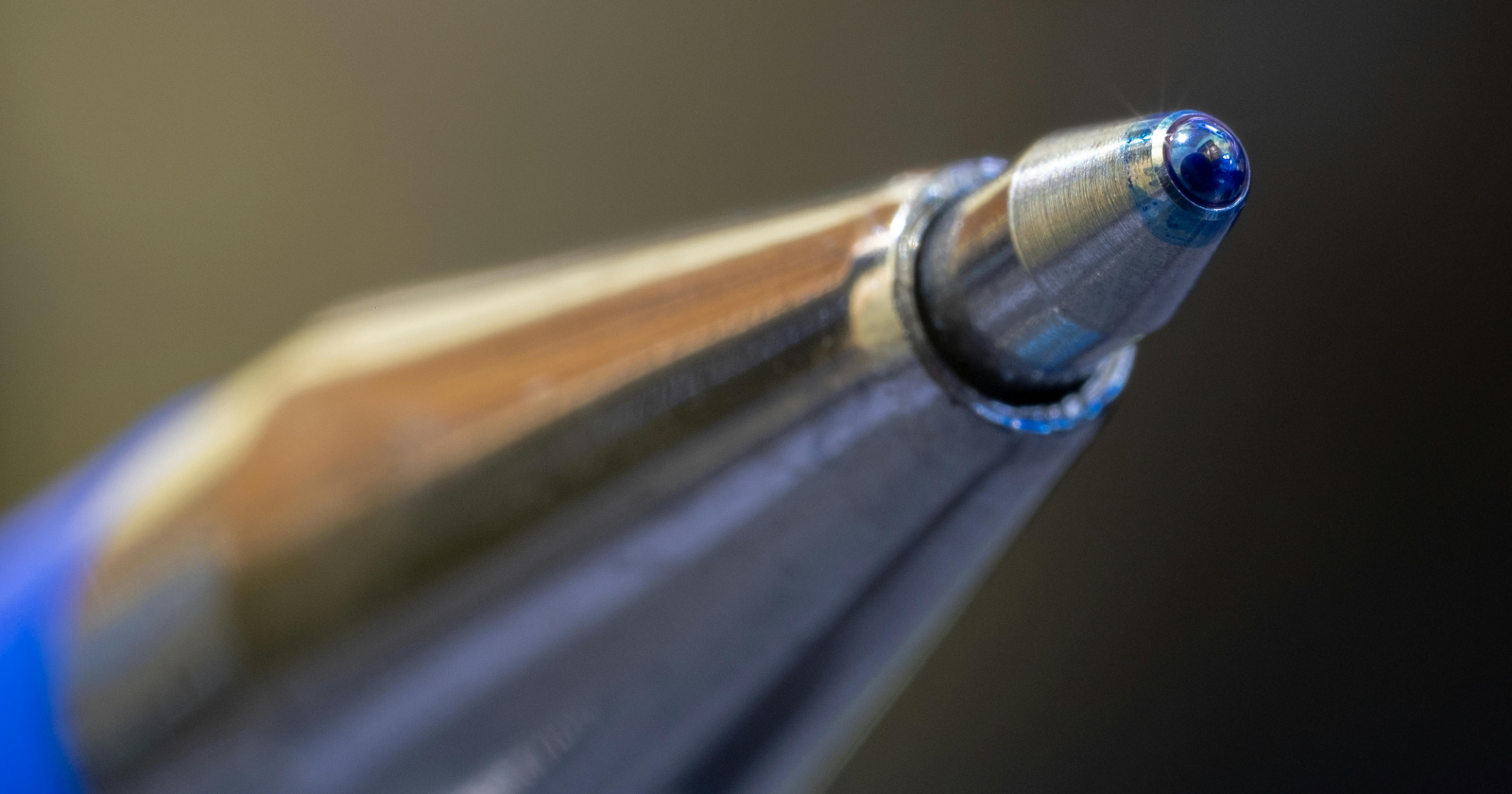
There is a decent chance the pen nearest you right now is named after a man most people have never heard of — and in much of the world, the pen isn’t just named after him, it is his name. In Britain, Australia, Italy and beyond, you don’t write with a ballpoint. You write with a biro.
The man was László Bíró, and the object was born of a very ordinary irritation.
The journalist’s complaint
Bíró, born in Budapest in 1899, had tried a dozen careers — medicine, hypnotism, art, motor racing — before settling into journalism in the 1930s. The job meant writing, constantly, with the only good tool available: the fountain pen.
Fountain pens were, and are, temperamental. They leak. They blot. Their thin ink dries slowly, so the heel of your hand drags through a fresh line and smears it, and the nib tears cheap paper and demands frequent refilling. For a working reporter filling notebooks against a deadline, the fountain pen was a daily small enemy.
Then Bíró, in the newspaper office, looked at the presses and noticed the contrast. The thick ink the printers used dried almost the instant it touched the newsprint — no smudge, no blot, dry enough to stack and sell within minutes. He wanted that ink in his pen.
But he couldn’t. Printer’s ink is far too thick and gluey to flow through a fountain pen’s nib; it would clog instantly. The very property that made it dry fast — its heavy, syrupy body — made it impossible to deliver by the old method. Bíró had identified the ink he wanted and the reason he couldn’t use it in the same glance.
The brother with the chemistry
What Bíró had that most frustrated writers didn’t was a brother named György — a dentist by training and a chemist by inclination.
Together the brothers attacked the problem from both ends. The delivery mechanism was László’s insight: instead of a nib, put a tiny ball bearing in a socket at the pen’s tip. As the ball rolls across the paper it turns, picking up ink from a reservoir on its inner side and laying it down on the outer — the ball acts as its own valve, rolling the thick ink on in a controlled line and sealing the reservoir against leaks and drying when still. And György worked on the ink: a formulation viscous enough to dry on contact like a printer’s ink, but engineered to feed smoothly to a rolling ball.
The pairing was the whole invention. A ballpoint fails without quick-drying ink; quick-drying ink is unusable without a ball to meter it. Earlier inventors had patented ball-tipped pens decades before — the idea itself wasn’t new — but nobody had made the ball and the ink work together well enough to sell. The Bírós did, filing a patent in 1938.
The pen that outran its inventor
History then intervened, as it did with everyone in Europe in 1938. The brothers were Hungarian Jews, and as war closed in they fled, eventually to Argentina, where they refiled their patent in 1943 and began manufacturing in Buenos Aires.
The pen’s first great customer was aviation. Fountain pens leak at altitude — falling cabin pressure pushes ink out of the nib — but the sealed, pressure-tolerant ballpoint wrote fine in an unpressurized cockpit, and the British Royal Air Force ordered thousands for its navigators, giving the design its first real market. From there the ballpoint went where all good inventions go: into a patent scramble and a price war. Others bought, borrowed and skirted the Bíró patents; an entrepreneur named Marcel Bich licensed and refined the design into a disposable sold for pennies, and shortened his own name to brand it — BIC, the pen that would sell in the tens of billions.
Bíró himself, as first inventors often do, saw comparatively little of the fortune his idea generated. But he got the rarer prize: his name became the object. Across the English-speaking and much of the non-English-speaking world, the biro is simply what the thing is called, an inventor’s surname worn so smooth by daily use that most of the people saying it have no idea they’re naming a man. Argentina marks his birthday, September 29, as Inventors’ Day.
The whole empire traces to a reporter’s smudged hand and a single lateral glance — the decision to stop cursing the fountain pen and start envying the printing press. Bíró didn’t invent fast-drying ink; the printers already had it. He didn’t invent the rolling ball; the patents predated him. What he invented was the connection between them, which is what invention usually is: not a new thing from nothing, but two old things that nobody had thought to introduce. He introduced them behind a tiny ball, and put his name on your desk forever.