

How does a track cyclist end up already rolling at the moment the clock starts, without being pulled for a false start? The answer, measured on three of France’s specialist team-sprint starters and published this month in Royal Society Open Science, is that for the first fifth of a second the rider’s own body does the pushing. For the quickest of the three off the line, the arrest of a forward lunge timed to the gate release drove about 1800 newtons into the bike, against the roughly 370 newtons the gate can hold the rear wheel with.
The work also clears up an awkwardness that has sat inside track-cycling models for years. Predictive models have simply been handed a non-zero speed at time zero as an input rather than deriving it, a choice the authors call ad hoc at first sight before showing that it falls out of a soft-impact transfer of momentum from rider to bike.
The gap between wheel and line
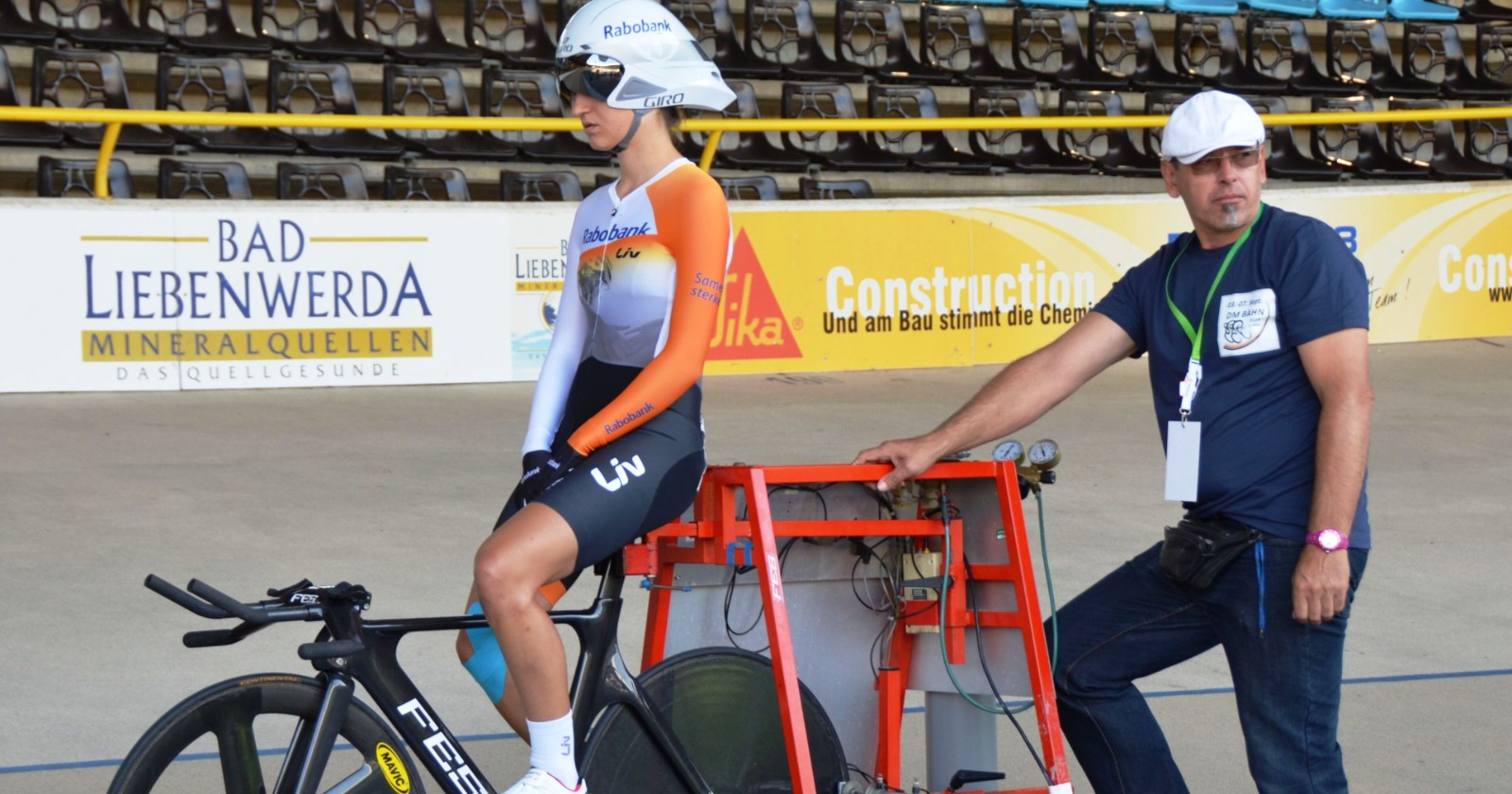
Held standing starts are used in the kilometre time trial, the team sprint and the individual and team pursuits, and in comparable para-cycling timed events. The rear wheel is locked into a starting gate that opens when an audiovisual countdown reaches zero. That instant defines time zero for the race.
That opening instant gets measured closely. A 2024 analysis of elite track cycling found the quality of the initial launch correlates with early split times in the team sprint, which is why a tenth of a second at the gate is worth a laboratory’s attention.
The rule on jumping the start is simple. As the paper states the practical constraint, the front wheel must not cross the start line before the official signal, and a start judge decides whether a start has to be stopped. The constraint bites on the wheel rather than on the bicycle.
That distinction is what makes the rest possible. Because the gate is placed by officials and bicycle frames differ in length, a rider’s front wheel often sits some distance behind the line at the start. The team measured offsets of 6 and 14 centimetres on their three riders, and note that the range seen in competition runs from zero to about 10 centimetres. Speed built up inside that gap is legal, on condition that the wheel is still behind the line when the signal comes.
The three riders were filmed at 120 frames per second, which resolves the trace to 8.3 milliseconds, and with spatial calibration to sub-centimetre positions. Only one of them arrived at the signal already moving. Starter 1, whose wheel sat 6 centimetres back, was already doing 0.4 metres per second when the signal came and reached the 30-centimetre mark in 0.23 seconds. Starters 2 and 3 both had larger 14-centimetre gaps to work with and both began from a dead stop, reaching 30 centimetres in 0.35 and 0.40 seconds. The gap alone was not enough. The phasing of the body motion against the gate release was decisive too.
Inside the Swiss Timing gate
Before the riders could be modelled, the gate had to be. The Swiss Timing device used at UCI World Cups, World Championships and Olympic Games clamps the rear wheel with pneumatic actuators fed from a 200-bar nitrogen cylinder through a regulator, with 6 bar the standard competition setting.
The team put a force sensor between the caliper jaws and ran the gate at a range of pressures. Clamping load rose with regulator pressure on what the paper calls an affine fit, of about 43.4 newtons per bar, and at the competition setting they measured a normal load of about 278 newtons. Those are two separate facts, and this piece keeps them separate: the appendix’s own tabulated loads scale on that slope alone, which at 6 bar would fall short of 278, so what follows rests on the measured value, which is the one the paper’s model runs on. Then they secured an instrumented bike in the gate and had someone pedal against it until the wheel slipped free, which returned a mean effective friction coefficient of 1.33 across seven slip-release trials, all of them run at lower pressures than competition.
Multiply that coefficient by the competition-pressure clamping load and the gate resists forward motion with about 370 newtons before it opens. Time-resolved traces showed the gate starting to move immediately after the official signal and finishing its release in about 0.06 seconds, after which the clamping force falls to effectively nothing. In practice its grip is gone within the first few centimetres of travel.
The body is the first engine
Three things push or hold the bicycle in that opening fraction of a second: the gate braking it, the drivetrain driving it, and the rider’s mass moving relative to the frame. The third dominates the first fifth of a second.
Each rider’s centre of mass was reconstructed frame by frame from digitised joint positions using published sex-specific segment mass fractions, and it follows a consistent path. Back first, then hard forward. Starter 1 pulled his centre of mass furthest rearward before the signal and reached the highest peak forward speed relative to the bike, about 2.0 metres per second, against roughly 1.6 for Starter 2 and 1.4 for Starter 3.
The propulsive moment is not the lunge itself. Force reaches the bicycle from the deceleration that ends it, when the rider’s forward-travelling mass is arrested against the machine. Peak centre-of-mass velocity is not the quantity that matters on its own. The paper’s term is the relative acceleration together with its timing. Multiplied by the rider’s mass, it becomes a force on the bicycle, and for Starter 1 that force peaked at about 1800 newtons, against the roughly 370 newtons the gate can hold. Peak values for all three riders arrived within the first 0.2 seconds after the signal.
Pedalling, measured with an instrumented crankset sampling at 200 hertz, delivered peak forces the paper describes as of the order of a few hundred newtons, and settled into a near-plateau after about 0.2 seconds. The chain takes over once the gate has let go and posture has stabilised. It is not the dominant term while the gate is still releasing.
A tenth of a second in either direction
With the gate characterised and the three force terms measured independently, the model reproduces the measured velocity traces without being told the starting speed. It matched Starters 1 and 3 closely. For Starter 2 it predicted a slightly late onset and correspondingly lower early speeds than the video showed.
That independence from an assumed start speed is what makes the optimisation worth reading. Its baseline is Starter 1 at his 6-centimetre offset with the timing the model says is best for it, which puts his speed at the signal at 1.34 metres per second, against the 0.4 metres per second he actually managed. From there the team perturbed each model parameter by 10 per cent and compared the resulting speed at the signal. Increasing the explosiveness of the centre-of-mass motion by a tenth raised it by 10.45 per cent. A tenth more crank torque bought 1.49 per cent. A tenth more bicycle mass cost 0.75 per cent, and a tenth taller gearing cost 1.49 per cent. A tenth more rider mass bought 1.49 per cent, and a tenth more grip from the gate cost 2.24 per cent.
Timing swamps all of it. Initiating a tenth of a second later dropped the modelled speed at the signal by 91.04 per cent. Initiating a tenth of a second earlier raised it by 39.55 per cent, and the paper is explicit that this row is a sensitivity case rather than a recommendation, because at a 6-centimetre offset it would very likely put the wheel over the line before the signal.
The team also ran the limiting case with the wheel effectively on the line, where any movement before the signal would be a false start. The model says the best legal onset there is about 0.03 seconds later than what Starter 1 actually did, and that it reaches 30 centimetres in 0.22 seconds with effectively no speed at the signal. That is a modelled figure, and it comes out 0.01 seconds under the 0.23 seconds he actually recorded on video with 6 centimetres of room. Run the same optimisation at his real 6-centimetre offset and the model returns 1.3 metres per second at the signal, which is the sensitivity table’s 1.34 to the precision this second table prints it, and 0.18 seconds to 30 centimetres. The paper’s reading is that he had been using only part of the distance the rules allowed him.
The measured core underneath all of that is narrow. Three riders from one national programme, two men and one woman, on one gate, filmed during their own training sessions. All three were adults who consented, no minors were involved, and the study was exempt from formal ethical review as an observational one with no intervention. The gate characterisation was made on the device itself and does not depend on the riders, although its 370 newtons is a clamping load measured at competition pressure multiplied by a friction coefficient measured well below that pressure. Every statement about how riders behave rests on three people, one of whom the model fits imperfectly.
Numbers that are not measurements
The most eye-catching figures in the paper are not its own measurements. The comparison rows showing British and Australian starters already doing 1.2 and 2.0 metres per second at the signal, and reaching 30 centimetres in 0.14 and 0.11 seconds, are drawn from a companion analysis of the 2022 World Championships by the same group, which the paper lists as under review and not yet published.
The Australian starter reached that 2.0 metres per second at the signal from an offset of only 4 centimetres, smaller than Starter 1’s 6. The authors treat it as an athlete-specific observation rather than something the model predicts from Starter 1’s parameters, and note that matching it from a smaller offset would take a bigger and more precisely phased body impulse than Starter 1 produced.
The percentages are outputs of the model, not repeated trials. The sensitivity table asks what the model does when one parameter is nudged while everything else is held fixed, which is not the same as putting three riders through a tenth of a second of mistiming and watching what happens. The team is similarly careful about the offset result, declining to read it as a universal monotonic law and noting that very large offsets would depend on gate geometry, frame size and whether a rider can load the gate without losing balance. Aerodynamic drag and rolling resistance are left out of the model entirely, which is defensible over 30 centimetres and would not be over a kilometre.
What the framework does offer is portability. A held start followed by a release, with a compliant coupling between athlete and apparatus, describes BMX gates, athletics blocks, short-track skating and swimming block departures in the same terms as a velodrome. Each would need its own gate measured before the decomposition means anything, and the paper is clear that each needs its own instrument: a block’s reaction in athletics, a hinge’s dynamics in BMX. That part is measurement, not modelling. The team has posted its data and code.