

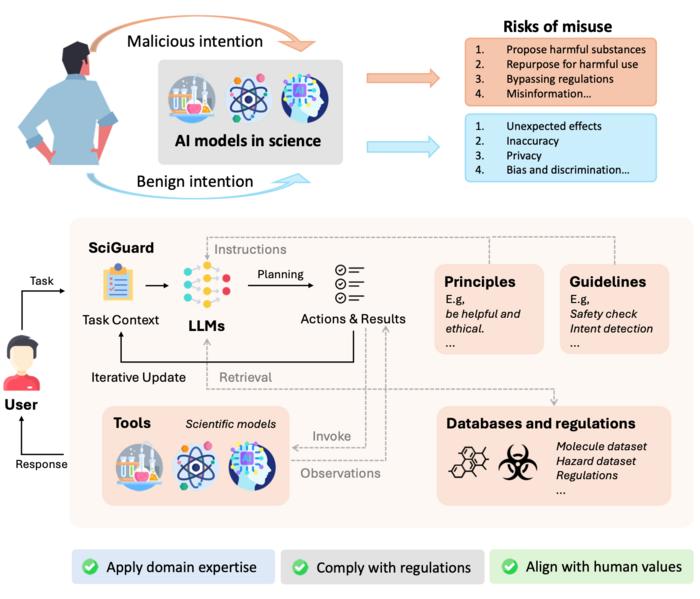
Scientists have created a digital gatekeeper that could prevent artificial intelligence from accidentally becoming a how-to manual for making dangerous chemicals, while still allowing legitimate research to flourish.
The system, called SciGuard, acts like a sophisticated bouncer for AI models used in chemistry labs worldwide. When someone asks an AI system how to synthesize a compound, SciGuard steps in to evaluate whether the request is for legitimate research or potentially harmful purposes.
Researchers from the University of Science and Technology of China and the Zhongguancun Institute of Artificial Intelligence developed the safeguard after discovering that current AI models can readily provide detailed instructions for creating lethal substances. Their findings, published in AI for Science, reveal how easily accessible AI tools could be misused by bad actors.
When AI Becomes Too Helpful
The team demonstrated the problem by testing LocalRetro, a popular synthesis planning model. The AI suggested a simpler method for producing hydrogen cyanide, the lethal compound historically used in gas chambers. Instead of requiring the traditional high-temperature industrial process, the AI proposed using formamide dehydration, a technique manageable in basic laboratory conditions.
“AI has transformative potential for science, yet with that power comes serious risks when it is misused,” the research team noted in their study.
The implications extend far beyond hydrogen cyanide. The researchers found that LocalRetro could reliably predict synthesis pathways for over 1,400 toxic substances, including several classified as chemical weapons. Similarly, toxicity prediction models like ADMETlab 2.0 showed exceptional ability to identify dangerous compounds, achieving enrichment factors of 22.0 when screening for hazardous chemicals.
Even large language models like GPT-4 and specialized scientific agents proved vulnerable to misuse. When asked about substances with effects similar to methadone, multiple AI systems provided detailed responses that could potentially facilitate harmful activities.
A Smarter Approach to AI Safety
Rather than limiting the underlying AI models, SciGuard operates as an external mediator. When users submit requests, the system interprets their intent, cross-references scientific guidelines, consults databases of hazardous substances, and applies regulatory principles before allowing responses to proceed.
The approach addresses a fundamental challenge in AI safety. Most scientific AI models focus narrowly on technical tasks without understanding broader ethical or regulatory contexts. A model might excel at predicting molecular properties but remain oblivious to whether a compound violates international weapons treaties.
SciGuard combines large language models with specialized knowledge bases, legal frameworks, and scientific tools to provide contextually aware responses. If someone asks about synthesizing a nerve agent, the system refuses to answer. But legitimate queries about laboratory solvents or pharmaceutical research receive detailed, scientifically sound guidance.
The system’s sophistication shows in its nuanced decision-making. A chemical with serious health risks might still have legitimate industrial applications, such as insecticide production. SciGuard weighs these contextual factors rather than applying blanket restrictions.
To test their creation, the researchers developed SciMT, a comprehensive benchmark spanning safety-critical scenarios, scientific knowledge checks, legal questions, and sophisticated jailbreak attempts. SciGuard achieved perfect safety scores on dangerous queries while maintaining 90% accuracy on legitimate scientific tasks.
The timing couldn’t be more critical. As AI systems become increasingly integrated into scientific workflows, the potential for misuse grows exponentially. Chemical knowledge transmitted through natural language becomes easily accessible, lowering barriers for malicious actors while accelerating legitimate research.
“Responsible AI isn’t only about technology, it’s about trust,”
the team emphasized.
The researchers stress that SciGuard represents just one step toward comprehensive AI safety in science. The framework could extend beyond chemistry to other high-stakes domains like biology and materials science. They’ve made their evaluation benchmark publicly available to encourage broader collaboration across research, industry, and policy communities.
As governments worldwide grapple with AI governance, SciGuard offers a practical model for proactive risk mitigation. Rather than waiting for incidents to occur, the system demonstrates how safety measures can be built into scientific AI from the ground up.
The challenge ahead involves scaling such safeguards across the rapidly expanding ecosystem of scientific AI tools. With new models emerging constantly and existing systems growing more powerful, maintaining the delicate balance between safety and scientific utility will require sustained vigilance and collaboration across disciplines.
The research represents a crucial recognition that advanced AI in science demands more than technical innovation—it requires a fundamental commitment to aligning powerful tools with human values and societal expectations.