Summary
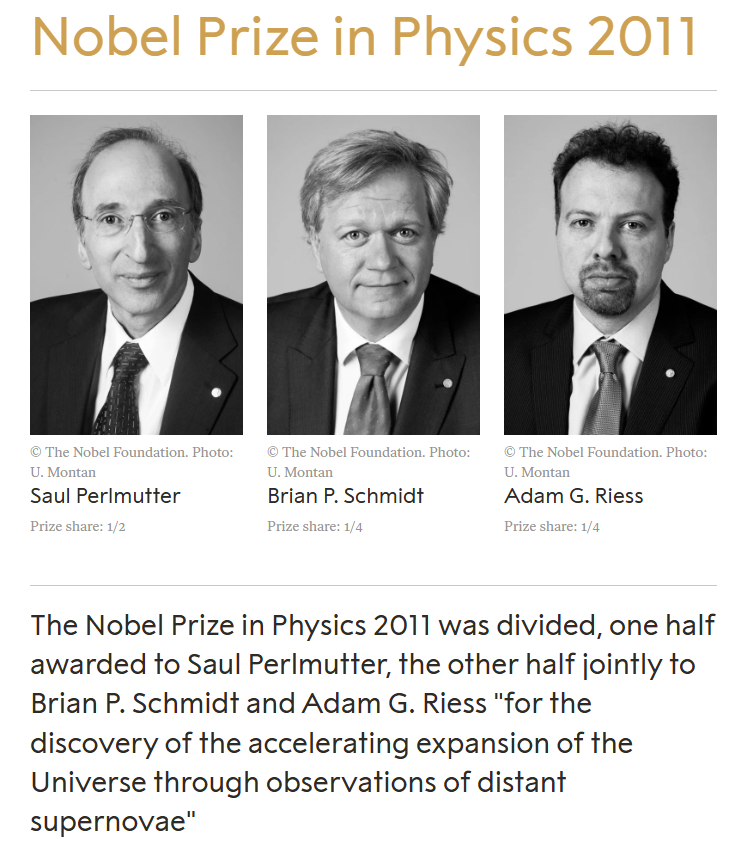
In 1997, two independent research groups published their finding that the expansion of the universe is accelerating. The concept of “dark energy” was introduced as a hypothetical source of negative gravity, which would add the acceleration to the standard Big Bang model. Subir Sarkar now claims that the two groups made the mistake of looking only at one patch of the sky, and that when the whole sky is considered, there is no evidence for acceleration, hence no need for “dark energy”.
Background
The Big Bang theory is rooted in the observation made by Ed Hubble in the 1930s that the universe is expanding. We know this because the further away things are from us, the faster they are moving.
(You shouldn’t think of us as the center of this expansion. Think instead that we are a raisin in a loaf of raisin bread baking in the oven. As the bread rises, every raisin is moving away from every other raisin. The further the distance between two raisins, the faster they are moving apart.)
In the Big Bang theory, the expansion was “baked into” the universe from the very beginning. Things that are far away are far away because their initial velocity was very different from our own. Things that are close by had velocities close to ours, so they never got very far from us, even after 13 billion years.
This picture is modified by gravity. All matter that we know of has positive gravitational attraction, so the expansion of the universe should be gradually slowing down.
How do we know how far away other galaxies are?
The expansion of the universe is charted by comparing the recessional velocity to the distance from us.
As it turns out, the recessional velocity is easy to measure. All the elements emit light at characteristic colors (wavelengths) that are very well defined. For example, hydrogen emits some of its light as a specific shade of green. When a galaxy is moving rapidly away from us, that green might appear yellow because of its motion. This is called the “redshift” because the color is shifted toward the red end of the spectrum.
In Hubble’s Law, a galaxy’s redshift is proportional to its distance away from us. But how is the distance determined? Hubble did the simplest thing and assumed that the faint, small galaxies were further away and the large, bright galaxies were closer.
But today, we try to do better than Hubble. If a galaxy appears small and dim, it might be because it’s far from us, or it might just be a small, dim galaxy that’s close by. How can we tell? In determining the distance/velocity relationship, it is distance that is a lot harder to determine.
The best way we’ve found so far involves supernovae. A supernova is an exploding star. Over a few weeks, a star at the end of its life becomes phenomenally bright, billions of times brighter than it was while it was just humming along like our sun. But easy come — easy go; the brightness fades rapidly. Tracing the rise and fall of light from supernovae in distant galaxies is how astronomers determine how far away they are.
Astronomers speak of “standard candles”. What they mean is that they know how bright a supernova is on an absolute scale, so they can infer its distance from how bright it appears to be. Supernovae make good “standard candles” because (1) they are super-bright, so we can see them even if they are very far away; that way, we can explore the universe far back in time. (2) we can calculate the absolute brightness from how rapidly they explode, using an empirical relationship discovered by Mark Phillips. Back in 1993, Phillips charted the brightness of just nine nearby supernovae for which we were confident of their distance from earth, and which we were fortunate enough to have caught early on, so we had records of their waxing time. He showed that from the rise time of the light curve (how many days from initial explosion to maximum) you can calculate the absolute brightness pretty accurately.
So the project during the 1990s was to keep an eye out for supernova explosions in distant galaxies. They watched the brightness wax from night to night, to see how rapidly it reached its peak brightness. From this time scale, they were able to determine how bright the supernova would appear if it were close by. They compared that to how bright it appears and inferred a distance.
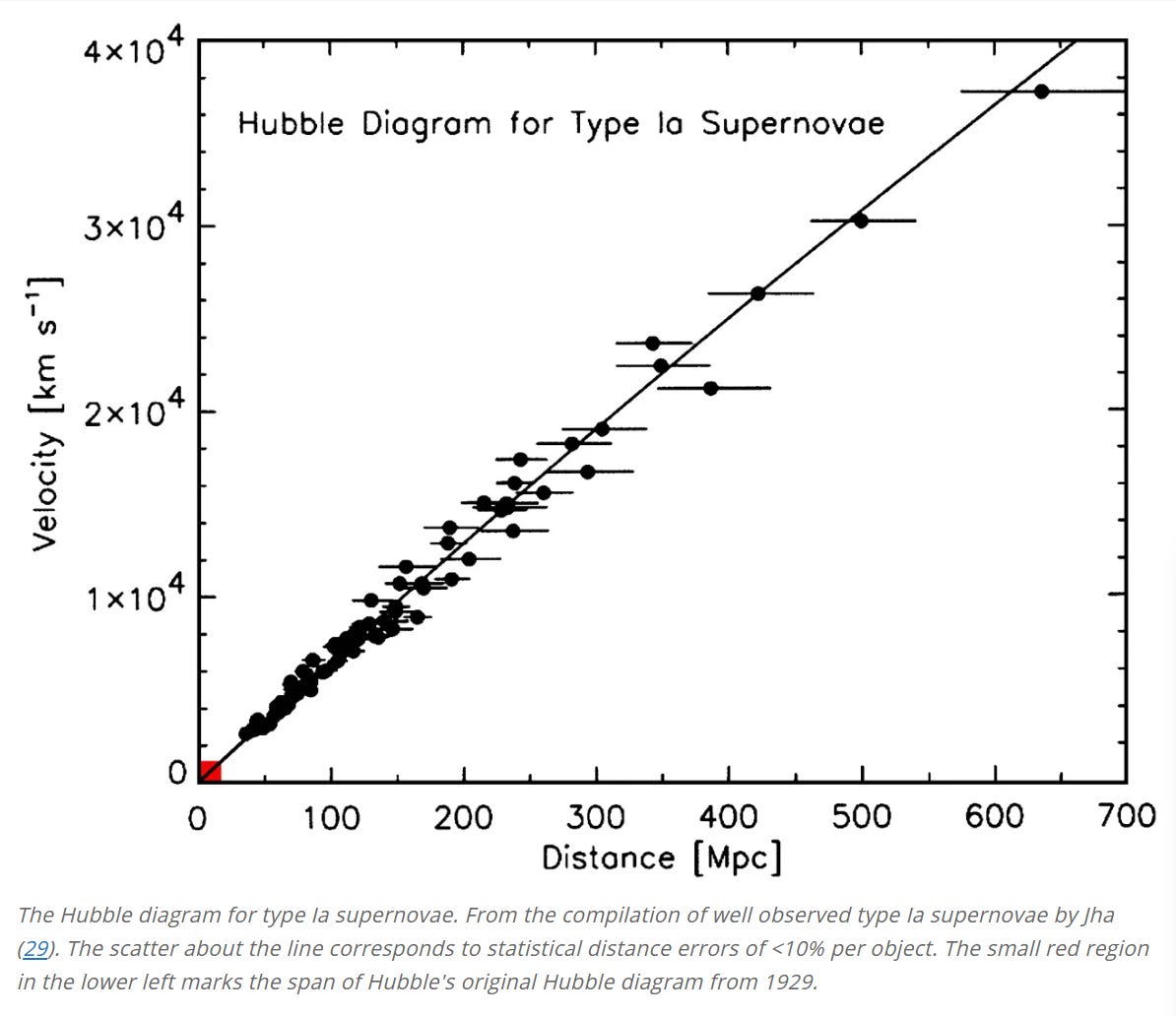
Hubble’s law says that the recessional velocity of an object is proportional to its distance away from us.
Accelerating expansion
Add to this picture the fact that galaxies have mass and they are pulling on each other, slightly slowing the expansion over time. The objects that are furthest away are seen as they were long, long ago, because it has taken their light so long to reach us. So they will now be going somewhat slower than we observe them. In comparison, light from objects that are close didn’t take so long to reach us, so we see them pretty much with the velocities they have at present.
So we expect that the galaxies that are furthest away will deviate from the straight line in Hubble’s Law. Their velocities will appear a little too large, because we see them as they were long ago (faster) not as they are now (slower). The straight line should bend slightly upward at the far end.
The graph above represents only 15% of the history of the universe. Suppose we were to extend it back to 50% of the universe. We might hope to see that bending upward. This was the project of astronomy in the last decade of the 20th century, when telescopes had advanced to the point where we could see far-away objects.
But surprise! What astronomers found instead was that the curve bends downward for supernovae that are very far away. It is as if gravity is working in reverse, pushing instead of pulling.
Physicists had no real explanation for the acceleration, or the “negative gravity”. They added the phenomenon to their Big Bang models and called the culprit “dark energy”, but they didn’t have any understanding of what dark energy is or why it should have this unique property of “negative gravity”.
What’s new from Subir Sarkar
Kurt Jaimungal is a geeky podcaster with a PhD in physics. This week, he interviewed Subir Sarkar, a particle physicist who has turned his attention to cosmology. Here’s the story that Sarkar tells:
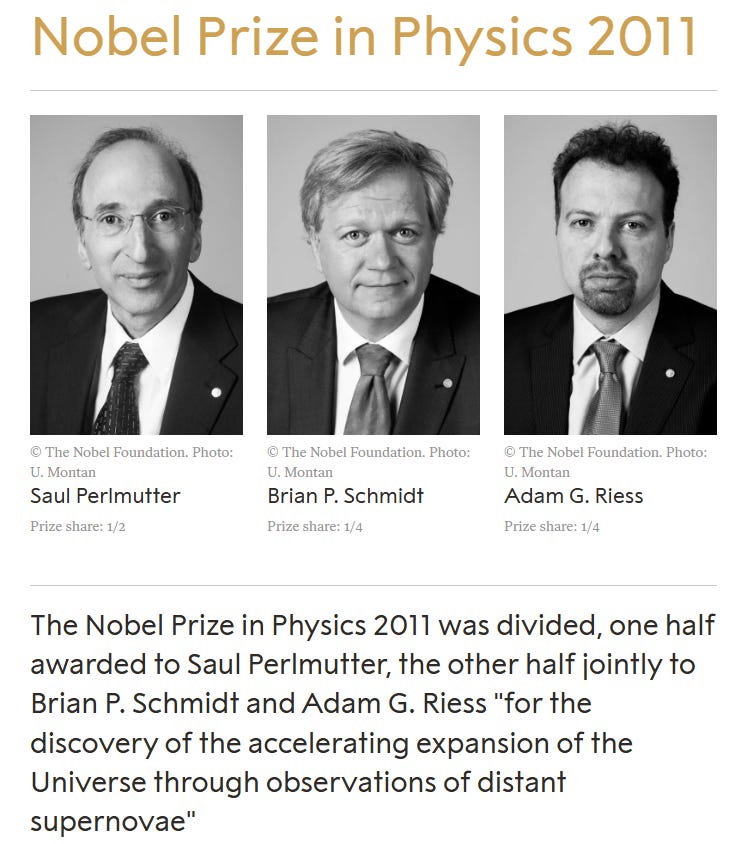
Our galaxy is close to Andromeda galaxy, and several other large objects in that direction. As a result, we’re being pulled in the Andromeda direction. It happens that this is the direction where most of the supernovae were found on which the calculations were based that led to the accelerating expansion and the 2011 Nobel prize. The Hubble curves that were calculated failed to take account of our own galaxy’s motion. When this is properly taken into account, the acceleration disappears.
Our own motion makes the nearby galaxies appear to be moving a little faster than they would be otherwise. The most distant galaxies appear, in comparison, to be moving a little slower than they should be, not because they’re really too slow but because we’re comparing to the anomalous velocity measurements of nearby galaxies. This accounts for the downward curve of the Hubble graph. The most distant galaxies, far back in time, are not really moving slower than we would expect; hence there is no evidence that they have been accelerating in the interim. Without evidence of acceleration, there is no need for dark energy.
Here’s what convinces me that Sarkar is right
The best method we have for judging distance of a supernova is to use the empirical relationship with waxing time to infer absolute brightness, then compare that to the apparent brightness to calculate its distance. According to Sarkar, the Joint Lightcurve Analysis team [Ruben & Hayden, 2016] didn’t do this. They included an extra fudge factor, by which the relationship between waxing time and brightness depends directly on distance! If this is what they did, it is truly a breach of experimental protocol. The supernova is no longer a “standard candle”, and the data can say anything you want them to say, depending on how you adjust the fudge factor.
Implications
Sarkar’s story, if correct, removes one big anomaly from the Big Bang theory, and makes for a better fit between theory and what we know. But there remain two other anomalies that haunt the Big Bang, and which could potentially bring the theory down. Briefly, these are
- We don’t understand what the gravitating mass in the universe comes from. We suspect it is not ordinary electrons, neutrons, and protons, because if it were, accounts of the First Three Minutes would result in a lot more helium and especially lithium and deuterium.
- Newest results from the Webb Space Telescope indicate that there were ordinary stars and galaxies almost immediately after the Big Bang. Our models can’t account for how they might have appeared so fast.
I wrote about both of these (together with dark energy) last year.
I don’t think the narrative of the Big Bang will survive even though it has dominated the field of astronomy all through my professional life. Time will tell.