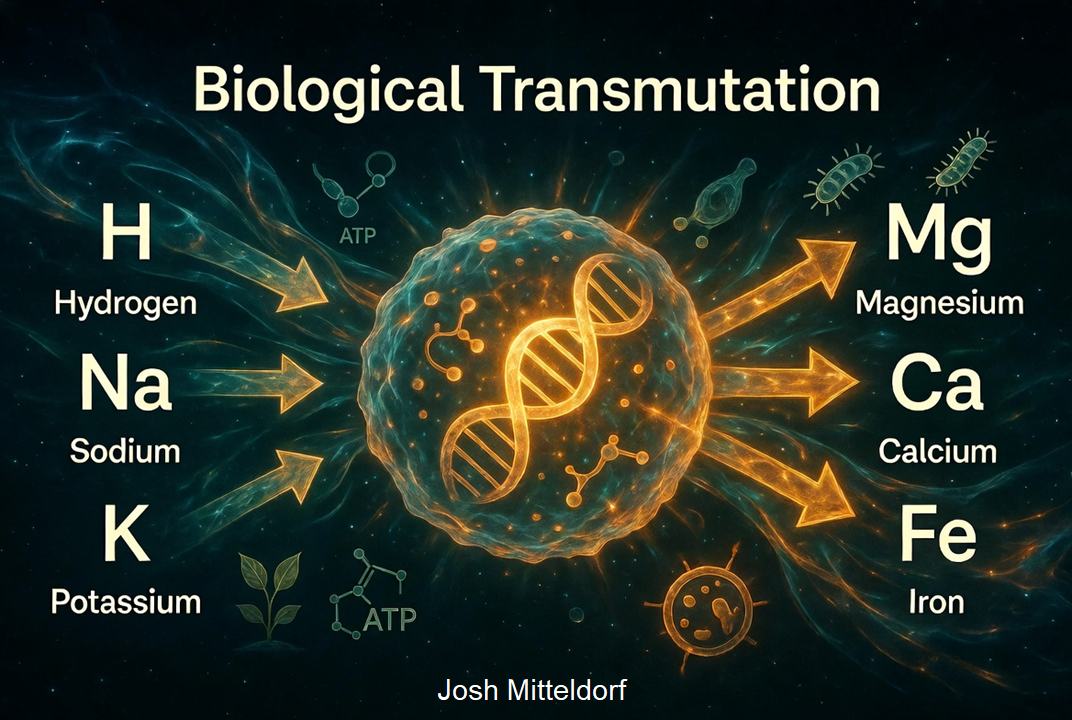
Transmutation is alchemy, the transformation of one chemical element into another. 18th century scientists first figured out that this is impossible; then in the 20th century, nuclear engineers amended this to say that it could be done inside a high energy nuclear reactor. But well before it was reported as impossible, there were already reports that living things can do this — biological transmutation. Not lead into gold, but potassium into calcium, phosphorus into sulfur, manganese into iron, The experiments continued through the 18th and 19th centuries, experiments with the elemental composition of egg shells and with the ash from burning plants. It was a backwater of science because it is so completely implausible, until 1989. That was the year Fleischmann and Pons reported cold fusion. If they could make hydrogen into helium with only available chemical and electrical energies, it gave new plausibility to the notion of biological transmutation. Today the subject is rarely acknowledged in the literature either of biology or physics. But there is one lab in Ukraine actively pursuing this research, using Mossbauer spectroscopy to detect the signatures of isotopes for which no environmental source can be found.