Skip to content
ScienceBlog.com
  • Featured Blogs
    • EU Horizon Blog
    • ESA Tracker
    • Experimental Frontiers
    • Josh Mitteldorf’s Aging Matters
    • Dr. Lu Zhang’s Gondwanaland
    • NeuroEdge
    • NIAAA
    • SciChi
    • The Poetry of Science
    • Wild Science
  • Topics
    • Brain & Behavior
    • Earth, Energy & Environment
    • Health
    • Life & Non-humans
    • Physics & Mathematics
    • Social Sciences
    • Space
    • Technology
  • Our Substack
  • Follow Us!
    • Bluesky
    • Threads
    • FaceBook
    • Google News
    • Twitter/X
  • Contribute/Contact

black holes

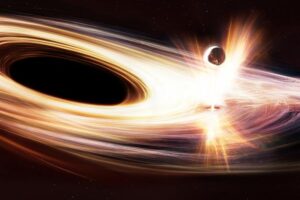
Artist’s impression of the accretion disc around the massive black hole Ansky and its interaction with a small celestial object

From boring to bursting: a giant black hole awakens

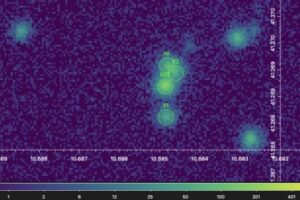
X-ray data gathered by the Chandra telescope from the center of M31, highlighting the four nuclear sources — S1, SSS, N1, and P2. P2 corresponds to the position of the supermassive black hole at the center of the Andromeda galaxy.

When a Black Hole Winks at You

Artist’s impression of supermassive black holes (Courtesy of NOIRLab/NSF/AURA/J. daSilva/M. Zamani)

Black Holes: Cosmic Gardeners That Might Actually Nurture Life

A star and a black hole orbit each other closely: mass from the star is captured by the black hole. As a consequence of this, a pair of jets launch away from the black hole.

Tiny Black Holes Pack a Cosmic Punch: Scientists Spot New Particle Accelerators in Space

Artist’s impression of the interacting galaxies observed in this research. The gravitational interactions during the merger trigger both starburst and quasar activity.

Galaxy Merger Reveals Birth of Cosmic ‘Monster’ 12.8 Billion Years Ago

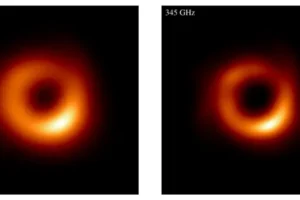
Side-by-side simulated images of M87* show the improvement in clarity and resolution from 230 GHz to 345 GHz. These improvements are allowing scientists to measure the size and shape of black holes more precisely.

Event horizon telescope makes highest-resolution black hole detections from Earth

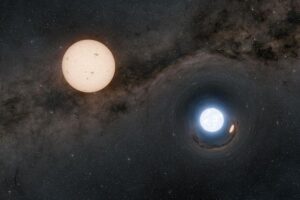
This illustration depicts a binary star system consisting of a dense neutron star and a normal Sun-like star (upper left). Using data from the European Space Agency's Gaia mission, astronomers found several systems like this one, in which the two bodies are widely separated. Because the bodies in these systems are far apart, with separations on average 300 times the size of a Sun-like star, the neutron star is dormant—it is not actively stealing mass from its companion and is thus very faint. To find these hidden neutron stars, the scientists used Gaia observations to look for a wobble in the Sun-like stars caused by a tugging action of the orbiting neutron stars. These are the first neutron stars discovered purely due to their gravitational effects.

Sun-like stars found orbiting hidden companions

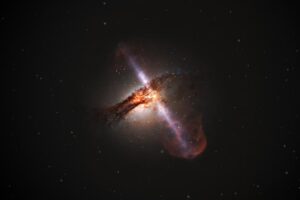
An artist’s impression showing bi-polar jets of gas originating from a supermassive black hole at the centre of a galaxy.

How the ‘heart and lungs’ of a galaxy extend its life

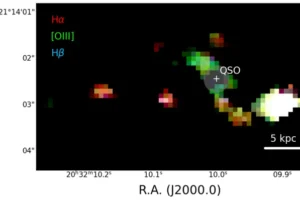
Here's a clearer version of the image caption: Colored map of the PJ308-21 system showing gas emissions: - Hydrogen: Red and blue - Oxygen: Green The central quasar's light has been masked out. Color variations in the quasar's host galaxy and its companions indicate different gas properties in each region.

Webb Space Telescope captures staggering quasar-galaxy merger in remote universe

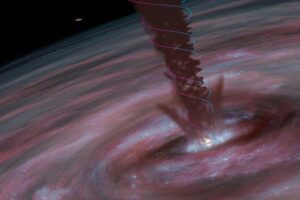
A black hole and spiral wind

Cosmic Growth Spurt: Supermassive Black Hole Mimics Star Formation

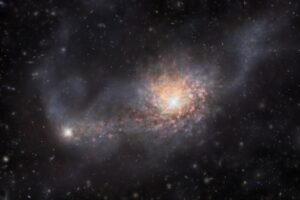
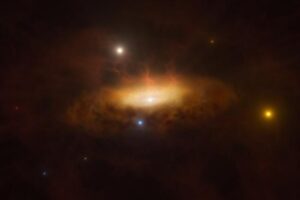
A galaxy suddenly became much brighter in late 2019. This reveals a giant black hole at its center that's woken up and started feeding on surrounding gas, making the whole galaxy light up. This is the first time scientists have observed this awakening happen.

Astronomers Witness a Massive Black Hole Awakening in Real-Time for the First Time

Illustration of pair plasma in a beaker

Pair plasmas found in deep space can now be generated in the lab

A 3D rendered image of the spiral galaxy NGC 4151, with a bright central region representing the active galactic nucleus. The image zooms in to show a glowing accretion disk surrounding a supermassive black hole, with twin jets of particles emanating from the disk's center. Colorful spectral lines are overlaid on the image, highlighting the iron fingerprints detected by XRISM's Resolve instrument.

XRISM Telescope Reveals Iron Fingerprints in Nearby Galaxy

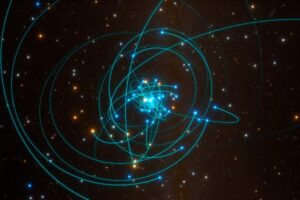
This illustration shows the orbits of stars very close to Sagittarius A*, a supermassive black hole at the heart of the Milky Way.

Zombie Stars in the Milky Way Eat Their Neighbors to Stay Young

Older posts
Page1 Page2 Page3 Next →
Substack subscription form sign up

Comments

  • Kidreadytobreed on Global warming reduces available wind energy
  • James on Global warming reduces available wind energy
  • James on Global warming reduces available wind energy
  • Booklet AI on Key to online education: Test early and often
  • Karoly Mirnics on Common Prescription Drugs May Disrupt Cholesterol Pathways in the Womb and Raise Autism Risk
© 2026 ScienceBlog.com | Follow our RSS / XML feed