Skip to content
ScienceBlog.com
  • Featured Blogs
    • EU Horizon Blog
    • ESA Tracker
    • Experimental Frontiers
    • Josh Mitteldorf’s Aging Matters
    • Dr. Lu Zhang’s Gondwanaland
    • NeuroEdge
    • NIAAA
    • SciChi
    • The Poetry of Science
    • Wild Science
  • Topics
    • Brain & Behavior
    • Earth, Energy & Environment
    • Health
    • Life & Non-humans
    • Physics & Mathematics
    • Social Sciences
    • Space
    • Technology
  • Our Substack
  • Follow Us!
    • Bluesky
    • Threads
    • FaceBook
    • Google News
    • Twitter/X
  • Contribute/Contact

Gravitational Waves

Artist’s impression of the accretion disc around the massive black hole Ansky and its interaction with a small celestial object

From boring to bursting: a giant black hole awakens

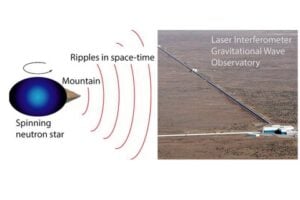
mountain on neutron star

Space Mountains on Dead Stars Could Send Ripples Through Space-Time

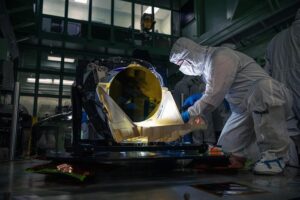
The prototype LISA telescope undergoes post-delivery inspection in a darkened NASA Goddard clean room on May 20. The entire telescope is made from an amber-colored glass-ceramic that resists changes in shape over a wide temperature range, and the mirror’s surface is coated in gold.

NASA reveals prototype telescope for gravitational wave observatory

A gravitational atom. Just as electrons can orbit around the nucleus of an atom, a cloud of previously undiscovered ultralight particles can orbit around pairs of black holes.

Black Hole Mergers Could Reveal Elusive Ultralight Particles

Artist’s impression of a warp bubble collapse (AI)

Gravitational Waves from Failed Warp Drives: A New Frontier in Space Exploration

Simulation of the light emitted by a supermassive black hole binary system where the surrounding gas is optically thin (transparent). Viewed from 0 degrees inclination, or directly above the plane of the disk. The emitted light represents all wavelengths.

Astrophysicists uncover supermassive black hole/dark matter connection in solving the ‘final parsec problem’

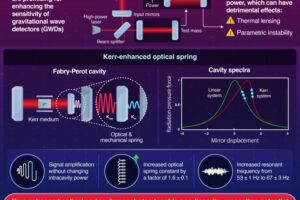
Kerr-enhanced optical spring demonstrates tunable non-linearity, presenting potential applications for enhancing GWD sensitivity and in various optomechanical systems.

Revolutionizing Gravitational Wave Detection: The Kerr-Enhanced Optical Spring

All together now…

Alessandra Corsi, via Texas Tech

In search of electromagnetic counterparts of gravitational waves

This artist’s concept shows stars, black holes, and nebula laid over a grid representing the fabric of space-time. Ripples in this fabric are called gravitational waves. The NANOGrav collaboration detected evidence of gravitational waves created by black holes billions of times the mass of the Sun. Credit: NANOGrav collaboration; Aurore Simonet

15 Years of Radio Data Reveals Evidence of Space-Time Murmur

A 31.5 solar-mass black hole with an 8.38 solar-mass black hole companion viewed in front of its (computer generated) stellar nursery prior to merging.

Unveiling the origins of merging black holes in galaxies like our own

Artist's concept of a collection of pulsars that detect gravitational waves from pairs of orbiting supermassive black holes.

Scientists find evidence for slow-rolling sea of gravitational waves

Schematic of the inflaton field fragmented into oscillons, with superimposed gravitational waves. (Credit: Kavli IPMU, Volodymyr Takhistov)

Scientists Uncover Universe’s Hidden Waves from Ancient Times

This artist’s conception shows a late-stage galaxy merger and its two newly-discovered central black holes. The binary black holes are the closest together ever observed in multiple wavelengths.

Doomed pair of supermassive black holes the closest to collision ever seen

Substack subscription form sign up

Comments

  • Not Buying Yer Bullshit on More Than a Third of Americans Have Lost Relationships Over Politics
  • Marco Messina on More Than a Third of Americans Have Lost Relationships Over Politics
  • Anon on Why Fructose Behaves Less Like a Calorie and More Like a Hormone
  • Mark Mellinger on Living Plastic Can Self-Destruct on Command
  • Marie Feret on The Silent Frequency That Makes Old Buildings Feel Haunted
© 2026 ScienceBlog.com | Follow our RSS / XML feed