
embryonic stem cell

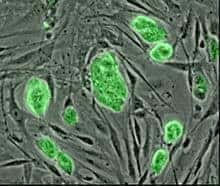

Human stem cells transformed into key neurons lost in Alzheimer’s
CHICAGO — Northwestern Medicine researchers for the first time have transformed a human embryonic stem cell into a critical type of neuron that dies early in Alzheimer’s disease and is a major cause of memory loss.
This new ability to reprogram …
New induced stem cells may unmask cancer at earliest stage
MADISON – By coaxing healthy and diseased human bone marrow to become embryonic-like stem cells, a team of Wisconsin scientists has laid the groundwork for observing the onset of the blood cancer leukemia in the laboratory dish.
“This is the first…
Embryonic stem cells help deliver ‘good genes’ in a model of inherited blood disorder
Researchers at Nationwide Children’s Hospital report a gene therapy strategy that improves the condition of a mouse model of an inherited blood disorder, Beta Thalassemia. The gene correction involves using unfertilized eggs from afflicted mice to …
Researchers generate iPSCs to further treatments for lung disease
(Boston) A team of researchers from Boston University’s Center for Regenerative Medicine and the Pulmonary Center have generated 100 new lines of human induced pluripotent stem cells (iPSC) from individuals with lung diseases, including cystic fib…
Stem cell research: What progress has been made, what is its potential?
New York, NY, September 9, 2010 — The use of stem cells for research and their possible application in the treatment of disease are hotly debated topics. In a special issue of Translational Research published this month an international group of m…
Research!America asks Congress to support embryonic stem cell research now
WASHINGTON — September 8, 2010 — Research!America today called on Congress to take legislative action that will allow federal funding for human embryonic stem cell research to proceed, in light of U.S. District Judge Royce Lamberth’s refusal yeste…
American Society for Biochemistry and Molecular Biology reacts to stem-cell ruling
BETHESDA, Md., Sept. 2, 2010 — The American Society for Biochemistry and Molecular Biology expressed its disapproval and disappointment this week in response to the Aug. 23 ruling in the U.S. District Court for the District of Columbia that grante…
Sight-saving research halted by stem cell ruling
The Association for Research in Vision and Ophthalmology (ARVO), a professional organization of member scientists, opposes the Federal District Court injunction that froze federal funding for human embryonic stem cell (hESC) research. ARVO is trou…