
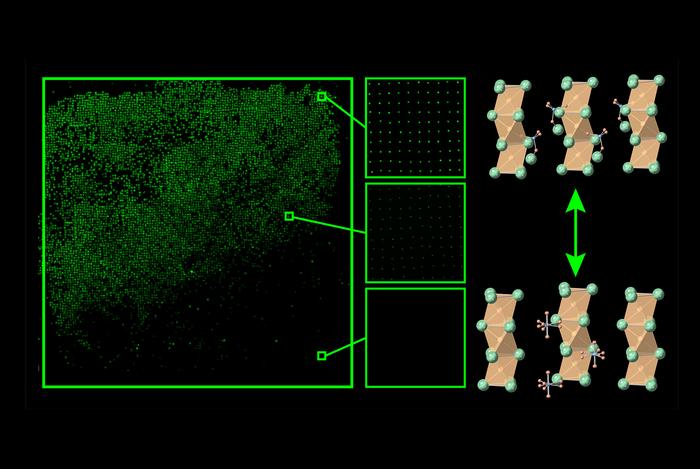
The chip is about the size of a thumbnail. Under a dark-field microscope it glows faintly, a grid of tiny crystalline specks arranged with the regularity of pixels on a screen. Each speck is a distinct material, a unique combination of atoms no chemist has ever made in bulk, and there are roughly 1.44 million of them. The whole thing fits in the palm of your hand. Within 30 minutes of being placed under a laser, the chip can tell you which of those million materials are piezoelectric and which are not. Chad Mirkin, the Northwestern University chemist who invented this platform, calls it a megalibrary. The name is, if anything, an understatement.
Mirkin’s team reported this week in Science Advances that megalibraries can now do something more consequential than merely sifting for promising materials. They can be used to design materials with specific, predetermined properties on demand, potentially collapsing years of trial-and-error materials discovery into a single afternoon.
The implications stretch quite a bit further than a clever laboratory technique. Materials science has a chronic discovery problem. Our civilisation runs on an extraordinarily narrow slice of what chemistry actually permits. Silicon, copper, lithium, barium titanate: the periodic table contains 118 elements, and their combinatorial possibilities are almost incomprehensibly vast, yet we tend to circle back to the same few workhorse materials generation after generation. The reason is mundane: traditional synthesis is serial. You make one compound, test it, discard it or refine it, then try the next. Generations of chemists have laboured over single substances for entire careers. Vast regions of chemical space remain, in Mirkin’s phrase, essentially unexplored.
A Million Experiments at Once
What megalibraries do is run those experiments in parallel, not one by one. The platform uses polymer pen lithography, arrays of roughly ten thousand tiny silicone tips per square centimetre, to deposit minuscule droplets of precursor solution onto a substrate. As the solvent evaporates, nanocrystals form. By spraying different chemical inks from opposing corners of the pen array, the team creates compositional gradients across the chip: one edge is rich in one ingredient, the opposite edge in another, and every point in between represents a different ratio. A single chip can encode more than a million distinct compositions simultaneously, each nanocrystal positionally encoded so researchers know exactly what chemistry they are looking at.
The bottleneck, until recently, was characterisation. Making a million materials is not enormously useful if reading them out takes years. That is where second harmonic generation microscopy comes in. SHG, as the technique is known, exploits a quirk of certain crystal structures: when a pulsed laser hits a material lacking a centre of symmetry, it converts two photons of the same frequency into a single photon at exactly double the frequency. Centrosymmetric materials, which cannot be piezoelectric, produce no signal. Noncentrosymmetric ones light up. The distinction matters enormously, because only about 22 percent of known organic crystals are noncentrosymmetric, a figure that drops to below eight percent when the crystals are grown from a mixture of molecular handedness. Finding the useful ones among the rest used to require painstaking structural analysis on each candidate individually.
With scanning SHG microscopy, Mirkin’s team can image the entire megalibrary, a centimetre-scale chip containing over a million individual nanocrystals, at single-particle resolution in under half an hour. Bright spots mark the piezoelectric candidates; dark areas can be set aside. “We have developed a screening capability based on a technique called second harmonic generation (SHG) microscopy that allows researchers to review more than a million different material samples in less than 30 minutes,” Mirkin said. “In this study, we show we can not only build a library of a million different materials, but we also can interrogate them at the individual particle level.”
Designing Backwards
Discovery alone is impressive enough. The genuinely novel step, though, was running the process in reverse. Once the team had mapped how Curie temperature, the point above which a piezoelectric material loses its polarisation and stops working, varied with chemical composition in one particular family of halide perovskites, they could use that relationship as a lookup table. They wanted a material that would retain its piezoelectric behaviour up to 80 degrees Celsius, a useful threshold for devices that operate in warm environments. The compositional map told them which chemistry to target. They made it; it worked at exactly the temperature they specified. “With the megalibrary format, we can synthesize materials faster than has ever been contemplated before,” Mirkin said. Jarod Beights, a graduate student in the group and one of the study’s lead authors, was rather less restrained about the competition: “Compared to the megalibrary, which moves at a sprint, self-driving labs are basically crawling. Those labs cannot compete with our speeds and cannot compete with the generation of data, which is absolutely essential for training AI algorithms.”
That last point is worth dwelling on. The great promise of AI in materials science is the same as its promise elsewhere: finding patterns humans miss, predicting which of an astronomical number of candidate compositions might have useful properties, shortcutting the experimental grind. But AI systems are only as good as the data used to train them, and high-quality, structured experimental data, real synthesis results linking exact chemistry to exact performance, have been painfully scarce. The megalibrary changes that arithmetic considerably. A single run generates a million data points with known compositions and known properties. Jun Li, a co-first author who is now at the University of Colorado Boulder, put it simply: “We’ve developed a screening capability that allows researchers to look at literally a million different materials, generating a million data points. We can use that data to train algorithms.”
Beyond the Lab Curiosity
The specific material the team discovered this time, a high-entropy halide perovskite combining four different atomic species at three different structural sites, had a piezoelectric coefficient sitting comfortably above that of commercial piezoelectric polymers. It doesn’t yet rival the best ceramics, which is perhaps not surprising for something found on a first pass through a previously unexplored compositional region. But the point isn’t this particular crystal; the point is that such crystals can now be found, and designed, at a speed that changes the practical economics of materials research.
Piezoelectric materials are already embedded throughout modern technology in ways most people barely register: the sensors in ultrasound imaging, the actuators in precision positioning systems, energy harvesters in wearable devices, the motion detectors in your phone. Most of them rely on a handful of well-characterised compounds that were discovered decades ago through methods essentially unchanged from the 1950s. The megalibrary approach offers something genuinely different, a systematic way to map unexplored territory rather than refining the same familiar ground.
Mirkin speaks with the confidence of someone who thinks the interesting part is only just beginning. “We’ve found materials for piezoelectrics, catalysis and photocatalysis, and we’re going to continue discovering materials across the board,” he said. “We’re going to repeat this process to find materials for batteries, for fusion, for optics. Our world depends on new materials, and we’ve only explored a tiny fraction of materials possibilities so far.” Somewhere in that vast unmapped territory, the materials for technologies we haven’t yet imagined are presumably waiting. The question now is how quickly a thumbnail-sized chip and a fast laser can find them.
https://doi.org/10.1126/sciadv.aee1359
Frequently Asked Questions
What is a piezoelectric material and why does it matter?
Piezoelectric materials generate an electric charge when squeezed or bent, and conversely deform slightly when a voltage is applied. This makes them essential in a surprisingly wide range of technology: ultrasound imaging, the pressure sensors in smartphones, precision actuators in scientific instruments, and small-scale energy harvesters in wearable devices. Most of the piezoelectrics currently in commercial use were discovered decades ago, and the megalibrary approach could substantially expand the palette available to engineers.
Why is finding new materials so difficult normally?
Traditional materials synthesis is a serial process: chemists make one compound, characterise it, assess it, and then try another. Even with modern automation, working through the near-infinite combinations of elements and structures is effectively impossible at that pace. Only a small fraction of organic crystals have the asymmetric structure required for piezoelectricity, so most candidates fail before they get interesting, and locating the exceptions by hand is laborious beyond most research budgets.
How is the megalibrary approach different from self-driving labs?
Self-driving labs are automated systems that propose and test experiments iteratively, refining one result before selecting the next. They are considerably faster than human researchers working manually, but they still operate sequentially, one experiment at a time. Megalibraries run more than a million distinct experiments simultaneously on a single centimetre-scale chip, then screen all of them in under half an hour, producing a dataset that would take a self-driving lab an extraordinarily long time to replicate.
Could this technology speed up the search for better battery materials?
That appears to be the explicit intention. Mirkin’s group has already used megalibraries to find materials in catalysis and photocatalysis, and the team has identified batteries and fusion energy materials as near-term targets for the same approach. The platform is, in principle, chemistry-agnostic: any property that can be read out rapidly from a large array of nanocrystals is a candidate for this kind of massively parallel screening.
What does “high-entropy” mean for a material?
High-entropy materials contain multiple principal elements or molecular components mixed together at roughly equal proportions, rather than one dominant component with minor additions. The configurational disorder this creates can produce unexpected properties that none of the individual components would have alone. The piezoelectric crystal discovered in this study mixes two different organic cations, two different metal ions, and two different halide anions simultaneously, a combination so chemically complex it would be unlikely to emerge from conventional trial-and-error synthesis.
Discover more from NeuroEdge
Subscribe to get the latest posts sent to your email.