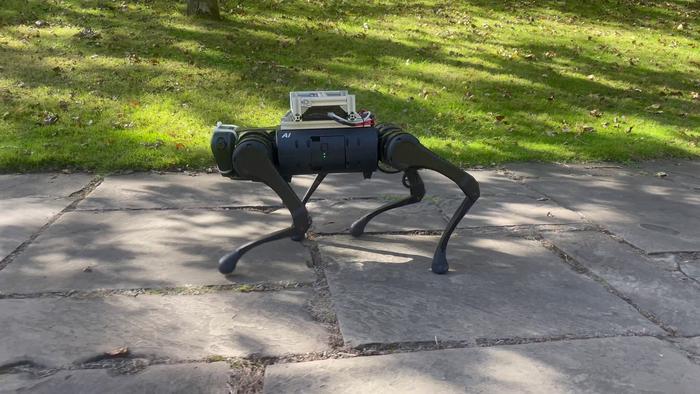
Watch a dog navigate from sidewalk to forest floor—notice how seamlessly it shifts from trotting to bounding, adjusting its gait without conscious thought. Now scientists at the University of Leeds have taught a four-legged robot named “Clarence” to do the same thing, learning in just nine hours what takes young animals days or weeks to master.
The robot achieved something no machine has done before: autonomously switching between eight different gaits—trotting, running, bounding, hopping, and more—based purely on terrain conditions it encounters. Unlike current robots that must be programmed for specific movements, Clarence adapts its stride in real-time, even on surfaces it has never experienced.
The Animal Blueprint
Animals switch gaits for survival—to save energy, maintain balance, or escape predators. A horse shifts from walk to trot to gallop not by following a rulebook, but through strategies embedded in its nervous system. The Leeds research team reverse-engineered these biological principles into artificial intelligence.
“Our findings could have a significant impact on the future of legged robot motion control by reducing many of the previous limitations around adaptability,” notes first author Joseph Humphreys, a postgraduate researcher. His framework embeds three core animal abilities: gait transition strategies, procedural memory for different movements, and real-time motion adjustments.
The breakthrough lies in teaching robots not just how to move, but how to decide which movement to use. Traditional robots follow pre-programmed patterns—imagine trying to navigate varied terrain while locked into a single walking style. Clarence learns to evaluate conditions and choose optimal gaits on the fly.
Beyond Programming: Learning to Choose
The research team developed what they call bio-inspired metrics—mathematical representations of principles animals use for gait selection:
- Energy efficiency: Minimizing power consumption like animals conserving energy
- Stability: Maintaining balance across unpredictable surfaces
- Force management: Protecting joints and actuators from excessive strain
- Work optimization: Reducing mechanical effort required for movement
These metrics work together—no single factor drives gait choice, just as in nature. When Clarence encounters loose timber, sensors detect instability and the AI rapidly shifts from trotting to bounding, recovering balance before catastrophic failure.
Real-World Validation
The true test came outside the laboratory. Researchers unleashed Clarence on terrain it had never seen: muddy grass, rock piles, overgrown roots, even loose timber that shifted underfoot. The robot navigated them all, switching gaits autonomously as conditions demanded.
One striking parallel emerged with wild animal behavior. When Clarence encountered particularly challenging terrain, it deployed auxiliary gaits—specialized movements like pronking and limping that animals use for stability recovery. The researchers hadn’t programmed this strategy; it emerged naturally from the AI’s decision-making process.
Professor Zhou from UCL Computer Science explains the significance: “Instead of training robots for specific tasks, we wanted to give them the strategic intelligence animals use to adapt their gaits—using principles like balance, coordination, and energy efficiency.”
From Simulation to Reality
The training occurred entirely in virtual environments using deep reinforcement learning—essentially high-powered trial and error across hundreds of simulated terrains simultaneously. This approach mirrors how Neo learns martial arts in The Matrix, as Humphreys notes: “All of the training happens in simulation. You train the policy on a computer, then take it and put it on the robot and it is just as proficient as in the training.”
What makes this remarkable is the seamless transfer from simulation to reality. Despite never experiencing rough terrain during training, Clarence successfully navigated complex real-world surfaces on its first attempt—a notorious challenge in robotics known as the “sim-to-real gap.”
The robot achieved 90.6% accuracy in gait selection while consuming minimal energy—just 4 joules to complete tasks that would typically require significantly more power. This efficiency becomes crucial for applications where battery life determines mission success.
Implications Beyond Robotics
The framework opens pathways for robots in hazardous environments where human presence risks lives: nuclear decommissioning, disaster response, planetary exploration. Current robots often fail when encountering unexpected conditions—a limitation that could prove fatal in rescue scenarios.
Perhaps more intriguingly, this research offers a new tool for studying animal biomechanics itself. Rather than burdening living animals with invasive sensors or dangerous experiments, researchers can test hypotheses using robotic surrogates that replicate natural movement patterns.
The work represents a fundamental shift from programming specific behaviors to instilling adaptive intelligence. As artificial systems become more autonomous, the biological principles that enabled millions of years of successful navigation may prove invaluable guides for the next generation of adaptive machines.
Discover more from NeuroEdge
Subscribe to get the latest posts sent to your email.
