
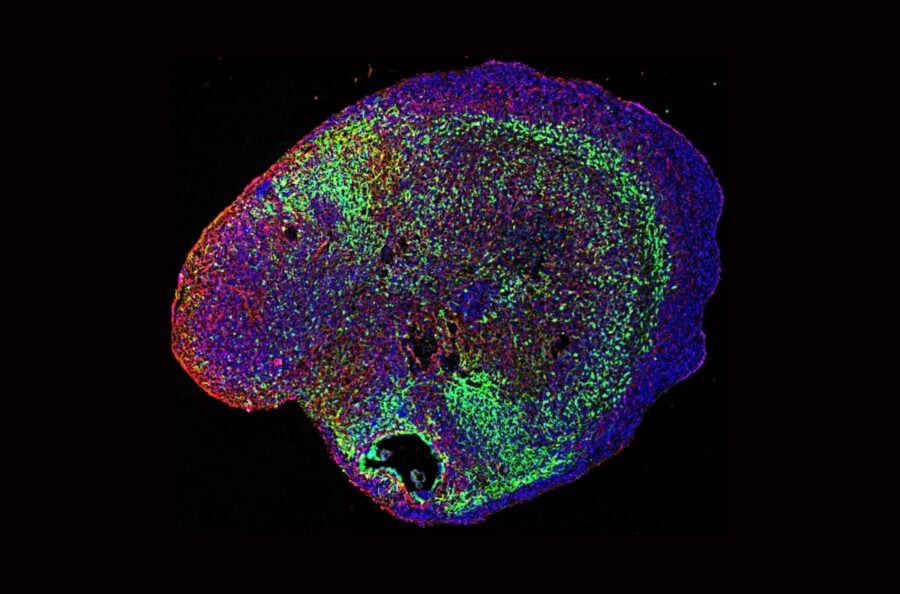
Start with a skin cell. Bathe it in the right cocktail of chemical signals and it forgets what it is, regressing to a state of biological openness, capable of becoming almost anything. Over the next several months, coax it toward a neural fate. What you end up with, roughly a year after you started, is a small sphere of living brain tissue sitting in a laboratory dish, about the size of a sesame seed. Fire electrodes through it and it responds. Change the signals and it adapts. Somehow, in ways that remain genuinely mysterious, it learns.
This is where computing goes next. Or, at least, that is what a growing number of researchers reckon.
Two companies are leading the charge: Cortical Labs, based in Australia, and FinalSpark, out of Switzerland. Both grow these organoids on top of dense arrays of electrodes embedded in hardware shells, creating what they call biocomputers. The system can receive electrical and chemical stimuli and record how the organoid responds. Crucially, those responses change over time. The organoid, in some meaningful sense, updates itself. Cortical Labs made headlines in 2022 when its scientists trained one of these 2D brain organoids to play Pong, encoding the game’s variables, like ball and paddle positions, as patterns of electrical signals. Earlier this year, a graduate student took the company’s CL1 hardware platform and, within roughly a week, got it running DOOM. The 1993 first-person shooter is not exactly a benchmark of modern computation. But what it demonstrates is something harder to measure: that people with no specialist background can now sit down and build experiments on living neural tissue.
Why Biology, Not Silicon
The origin story of FinalSpark is instructive. When Fred Jordan, PhD, and his co-founder Martin Kutter, PhD, set out to build a thinking machine, they turned first to artificial neural networks, the mathematical approximations of neurons that now underpin large language models. The results weren’t compelling. Neither, it turned out, was the energy bill. Jordan’s pivot was characteristically blunt. “Maybe it’s a better idea to use real neurons,” he said.
The efficiency argument is striking, if hard to pin down precisely. Exact comparisons are scarce, but analyses of rat brain tissue suggest the biological brain runs on roughly 30 watts, which is less than some lightbulbs. Training a frontier AI model costs orders of magnitude more. Brett Kagan, PhD, chief scientific officer at Cortical Labs, puts it in terms that go beyond energy: biological networks are better at handling chaotic, noisy data, he argues, and they can learn from substantially less input than conventional AI systems require. “The complexity of how biological neural systems compute and process information is a huge question,” Kagan said. “But what we’re doing is we’re able to break it down now to the level of information physics.”
That framing, somewhat grandiosely, gestures at something real. Biological neurons do not simply fire or not fire; they modulate, rewire, strengthen and weaken connections dynamically in ways that ANN weights, frozen between updates, cannot replicate. The organoids, critically, are never truly quiet. Even without stimulation they keep firing. This is part of what makes them useful, and part of what makes them difficult.
A Cloud of Brain Cells You Can Rent
FinalSpark became, in 2023, the first biocomputing lab to offer remote access to its hardware. Nine universities got free accounts. Their interface, called Neuroplatform, works roughly like this, per Jordan: “I give you access to my brain organoids. Then you can write Python code, and I will give you an API to stimulate the neurons and to listen to them.” The company has since connected Neuroplatform to a large language model that can autonomously design and run experiments. Jordan reported the results were comparable to what trained researchers achieved using conventional tools.
Cortical Labs offers three routes in. Scientists can buy the CL1 hardware and do everything themselves. They can access it via the cloud and interact with the cells remotely. Or Cortical Labs will run the whole experiment for them. Kagan is blunt about what this means for who gets to do cutting-edge neuroscience. “You can actually allow anyone to build amazing things with this technology,” he said. “Not just the scientists in the lab who have spent their life doing it.”
Current applications include drug discovery, where researchers test how experimental compounds affect the way organoids learn, and connectome mapping, exploring how the network of neural connections shifts in response to stimulation. Thomas Hartung, MD, PhD, a professor at Johns Hopkins who works in the field, thinks the longer-term prize is neuromorphic engineering: building artificial hardware that actually mimics how biological neurons process information, rather than approximating it with maths. The organoids, in this view, are not the destination but a teaching tool, something to study and learn from before the real hardware gets built.
Consciousness in a Dish
Bioethicists have been circling this field with some urgency, though Hartung is sanguine about the near-term risks. “We are so far away from the experimental side to something which is a relevant material for ethicists,” he said. His own lab embeds an ethicist directly in laboratory meetings, a proactive approach rather than a reactive one. The questions on the table are familiar from stem cell research: the moral status of organoids, the possibility of something like consciousness in sufficiently complex systems, informed consent from the donors whose cells were reprogrammed, and thorny questions about commercialisation and intellectual property. Cortical Labs and FinalSpark are both working with bioethicists. But the field is moving fast enough that the ethical frameworks are somewhat playing catch-up.
The deeper technical problem, for now, is training. In the 1990s, researchers cracked how to train artificial neural networks by adjusting the weights of connections to improve output accuracy. With organoids, no one has done the equivalent. The network is always active; there is no stable baseline to tune against. Jordan sees mastering this as the central challenge for the next phase of the field, the problem whose solution would unlock everything else. Hartung is more cautious, noting that a biocomputer that truly learns might require years of training, not unlike, he points out, a human child.
Jordan is less impressed by that comparison than Hartung perhaps intended. “I think in 10 years,” he said, “biocomputers will be way more useful than quantum computers today.” Quantum computing, despite decades of headlines, remains largely pre-commercial. Biocomputing has already played Doom.
https://doi.org/10.2196/100949
Frequently Asked Questions
Could brain organoids in a computer actually become conscious?
No one can rule it out, which is precisely why bioethicists are already involved. Current organoids are tiny, around the size of a sesame seed, and lack the structural complexity associated with consciousness in mature brains. Researchers like Thomas Hartung at Johns Hopkins take a proactive approach, embedding ethicists in lab meetings, because the question is serious enough to warrant monitoring even if the risk is distant.
Why use biological neurons instead of just making better AI chips?
Partly efficiency: biological brains run on roughly 30 watts, orders of magnitude less than training a large AI model. But the more interesting argument is qualitative. Biological networks can learn from far less data and handle noisy, chaotic input better than current artificial systems. The goal isn’t to replace silicon entirely, but to understand what biological computation does differently and potentially to build hardware that mimics it.
What is actually stopping biocomputers from being widely used right now?
The main bottleneck is training. Researchers know how to stimulate organoids and measure responses, but they haven’t yet cracked how to systematically improve performance the way gradient descent does for neural networks. Organoids are also always active, which makes it hard to establish a clean baseline. Solving the training problem is widely seen as the unlock for the field’s broader applications.
Can researchers actually access these brain organoids remotely?
Yes, right now. FinalSpark’s Neuroplatform has offered cloud access since 2023, and Cortical Labs provides remote access to its CL1 hardware. Researchers can write code to stimulate the neurons and record their responses without being in the same building, or the same country. Nine universities were given free access during FinalSpark’s initial rollout.
Discover more from NeuroEdge
Subscribe to get the latest posts sent to your email.