Skip to content
ScienceBlog.com
  • Featured Blogs
    • EU Horizon Blog
    • ESA Tracker
    • Experimental Frontiers
    • Josh Mitteldorf’s Aging Matters
    • Dr. Lu Zhang’s Gondwanaland
    • NeuroEdge
    • NIAAA
    • SciChi
    • The Poetry of Science
    • Wild Science
  • Topics
    • Brain & Behavior
    • Earth, Energy & Environment
    • Health
    • Life & Non-humans
    • Physics & Mathematics
    • Social Sciences
    • Space
    • Technology
  • Our Substack
  • Follow Us!
    • Bluesky
    • Threads
    • FaceBook
    • Google News
    • Twitter/X
  • Contribute/Contact

Renewable energy

Solar panels on an industrial rooftop

Ultra-Light Solar Cells Bend Rules While Breaking Efficiency Records

ocean waves

Florida, S. Africa Emerge as Ocean Energy Hotspots in Global Hunt for Renewable Power

Integrating GGO-based Optimization for Solar PV System Performance.

How Greylag Geese Could Help Farmers Harness Solar Power More Efficiently

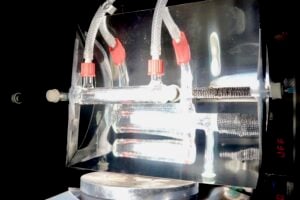
Researchers have developed a reactor that pulls carbon dioxide directly from the air and converts it into sustainable fuel, using sunlight as the power source.

Sun-Powered Device Turns Air into Fuel, No Fossil Fuels Required

Concrete could store considerable amounts of CO2 if conventional aggregates were replaced by pellets made from, say, biochar.

Could Concrete Be the Key to Removing Excess Carbon from Our Atmosphere?

For the first time, researchers have utilized detailed factors such as water depth and temperature to better estimate the capacity for floating solar panels on U.S. reservoirs. Even under conservative projections, these reservoirs present enormous potential, with the ability to support projects generating up to 77,000 megawatts. (Photo: Getty Images)

US Federal Reservoirs Could Host Enough Floating Solar to Power Half the Nation’s Clean Energy Needs

Solar farm in desert

New Research Field Studies How Solar Farms Affect Desert Life

Ohio State logo

Turning carbon emissions into methane fuel

Pollution seen via a hazy sky showing a golden sun

Global Carbon Emissions Hit New Record in 2024, Still No Peak in Sight

windmills

Power grids supplied largely by renewable sources experience lower intensity blackouts

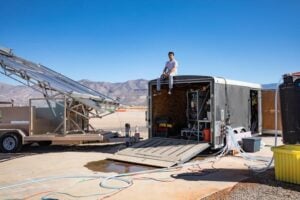
Jon Bessette sits atop a trailer housing the electrodialysis desalination system at the Brackish Groundwater National Research Facility (BGNDRF) in Alamogordo, New Mexico. The system is connected to real groundwater, water tanks, and solar panels.

Solar-powered desalination system requires no extra batteries

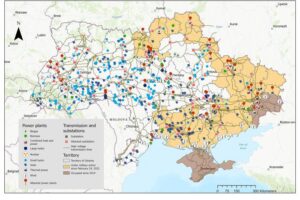
The map displays all electricity generation and transmission assets in Ukraine as of February 2022, along with military attacks through 6 June 2023. In February 2022, Ukraine's mainland power system included over 1,500 generation plants across seven regional power systems, with a total capacity of 59 GW. Of this capacity, 49% came from fossil fuels (coal and/or gas), 23% from nuclear power, and the rest from solar (13%), hydropower (11%), wind (3%), and biomass/biogas (

Ukraine’s Energy Rebirth: Renewables Key to Post-War Recovery

co2 to food set up

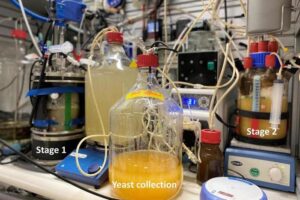
Eating Air: Microbial Protein as a Sustainable Food Source

Illinois researchers have opened up the AI "black box" to gain valuable new insight about chemistry for solar energy applications. Pictured, from left: Professor Charles Schroeder, graduate students Changhyun Hwang and Seungjoo Yi, professor Ying Diao, professor Nick Jackson and graduate student Tiara Torres Flores. Photo by Michelle Hassel

AI Unveils Chemical Secrets for Solar Energy: Turning the Black Box Transparent

Older posts
Page1 Page2 … Page5 Next →
Substack subscription form sign up

Comments

  • Karoly Mirnics on Common Prescription Drugs May Disrupt Cholesterol Pathways in the Womb and Raise Autism Risk
  • Aizen on Laziness helped lead to extinction of Homo erectus
  • Norwood johnson on Electrons in New Crystals Behave as If They Live in Four Dimensions
  • ScienceBlog.com on Hidden Geometry Could Finally Fix Quantum Computers
  • Theo Prinse on America Is Going Back to the Moon. This Time, It Plans to Stay
© 2026 ScienceBlog.com | Follow our RSS / XML feed