We’ve been pretty serious for a while, which always makes me a little edgy. And “tattoos” or some version thereof continues to be one of the biggest search terms for this blog. So, to raise the font size of “tattoos” in the tag cloud, I’ve put together a gallery of eye candy.

In their 1994 book, The DNA Mystique, Susan Lindee and Dorothy Nelkin write that “habitual images and familiar metaphors…provide the cultural forms that make ideas communicable.” The double helix is the scientific icon of our age—much like the Bohr atom was during the Cold War. Putting it on your body identifies you with science, with biotechnology, with life. It is also just a stone beautiful image, which works in a line, say down your spine, wrapped around a biceps or ankle, or curving sinuously just about anywhere. The best collection of science-themed tattoos of course is Carl Zimmer’s “Science Tattoo Emporium.” Many of these were borrowed from his archive, so a big hat-tip (tat-hip?) to him. I have the hardcover version Science Ink prominently displayed on my coffee table. Others drawn from elsewhere around the web. Click the picture to open the original url.

tree-dna
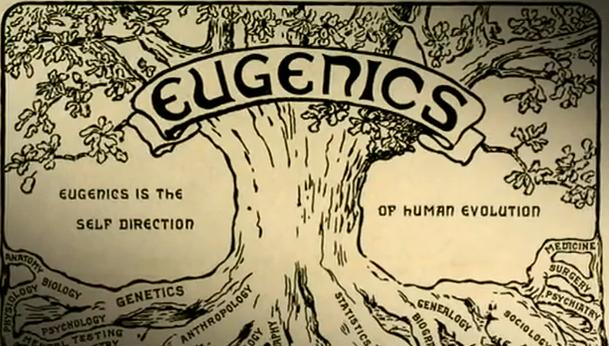
A DNA riff on the Darwinian image of the “tree of life.” But it of course also reminds me of the eugenics tree…

eugenics-tree

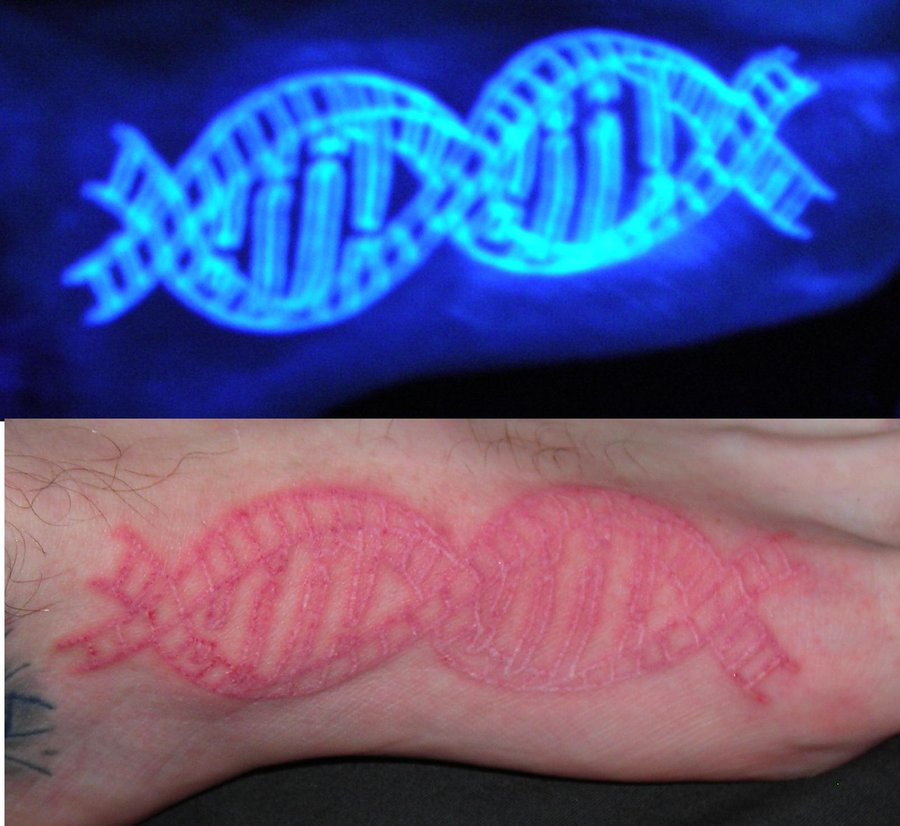
Foot tattoos are hard. Here's a cute rendition of unwinding DNA that flows nicely with the anatomy.
Foot tattoos are hard. Here’s a cute rendition of unwinding DNA that flows nicely with the anatomy.
Not the best execution of the image (no major and minor grooves), but a neat black-light effect that reminds me of fluorescent labeling.
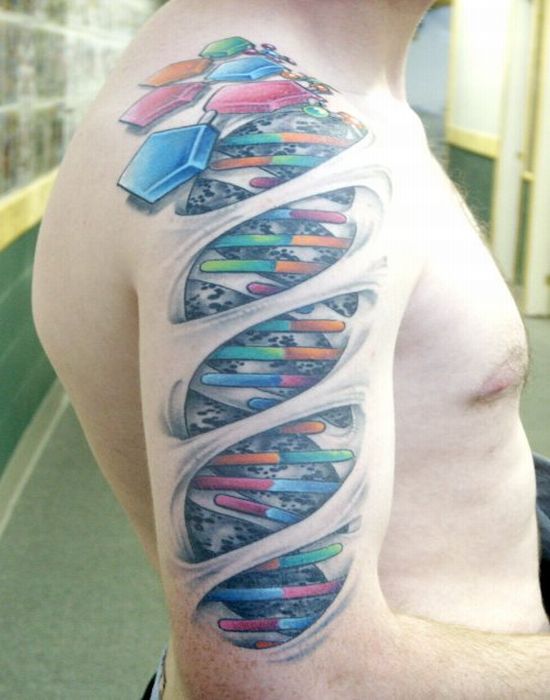
Just. Wow.
Just. Wow.
All right, I admit I'm wondering whether this represents bacterial DNA (and is therefore circular).
All right, I admit I’m wondering whether this represents bacterial DNA (and is therefore circular).
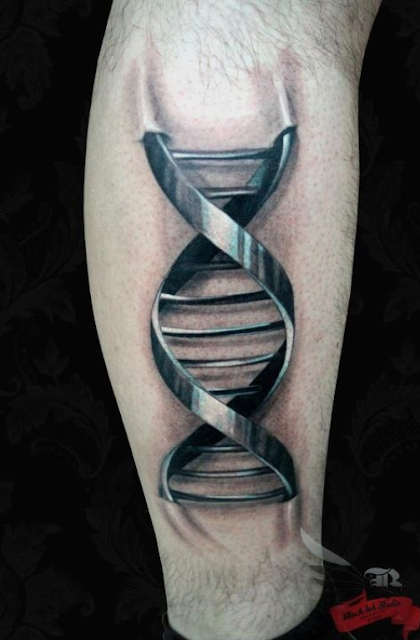
An interesting “biomechanical” visual effect.
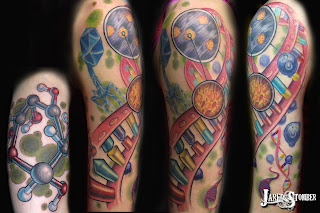
Here artist Jason Stomber has woven the double helix into a full sleeve.
Clever use of the DNA icon by a pair of twin sisters. Of course, when they line them up, they become prokaryotes.