


Part I : The Business Culture of Science
Since 2000, there has been a 20-fold increase* in research funding for anti-aging medicine. Wow! That’s a good thing. But let’s keep our eyes on the ball. There is danger that this welcome infusion of capital may be biasing research priorities toward those that are most likely to be profitable, and maybe even diverting the best researchers from the radical thinking that will change our understanding of biology.
Whoever discovers an effective age-reversal treatment is destined to become a multi-billionaire!
At first blush, this statement seems obvious, but that doesn’t mean it’s true. There are many historical examples of people who gave enormous gifts to the world, but struggled in their lifetimes for recognition and even for a livelihood. Schubert, Poe, and van Gogh are artists who died poor, while people after them reaped billions from their work. Inventors who never profited from their inventions include Johannes Gutenberg and Nikola Tesla, Jagadish Chandra Bose, and Antonio Meucci (who?). Reginald Fessenden invented radio a generation before Marconi. Rosalind Franklin got no credit for being the person whose diffraction data and analysis was stolen by Watson and Crick for their Nobel research on the double helix.
More to the point, there have been great discoveries that had no commercial value, or even negative commercial value. Linus Pauling spent the last years of his life documenting the anti-cancer action of intravenous vitamin C. To this day, vitamin C is under-utilized and under-studied precisely because it is so cheap that no one can get rich from it. I believe that aspirin and metformin may be two of the most potent life extention drugs that we currently know about, but we can’t be sure, because they are both long out of patent, and no private company can justify the investment to study them.
Rumors abound about cancer cures and energy technologies that are being suppressed because they would derail two of the most profitable businesses in the history of capitalism. I don’t dismiss such claims out of hand.
If there were a drug that could increase average human lifespan by 15 years (with side-effects that were wholly salutary), there would be a dozen companies tinkering with it, adding a methyl group here or a double bond there, looking for a variant that might boost lifespan by 18 or 23 years. In fact, there is about a 15-year advantage for people who are in a loving relationship, have deep community ties, assume responsibility for leadership, make lots of money, enjoy frequent sex, and remain close to young family members; in comparison, the typical middle-aged American is lonely, alienated, struggling financially, and sub-clinically depressed, with a life expectancy 15 years shorter than it could be. The most effective things you can do to increase your statistical life expectancy are psycho-social, but who is conducting research into optimizing the life-extending benefits of community and relationship?
Diet, exercise, saunas, and fasting are life extension strategies that are promising and under-researched because there is no clear path to mega-profits.
What I believe
I am convinced that the primary basis of aging is an epigenetic program. Systems that repair and protect our cells and tissues are gradually shut down, and destructive systems including inflammation and apoptosis are ramped up at late ages. Gene expression changes, modified systemically by transcription factors that circulate in the blood. I believe that these blood factors are the holy grail of aging research. Control over aging will come when we learn enough about the basic language of epigenetics to reprogram gene expression with our interventions.
The difficulty is that there are dozens of known epigenetic mechanisms, of which only a few have been studied in detail. A few years ago, it was understood that modifying non-coding regions of DNA could affect the transcription of nearby genes (cis epigenetic signals), but now we know that transcription of genes far away from the modification can also be affected (trans signals).
There is yet more complexity: most hormones and regulatory molecules have secondary roles that affect transcription. Imagine an ecosystem of signal molecules that maintains itself homeostatically, but also changes with age. Sixty years ago, we learned that the genetic code is as simple as it can logically be; every codon three base pairs on a DNA strand is uniquely transcribed to one amino acid, and a protein is built by chaining these together in order. Today we are learning that epigenetics is about as complex as it can be. So in my paradigm, basic research in epigenetics is an essential foundation for anti-aging medicine. If we are lucky, a dozen synergizing interventions will do enough reprogramming to re-set the aging clock. Perhaps there is even a region of the brain that is a common source for the molecules that induce age-related change. If we are unlucky, it may require re-balancing blood levels of hundreds of different substances.
I am optimistic that this can be done, but it will require collaboration on a broad scale. The process is unlikely to end with a single patent-holder who can rake in $ billions. The secrecy and the balkanization of corporate research is slowing progress.
Biases in Corporate Aging Research
For the last five years, Google CALICO has been the 800-pound gorilla in the room. Of course, we welcome their funding, the legitimacy they lend, and their collective brainpower to our field. But they don’t play by academic rules. They are not following the open-source / free-to-the-public model that has been so successful for Google in software. They trend secretive and are not collaborating with university experts outside their walls.
CALICO isn’t announcing its philosophy or paradigm, but we might guess from its lineage that their methodology is rooted in data mining and artificial intelligence. Other companies that have announced publicly that they are taking this approach include Unity Biotech, InSilico Medicine and Spring Discovery. They have in common a data-intensive approach founded in theoretical agnosticism.
Machine learning has been used successfully to create algorithms that translate languages, that drive cars, and that recognize faces. The best thing you can say about this approach to anti-aging medicine is that it is free of the theoretical biases that have plagued aging research through the decades. The worst thing you can say about it is that it misses a fundamental difference between organisms and machines.
Machines are designed by human logical minds, and each part is engineered to perform a single function and do it optimally. Organisms are evolved by a process that depends on results only and involves no logical thought. We have found empirically that in biology, parts tend to serve multiple purposes. Causes and effects are entwined in tangled feedback loops. Hormones and other proteins are likely to serve multiple, overlapping functions, some of which are metabolic and some of which are regulatory.
With a homeostatic physical system, you can tweak it to the right and it will bounce back to the left some fraction of the distance, so that the net effect is to move to the right but with less than your original amplitude. With a homeostatic biological system, you can tweak it to the right and it may bounce back and end up further to the left. The canonical example of this is hormesis, which is so counter-intuitive that it took experimental scientists two decades to establish its legitimacy among biological theorists.
The Challenge of Using AI to Modify Aging
Machine learning algorithms work by finding optimal paths toward a well-defined goal. The machine learning paradigm needs a clearly-defined goal as a prerequisite. In the previous triumphs of machine learning listed above, the goal was well-defined before the process was begun.
Application of machine learning to anti-aging will require a quantified measure of biological age. This is what has held up the field in the past. We can measure lifespans in worms in a few weeks, but to measure lifespans in humans takes decades. Aging research needs feedback that is faster than this.
Just in the last year, there are epigenetic clocks based on methylation that predict future mortality and morbidity far better than any other metabolic test. The bottleneck now is the availability of methylation data that is correlated to anti-aging interventions. That is why I have promoted the DataBETA project to collect methylation data from a diverse set of early-adopters of anti-aging interventions.
Using theory-free computer algorithms to search for anti-aging interventions is better than going about it with the wrong theory, but it’s not as effective as starting with the right theory.
This is larger than aging medicine
The culture of business has had a profound impact on science in general, not just aging science. A hundred years ago, people who pursued science were motivated by pure curiosity and intellectual ambition, because there was little reward to be had. Today, science is a career for something approching 10 million people worldwide. Then, science was pursued by dogged individuals. Now, science is managed by bureaucracies.
More patents have been issued since 2000 than all of history before. It’s often said that the number of working scientists is 10 times greater than all the scientists who have ever performed research in the past, but the actual figure is more than 100 times.
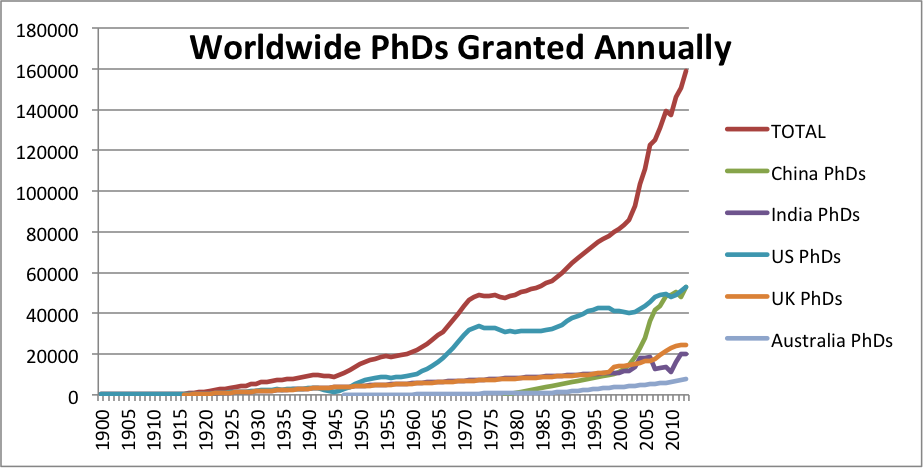
The advance in scientific data reflects this increase, and more. To the extent that scientific productivity can be quantified, the productivity per scientist has increased as the number of scientists has advanced exponentially.
What we don’t have is exponentially more understanding. It’s enlightening to compare the first half of the Twentieth Century with the second. The first half** brought us revolutions in understanding:
- Milliken made the electron real as Rutherford pointed to the structure of the atom
- Planck told us the world is quantized
- Einstein taught us to think in terms of a fabric of space-time, molded by matter-energy
- Heisenberg and Schrodinger taught us that the quantum world is fundamentally interconnected and indeterminate
- Godel surprised us with a demonstration that there are limits to mathematical certainty
- Hubble discovered that there are hundreds of billions of galaxies beyond our own, and that they’re flying away from us, the further the faster
- Lewis, Born, and Pauling gave us a science of chemical bonds based in quantum physics
- Alpher and Gamow proposed the hot Big Bang universe
- Franklin, Crick and Watson discovered the biochemical basis of genetics
What do we have in the second half of the century to compare? I’d put three things in the same league as the above list, and they are all observations for which a theoretical framework remains elusive:
- Penzias and Wilson stumbled on the 3 degree microwave background, promoting Big Bang cosmology to the status of a quantitative science (1965)
- Observations of distant galaxies proved that the expansion of the universe is accelerating; dark matter and dark energy were introduced as the least radical modification to established cosmology (1997)
- Epigenetics came into its own in the 21st century, as it was discovered that big variations in gene expression are more important for the direction of life than small variations in gene sequence.
With so many more scientists, why aen’t we seeing new and powerfully synthetic theories? It’s just not plausible that no one as smart as Newton or Euler or Darwin or Planck is alive today. Then, are the “easy” problems all solved, and the remaining problems in science so much harder? Certainly that’s true to some extent. But there is a larger part of the story, and it is the canalization of scientific thought. Scientists today are paid to be efficient. There is a model of productivity borrowed from industry that is completely inappropriate to science.
We are all agreed that your theory is crazy. The question that divides us is whether it is crazy enough to have a chance of being correct. — Niels Bohr (to Wolfgang Pauli)
Through the culture of business, science has become conservative, which is to say dogmatic. It is more difficult than it used to be to throw out a theory that doesn’t work. Almost everyone is working to push outward in the directions that science has already advanced, but almost no one is digging at the roots, or exploring fundamentally new directions. Almost everyone is engaged in the safe science of incremental advance and almost no one is taking the big risks. Tenure is granted to fewer science faculty members, and they are getting tenure at later ages. Career uncertainty makes scientists risk-averse.
With so much at stake, science is being managed by committees and bureaucracies. They judge on the basis of conventional wisdom and measurable results. Business by nature is risk-averse. But in the long run, science can only advance when we scrap the idea of predictable returns on investment and accept a very high failure rate.
Part II next week: survey of biotech companies doing research in anti-aging medicine.
———————
* 20-fold increase is my estimate, a soft number. I’ve been unable to identify hard statistics, and of course the very definition of “anti-aging” is changing as the idea that all diseases of old age can be delayed has come into general acceptance.
** I’ve taken the license to include two discoveries from 1952 in the first half of the century.
Discussion
72 reader comments
Imported threads are marked Archive. New comments are welcome and moderated for spam.
Your comments about how big pharma and others are perversely holding back progress are right on. Think about the manufactured crises about access to insulin and epinephrine. Both are long off patent- with insulin we're coming up to the hundredth anniversary of its discovery (1921). If news reports are correct, people in the US are dying because they can't afford to buy these drugs. Part of the problem is the drugs themselves are so cheap to produce that companies see little profit in doing so. Instead they spend their efforts tweaking things to get them back on patent where they can control the price. We can probably expect something similar if and when truly effective anti-aging drugs are discovered. I'm all for reseachers being rewarded for their work but there needs to be some regulation. Just as it takes a village to raise a child, it takes a society to advance scientific research. Society should have some say in how the results of that research are applied. Google for instance is quite happy to have access to and use the knowledge reported in hundreds of thousands of mostly publicly funded publications but feels that any insights that provides are theirs and theirs alone.
On the up side conferences like the one tomorrow and Friday in New York with the kind of investment on both an entrepreneurial and grassroots mobilization level were virtually unthinkable before the last. Kuddos to Josh here, Keith @ LEAF/lifespan.io, and everyone part of fostering this shift.
Meetup there is a case in point:
https://www.longecity.org/forum/topic/105946-anyone-going-to-ending-age-related-diseases-in-nyc-this-week/#entry876419
Hope to see others there.
Slightly off topic, but may be of interest.
Maria Blasco's team has come out with a new paper where they compared the rate of telomere loss per year across several species. They show that it strongly correlates with average lifespan better than other parameters such as body weight or heart rate.
I believe this was already known but at least hinted at in previous papers, but it is nice to see a more thorough investigation into it. Let's remember that the latest epigenetic clock for skin and blood also found a correlation between eAge and cell passage.
Yes Adrian, great to see Blasco continue the good work. The evidence for the rate of telomere shortening has been there for a while, but it's now extremely strong as being causal in aging.
Maybe time for Josh to remove the question mark from his Telomerase Therapies?
Hi Cassia
I tried to reply on your thread but cant do it. I do not follow any rigid pattern and most of what I do is intermittently, so the same applies to diet. I do keto most of the time and try to restrict my feeding time as much as reasonably practical as I have a work and a family and I have to integrate it into a normal life. I usually have breakfast and lunch (8 am and 12 am) and fast along the rest of the day but I do have dinners mostly on weekends or work meetings. If so I try to skip lunch that day. Anyway as mentioned, it is not a strict pattern and I think breaking it a little will force some metabolic flexibility as well so I do not care much about it. I do minimize carbs as much as possible and pay attention to the w-6s.
Thank you, Guillermo for your reply!
related to the ridiculous production of articles the science business has now. Maybe we have enough data un-asimilated to know more about aging that we think. I say that because of this application on AI in the large database of articles of Material Science.
https://www.nature.com/articles/s41586-019-1335-8
something similar can be done aiming longevity.
A little off-topic but ASSUMING epigenetic age was a reliable indicator of age I would like to know your opinion about the results I have personally had. I have made two measurements with myDNAGE, the first at 46 chronological years where my epigenetic age was determined as 41 (-5 years, I reported it here at that time) and I received my second test done two years ago with 48 chronological years and my epigenetic age tested 40 (-8 years). Accordingly, not only have I maintained my age, but I have reversed it one year. These measurements always have an error but in any case it seems that it is possible to keep the clock stable despite time passing by. I will carry out a third measurement in two years to continue validating these results, but in any case it would seem that an adequate combination of treatments allows to freeze the epigenetic age whatever that implies for the aging process and the lifespan modifications
my second test done two years ago -> my second test done two years afterwards
There are a lot of question about exactly what this test is measuring and how useful it is. But it IS interesting that reversal is possible. Assuming you are talking about the Zymo MyDNage test, the blood test is accurate to about 1 year. So you're results are well outside the bounds of error.
I took two tests 7 months apart and my results changed from -0.7 years to -2.4 years. So I also managed a small reversal, but with much less significance.
Yes, Zymo myDNAge. I am trying to find how significant this might be, I have done the usual combo and in a way betting on "aging slowly" rather than "looking young" as in my previous comment to you up in this post. Not much feedback from Zymo, they only mentioned they have people with -16 years in their database but I do not know if they were 80 years old or so and therefore not that much when compared as if I follow this trend I may accumulate a lot more than that. I am currently the top youngest for my age (48) in their database and was not when I was younger (46) so something might be going in the right direction. Again, although it feels good to see a parameter like this going in the right direction, who knows if it really means something. My hair still gets whiter and my sight is no the best so maybe I am just uncoupling some tissues and aging heterogeneously, who knows ;) Again, would like to know more about its significance if anyone can feedback on it
If they (Zymo) can't answer the question, then no one can (at present).
What do you attribute the reversal to? Are you on any particular medications or supplements?
Incidentally, I have a theory that statin use is correlated with younger epigenetic age.
Hi Guillermo:
I have observed people visually reduce some signs of aging when first implementing nutritional protocols suggested by various age researchers, this site, and organizations such as Life extension organization.
The reduction is not as dramatic as plastic surgery, but still obvious. After about six months of continued use of the protocols, the person just looks healthier and more vibrant. Both are associated with youth.
When people who were prior deficient in certain nutrients initially implement these protocols their skin, without a doubt, looks tighter and healthier, their hair may gray more slowly, and skin collagen/thickness may increase which reduces the depth of wrinkles.
They also may lose some fat, muscle mass may increase more easily, and new skin wrinkles develop more slowly.
These factors level off, however, after continued use and are not as noticeable with regular usage of the protocols.
So, as you mentioned, and I agree, that it is likely that, after the initial improvements, the protocols are still slowing the age process to some degree, although over time the appearance of the slowed aging is not as dramatic as when the person first replenished the deficiencies.
Not sure they can't answer but they seem to be more into running the lab rather than looking at what happen to each and everyone they are testing. That is why I think I may get a better answer here, I will insist on them anyway ;)
I can only attribute the reversal (or the stable epi age) to my interventions but I am not really into anything particularly different to most people around. It did not change much from what I was doing, I commented it to you here two years ago when I tested -5, you were surprised at that time ;)
https://scienceblog.com/joshmitteldorf/2017/11/09/aging-in-the-news-this-week/
I do keto plus intermittent fasting, weekly 2 mg rapa + daily met at 800mg with some off periods, try to do a run of senolytics twice a year (last time combined Q+D+FOXO4DRI+mebendazole after a fasting period and boosting cell regrowth afterwards (NR + HC diet under SASP inhibitors). I take the usual combo Vit D K some NRF2 activators, intermittently go with ALT711 (not all the time as I get some gastric distress), pregnenolone + DHEA intermittently and not much more. I am testing ok in all blood works and would like to have a CAC score at some point but I keep my self away from statins. Not much exercise by the way and sauna also intermittently. Anyway, my approach seems to be effectively affecting epigenetic age so I am interested in analyzing it further. I hope I keep testing around the same number in two years ;)
There is definitely value in continued testing. Between the many of us trying interventions and getting tested every year (minimum), we should be able to work out what effective interventions are.
Forgot to mention mitoQ for the last 2 years as well, the curcumin + 10mg mitoquinol pill
Hi Guillermo,
Can you clarify a little further on your diet? Are you on a keto diet with time restricted feeding 16/8? And the feeding time is from when to when? Thank you!
Here are a few recent advances that rival the earlier discoveries you mentioned...
Development and testing of Quantum Trajectory Theory
Advancements in AI
Discovery of extra-solar planets
and of course, the Tesla Flamethrower
I think the detection of the gravitational waves is the big scientific breakout missing in Josh' list. Implications are huge.
AI is not a breakout, simply the outcome of more computing power.
However, I think the greatest achievement of the Human Being during the second part of the 20 century is the development of the microchip. The most important machine ever created since the combustion engine.
Ray -
I'm very familiar with the latter theory, promoted by Bruce Ames who has been a giant in the field of human nutrition and health, but who has a different concept of aging than my own.
As for sustained-release vitamin C, I'm skeptical until you show me the basis of the claim that it can extend human life.
It's based on the lifespan extension of mice that can't synthesis vitamin C compared to their lifespan when they supplement it. Unlikely to map 1:1 to humans (not to say it won't give us anything).
Another example is glycine. A common amino acid in the bloodstream, but insufficient in humans to provide for collagen turnover, and possibly glutathione production.
Hi Josh, Am on the mailing list of Bill Sardi, as have been taking longevinex since its introduction, on his last longevity email, there was a link which provided the news on this mouse study, Marks reply gives more info, they regarded the study as exciting milestone, with the race on to restore the Human gene back on to synthesis Vit C, the excitement being their belief that all roads lead to Vit C in aging and illness. The evidence of the mouse research was equated to us was 140 year life span. It explained to replicate study in meanwhile would be 2g of C spread in small doses over 24hrs. I am replicating it by taking 1000mg effervescent tablet in 4 doses. The other 1000mg I would consider I am already supplementing by the approx daily intake of 20 items such as grape seed, blueberry,carnosine,tumeric,lycopene,selenium,garlic,astaxanthin,PQQ,MitoQ, Q10, cranberry,CBD,etc.
Jim Watson blogged about this a few months ago, over at 'anti-aging firewalls' .
The theory goes that all primates would have lost the ability to synthesize Vit C as it promotes the accumulation of fat, possibly through its effect on higher levels of Uric Acid. This would have happened, according to this hypothesis, when our ancestors were living in present day Europe and had to face a period of global cooling.
A few million years later another mutation knocked out the production of uricase in all great apes. Supposedly with the same effect, an increase in the ability to accumulate fate off fructose thanks to higher levels of uric acid.
In the modern day these mutations are partially to blame for the obesity epidemic, so it makes sense that a restoration or supplementation may be statistically very beneficial. But does it slow aging? Only if you define it as an increase of the probability of death. I would say it is a carefully controlled developmental process and lack of Vit C is unlikely to be one of the controllers.
One only needs to look at most other mammals who still retain functional copies of these 2 genes. I don't know of any with an average lifespan higher than humans for example.
Still, it may be a good idea to supplement with Vit C or foods which are rich in it, if only for the reasons above.
The research is very helpful for anyone wanting to follow up potential benefits of Vitamin C, as it states that to mimic the research that equated to 140 year life span, it would not be practical b y diet alone to meet requirement of 2g daily of C. Reason being it would equate to consume 33 oranges daily. I find it easy to equate with the tubes of 1000mg tablets that are easy to break into smaller parts.
Hi Josh, thank you for the tremendous research and insights you are engaged in. The reason for post is your belief that aging is caused by gradual shut down of repair to cells. I read of new research that seems to have gone under the radar giving pointers to this. Gist of it was that Humans lost the function of genes that the body supplies for Vitamin C and animals have retained this gene. Research was done with mice that compared two groups with and without this gene, the conclusion from the research was that if Humans restored capacity to make Vit C, it would give lifespan of 140 years. It concluded effect could be mimicked by taking 2g of C, but spread in doses over 24 hrs to copy the mouse research. Another theory on same lines is that as we age, the body is unable to supply enough nutrients for body maintenaince, and diverts what it can to short term survival of essential organs, at expense of long term survival, conclusion was that it could be overcome by taking supplementation to address the shortfall and provide both maintenance and longevity. This is two different conclusions coming to the same path that you believe in your research, as such, I believe bells should start ringing. The mouse research of course, may or may not equate to Humans, but just the chance that it does and is cost free (£1 for tube of effervescent 1000mg tablets) with no side effects, it seems almost as though they are keeping it a secret.
@Josh,
this is a wonderful post. I've thought the same many times.
The worst is that all is becoming worse and worse. Nowadays, most of the faculty only cares about the number of publications, because that's what asked for a promotion.
When I finished my Ph.D., about 15 years ago, a Conference Paper in my field was something worthless, many of them are not even peer reviewed, now Ph.D. students, postdocs and teaching assistants to publish as many as them as they can. A decade ago, or so, most of the articles in my field had 1/2/3 authors, and now young people publish tens of articles with 5-10 authors. It's obvious they are not their creation, but the number is what matters.
Reviewing articles is the same. People send to publication without knowing the literature. Naive works that themselves know are naive, but don't care because what matters is to get the publication.
Funding, at least in my country, is an economic scheme to transfer the money to the rich people. Only, big bosses with big teams get the money to continue to do the same. There is no way people with good ideas and capability will get funded to pursue new lines.
Science now is a full-time job as any other.
josh has finally hit the nail on its head. science has become conservative and risk averse and aging research more so, because it deals with living life as we know it through religion, history and strong beliefs. conquering aging goes against everything we know how to live through various life stages. it will ultimately require mad people to conquer it
Hopefully I can contribute a bit of optimism.
I think that, as of today, we have about 3 or 4 competing theories on the proximal cause of ageing. That is, what is DIRECTLY causing the changes we perceive as 'ageing'.
1) Senescent cell accumulation and its associated SASP. I would include here any theory of cellular hyper-function, such the mTOR driven gero-conversion of quiescence cells into SC's. Also a more immune system centered SASP, as in the senescent associated macrophage theory of Gudkov (also working at the same institute as Blagosklonny). This may or may not include telomere attrition as big driver of 'unnecessary' senescence. This is the most promising area of study and treatment at the moment.
2) Ageing as driven by Epigenetic/gene expression changes. Like Josh, I still think this is the most likely, but probably one of the most difficult to tackle. As in the previous case, this may or may not include telomere shortening and its effects on gene expression through the TP effect. I would also include here changes in hormonal profiles and other chemical signals in the blood, as they must be ultimately driven by the cells themselves and should be the result in changes in gene expression.
3) Waste and damage accumulation. This is, at the risk of simplification, Aubrey DeGrey's approach at SENS. I would include here oxidative stress theories, DNA damage accumulation, extra cellular matrix damage accumulation through for example collagen loss and AGE's accumulation (also inside the cell), etc. Probably, also very difficult to tackle.
4) Loss of regeneration capability by stem cell niche depletion. This doesn't seem to have garnered much attention lately. Depending on its actual impact and ultimate cause/s, it could be included inside one of the 3 cause above.
Perhaps to complicate things, they are not mutually exclusive. But from what I can recall these past few years you can categorize all theories inside one of the 4 above.
In all these cases most of the relevant discovery have been made these past 4 or 5 decades. And before that time, practically nothing was known.
Yes, scientists can't help but come up with new theories all the time. Despite the fact current or past ones have not yet been falsified.
Looking at successful animal lifespan studies - almost all have worked through the growth vs. autophagy pathway/s . So for humans I'd ignore these and look at the exceptions. Only four immediately spring to mind - telomerase gene therapy (extending mean and max mice lifespan with a single treatment); senescent cell ablation either with drugs or genetically (extending mean mice lifespan); mitochondrial targeting of catalase (extended mean and max mice lifespan), and intermittently expressing pluipotency factors (extended mean and max lifespan of age accelarated mice strain).