

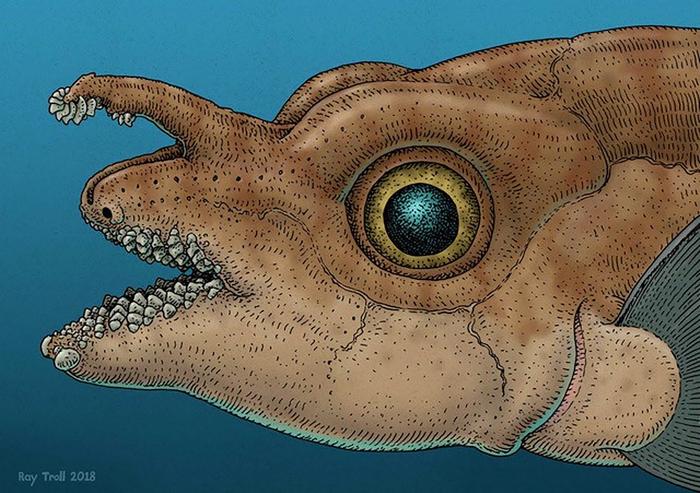
Teeth can grow on a fish’s forehead, then help it mate. That is the odd, very real story of male ghost sharks, deep-sea chimaeras related to sharks and rays.
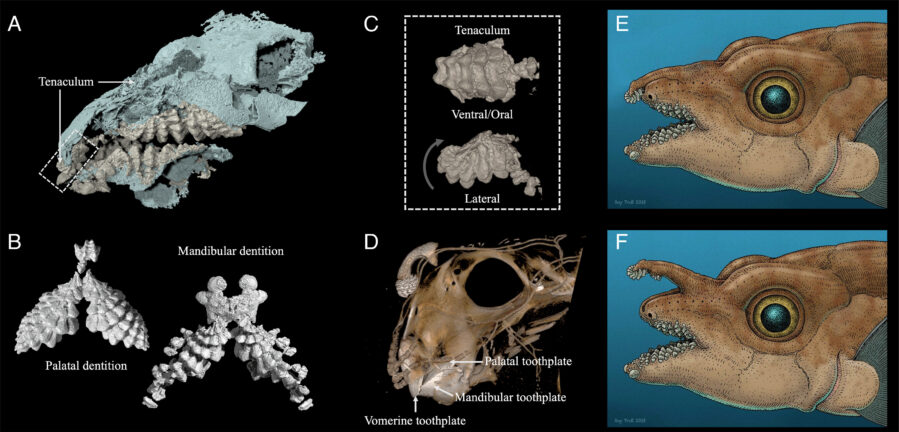
In new work led by the University of Florida and collaborators at the University of Washington and the University of Chicago, researchers show that the male’s forehead rod, called a tenaculum, is not just bristling with tooth-like points. It carries true teeth, produced by the same genetic machinery as teeth inside the mouth, and apparently used to grip females during sex, according to a study in the Proceedings of the National Academy of Sciences.
The tenaculum looks like a retractable club between the eyes, but up close it is arranged in neat rows of curved points. Not scales. Teeth. CT scans of modern spotted ratfish, Hydrolagus colliei, reveal serial rows, often around seven, with mineralized crowns, roots, and pulp cavities. A 315-million-year-old fossil shows a similar arrangement affixed to the upper jaw, which hints that this head spike once sat closer to the bite. And the real surprise came in the lab: the tenaculum expresses tooth-specific genes that mouth teeth need to form, including Sox2 and activated beta-catenin. In other words, the head gear hijacks the mouth’s recipe for dentition.
“If chimaeras can make a set of teeth outside the mouth, where else might we find teeth?” said Gareth Fraser, a University of Florida biologist and senior author.
For the scientists, the stakes are bigger than one strange fish. Teeth that appear outside the mouth challenge a tidy story about how vertebrate dentitions evolved and where they are allowed to grow. It suggests there is lingering dental potential in places we do not expect, a developmental relic waiting for natural selection to give it a job. In chimaeras, that job seems to be mating. Videos of rare courtship show males gripping females, and researchers note scars on female backs that match the arc of those head teeth. It is a rough romance, but in the deep sea, it seems to work.
There is a buried lede here, almost tossed off by the data. Chimaeras lost the standard shark setup of endlessly replacing oral teeth, swapping it for fused, beak-like tooth plates. Yet cyclical tooth replacement survives, just not in the mouth. It persists on the forehead. That is evolutionary economy in action, repurposing an old system where it still pays dividends. And yes, the economic angle surfaces even in marine oddities: biological designs that can be re-used reduce developmental costs, a kind of budget-friendly tinkering that nature never stops practicing.
The team did not just rely on gadgetry. They sliced tissue thin, stained it, and watched the tenaculum grow from an embryonic nub into a cartilage rod seeded with a dental lamina, the same tissue string that builds and renews teeth in jaws. Sequential rows appear, newer teeth budding near the base, older ones riding forward. The crowns mineralize first. The bases follow. If you know shark tooth assembly lines, you will recognize the choreography.
And the fossil record refuses to stay quiet. In the Carboniferous holocephalan Helodus simplex, the tenaculum’s tooth whorl nests in a gap between upper jaw plates, close enough for embryonic tissues to share signals. That proximity offers a credible route for odontogenic competence to jump from mouth to forehead, then linger as the structure migrates and shortens through evolutionary time. Turns out, boundaries in skull real estate are flexible when genes and tissues are willing to talk.
“It provides a beautiful example of evolutionary tinkering or bricolage,” explained Michael Coates of the University of Chicago. “These fishes co-opted a preexisting program for manufacturing teeth to make a new device that is essential for reproduction.”
Of course, none of this makes ghost sharks less strange. They still carry a venomous dorsal spine, pelvic claspers studded with denticles, and a beak built for crunching hard prey. But they also carry a forehead that bites, sort of. A forehead that learned to act like a mouth, because mating demanded a better grip. Nature, thrifty as ever, used what was on hand.
There is a cheeky thought experiment buried here. If teeth can sprout where the right instructions land, could other vertebrates hide pockets of dental potential outside the jawline? The study does not answer that. It just leaves you with an image: a fish raising a small, toothed baton from its brow, then tucking it away again when the work is done.
Quick Explainer: What Is a Tenaculum?
The tenaculum is a retractable, club-shaped appendage on the forehead of male ghost sharks, also called chimaeras. In this study of the spotted ratfish (Hydrolagus colliei), researchers show that the tenaculum is covered in true teeth arranged in rows. These teeth form using the same genetic program as mouth teeth, including signals tied to the dental lamina, a tissue strand that seeds and renews teeth in jaws. Fossils suggest that ancient relatives had longer tenacula connected closely to the upper jaw, which could explain how tooth-making capacity shifted to the forehead. Modern males likely use the tenaculum to grip females during mating, which helps explain why only males carry fully toothed versions.
Journal: Proceedings of the National Academy of Sciences
DOI: 10.1073/pnas.2508054122