

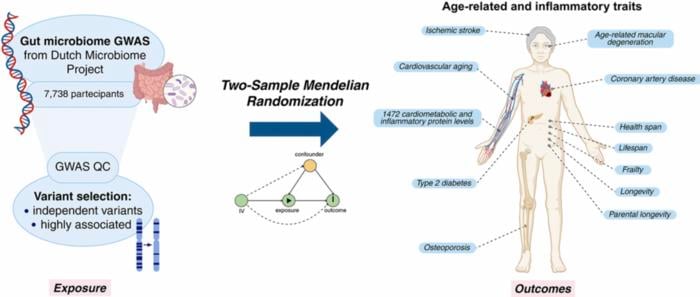
Some bacteria in the gut may quietly dictate which proteins rise or fall in our blood, deciding whether aging feels like a slow drift or a downhill slide. A study from Italy’s National Research Council, published in Aging-US on August 1, 2025, used genetic sleuthing to uncover 91 causal relationships between microbial features and age-related traits. One signal kept flashing: a microbial pathway that seemed to sap apolipoprotein M, a protein with a reputation for shielding the heart. The results suggest the microbiome isn’t just an innocent passenger on the aging journey — it’s fiddling with the dashboard controls.
The team led by Federica Grosso, Daniela Zanetti, and Serena Sanna ran more than 55,000 Mendelian Randomization tests, a method that treats genetic variants as natural experiments. Out of this massive data churn, 91 links cleared every hurdle. Most pointed to proteins tangled in inflammation and lipid metabolism — the very circuits where tiny biochemical nudges can echo as clogged arteries or creeping frailty.
“These results support the role of gut microbiome as modulator of the inflammatory and cardiometabolic circuits, that may contribute to the onset of age-related diseases […]” the authors wrote.
One pathway, purine nucleotides degradation II, was the troublemaker that stood out. It helps microbes break down purines into urate, a process that looks harmless until you notice ApoM levels falling at the same time. ApoM helps HDL do its cleanup job, sweeping cholesterol away and calming inflammation. With lower ApoM and higher urate, the setup looks like a two-for-one special on cardiovascular risk. Crucially, the finding held up in an independent cohort — replication being the gold currency in a field notorious for flimsy signals.
And then came the blood type wrinkle. People with type A secrete a sugar called GalNAc into the gut. Certain microbes, including strains of Faecalibacterium prausnitzii, know how to feast on it. In those individuals, the microbial sugar binge translated into measurable shifts in proteins tied to immunity and heart health. It’s a reminder that what you inherit at birth — in this case, your ABO blood type — may quietly shape how your microbiome meddles with aging biology. If you can imagine the supplement industry salivating at the thought of “Blood-Type A Microbiome Packs,” you’re not wrong.
The AMD story was murkier. Higher levels of Coriobacteriales bacteria seemed to raise risk of age-related macular degeneration in the main analysis, but the effect evaporated in three other datasets. Definitions of AMD varied, and the authors blame that mismatch. But it’s also a warning that one-off hits should be treated less like breakthroughs and more like shaky first drafts.
“Unlike previous studies, we performed replication analyses for the significant results using independent GWAS datasets, a fundamental step that has often been overlooked,” the researchers noted.
Still, the scope here is hard to ignore: 91 causal links spanning 36 inflammatory and 26 cardiometabolic proteins. That is a lot of biochemical levers for a gut community we usually meet in probiotic ads. Effect sizes are modest, but aging itself is a story of modest changes stacked year on year, like compound interest working against you.
The implications are double-edged. ApoM sits at the crossroads of lipid metabolism and vascular protection, so targeting the gut to tweak its levels is enticing. Yet the very complexity that makes this science exciting also makes it volatile. Diet, environment, even your blood type can shift the picture. For now, the safest bet is that the gut is not just along for the ride. It’s driving — and sometimes taking detours we barely understand.
Journal: Aging-US
DOI: https://doi.org/10.18632/aging.206293
Explainer: What Is ApoM and Why Does It Matter?
Apolipoprotein M (ApoM) is a small protein made mostly in the liver and kidneys. It attaches to HDL particles, giving them the muscle to haul cholesterol out of arteries and back to the liver. ApoM also carries bioactive lipids that calm inflammation and protect blood vessel lining. In this study, microbes that rev up purine degradation were linked to lower ApoM in the blood. That matters because lower ApoM weakens HDL’s protective functions and tilts the balance toward heart disease. The finding suggests one way the gut microbiome might act as an unseen hand in aging and cardiovascular decline.