

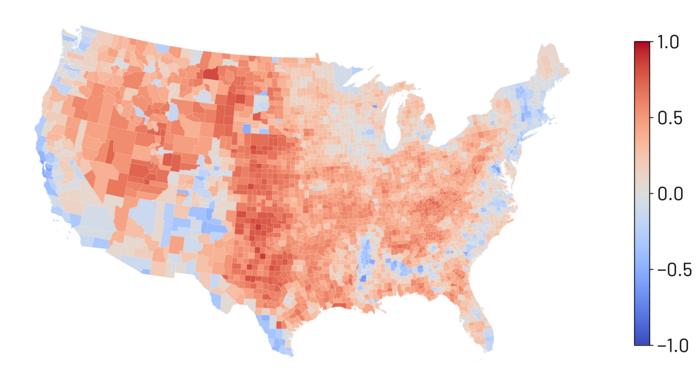
In a surprising twist to the social media polarization narrative, new research reveals that who you physically bump into at the grocery store or coffee shop might shape your political views far more than your Facebook friends. A comprehensive study analyzing anonymized location data from millions of Americans found that face-to-face encounters predict county voting patterns with 97% accuracy, significantly outperforming online social networks.
The research, published in PNAS Nexus, challenges the prevailing assumption that digital echo chambers are the primary culprit behind America’s political divisions. Instead, it paints a picture of a nation where physical segregation – not virtual separation – drives political behavior.
Tracking Political Proximity Through Phone Data
Michele Tizzoni from the University of Trento and his colleagues tapped into Meta’s Data for Good program, which tracks anonymized location data from Facebook app users who enabled location services. The researchers defined a “co-location” as two people spending at least five minutes within the same 600-by-600-meter area. They then compared these physical encounters with Facebook friendships and neighborhood demographics across all US counties.
The results were stark. Physical co-location patterns explained 97% of the variance in county-level voting patterns during recent presidential elections. Online connections through Facebook friendships explained only 85-87%, while residential proximity – essentially, who your neighbors are – explained just 75-80%.
“Affective polarization and increasing social divisions affect social mixing and the spread of information across online and physical spaces, reinforcing social and electoral cleavages and influencing political outcomes.”
Picture a typical American county: the casual encounters at local businesses, chance meetings at parks, and brief interactions in parking lots collectively paint a remarkably accurate portrait of how that county will vote. These fleeting moments of physical proximity appear to matter more than carefully curated online friend lists or the political leanings of immediate neighbors.
Education Emerges as Key Segregation Factor
The study also revealed that partisan segregation is actually more pronounced in physical spaces than online. Educational attainment emerged as the primary factor structuring this segregation, particularly in metropolitan areas. Counties with higher education levels showed distinct patterns of partisan mixing – or lack thereof – in their physical spaces.
To validate their findings at the individual level, the researchers analyzed survey data from 2,420 Americans collected during the 2020 presidential election. Again, offline social ties showed stronger effects on vote choice than online connections. The people respondents actually spent time with in person proved more influential than their digital networks.
This challenges years of intense scrutiny on social media’s role in political polarization. While platforms like Facebook and Twitter have faced criticism for creating filter bubbles and spreading misinformation, this research suggests the roots of political division run deeper – into the very geography of American life.
“Our results suggest a more fundamental role of real-world social mixing than online networks in reflecting political views.”
The implications are profound. If physical encounters matter more than digital ones, then addressing political polarization might require rethinking urban planning, community design, and public spaces rather than just reforming social media algorithms. The coffee shop where Democrats and Republicans never cross paths may be a bigger problem than the Facebook groups where they argue.
Of course, online and offline worlds aren’t entirely separate. Where people choose to go physically might be influenced by what they see online, and vice versa. But this research suggests that when it comes to predicting and understanding political behavior, there’s still no substitute for tracking actual human movement and interaction in the physical world.
As America grapples with deep political divisions, this study offers a reminder that despite our increasingly digital lives, politics remains fundamentally local – shaped by the people we pass on the sidewalk, stand next to in line, and encounter in our daily routines. The most powerful echo chambers, it seems, might not be virtual at all.