

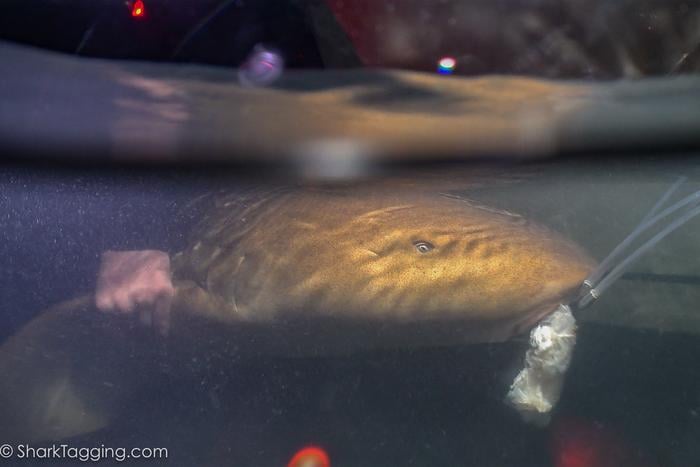
The nurse sharks swimming through Miami’s glowing coastal waters at night aren’t getting much sleep. Their blood tells the story: melatonin levels suppressed, circadian rhythms disrupted, all because the city never really goes dark. For the first time, researchers have measured the hormone in wild sharks and found that artificial light is throwing their biological clocks out of sync.
Off the coast of Miami – one of America’s brightest metropolitan coastlines – Abigail Tinari spent a year catching sharks at night. She wasn’t studying their behaviour or tracking their movements. She was after their blood. What she found suggests that light pollution, usually considered a problem for sea turtles and nesting birds, reaches far deeper into the marine food web than we’d realised.
The team caught nurse sharks and blacktip sharks from drumlines set in waters bathed in city light, then compared them with sharks from darker areas in Biscayne National Park. Every shark was sampled at least two hours after sunset, when melatonin production should be ramping up. The researchers used only red lights during their work – wavelengths sharks can’t detect.
Nurse sharks living in the brightest waters had significantly lower melatonin concentrations than those in darker areas. The difference was stark: sharks near the city’s glow showed suppressed hormone levels, whilst their cousins in the national park had readings you’d expect from an animal in proper darkness. Melatonin dropped as light levels increased, and rose again in deeper water where less illumination penetrates.
But blacktip sharks? No measurable difference. Same Miami glow, same dark control sites, yet their melatonin levels stayed consistent regardless of where they were caught.
The explanation, reckons Tinari, comes down to how each species lives. “These findings suggest that exposure to artificial light at night can suppress melatonin levels in wild sharks, but vulnerability depends on behavior,” she says. “Species that are highly resident in light-polluted areas appear more susceptible than species that regularly move between illuminated and darker habitats.”
Nurse sharks are homebodies. They’re benthic, often resting on the seafloor in the same areas for months. If that area happens to be lit up by urban skyglow every night, there’s no escape. Blacktip sharks, in contrast, are constantly on the move – ranging across broad coastal regions, diving deep, swimming in and out of light-polluted zones. Their exposure is patchy, diluted by time spent in darker water.
The melatonin values themselves – ranging from roughly 25 to 425 pg/mL in nurse sharks and 27 to 629 pg/mL in blacktips – are the first ever recorded for any shark species. That’s significant, because until now we simply didn’t know if sharks even had measurable circulating melatonin, let alone whether it responded to light like it does in bony fish and mammals.
Danielle McDonald, who co-authored the study, sees the findings as a reminder of deep evolutionary connections. “The first sharks started roaming the Earth’s oceans more than 400 million years ago. That this study suggests sharks might respond like humans emphasizes the fundamental importance of this process, because it is highly conserved over evolutionary time,” she says. The fact that sharks and humans share this vulnerability is striking. It also, she notes, “reinforces concerns doctors have about LED lighting, screens, and urban light pollution as contributors to illness and chronic disease.”
What happens to a shark with disrupted melatonin? We don’t yet know, but studies in bony fish offer clues. Suppressed melatonin has been linked to altered swimming behaviour, disrupted reproduction, impaired immune function, and increased metabolic rates. If sharks experience similar effects, the consequences could ripple through coastal ecosystems – especially given that sharks sit atop the food web.
Neil Hammerschlag, the senior author, puts it plainly: “Sharks play a key role in maintaining balanced marine ecosystems, and physiological changes in top predators could have cascading effects throughout the food web.” Light pollution, he argues, deserves recognition as a meaningful environmental stressor. “Our findings highlight light pollution as a meaningful environmental stressor that warrants consideration alongside more widely recognized threats such as habitat loss and chemical pollution.”
The study has its gaps. Adult blacktip sharks in Miami waters are sexually segregated – most males were caught in the bright areas, most females in the dark – making it impossible to compare like with like. The timing of sampling varied too; some blacktips were caught quite early in the night, possibly before their melatonin production peaked. And there’s the question of what “normal” shark melatonin rhythms even look like across a full 24-hour cycle, something no one has mapped yet.
But the core finding stands. Coastal cities are bright enough to suppress a fundamental biological process in wild sharks. Miami’s waterfront lights blaze at 17 lux on the brightest nights – roughly fifty times the illumination of a full moon. That’s more than enough to interfere with light-sensitive hormones, at least in species that can’t swim away from it.
As coastal development accelerates and LED lighting spreads, the reach of artificial light at night extends further offshore. Nurse sharks lounging on shallow seabeds near expanding urban coastlines are in the direct line of fire. For animals that have navigated by natural light cycles for hundreds of millions of years, the last century of electrification represents an environmental shift they never evolved to handle. Whether they can adapt, or whether this is one stressor too many, remains to be seen.
Study link: https://www.sciencedirect.com/science/article/pii/S0048969726001051
