

The old textbook picture is simple enough to draw: the brain decides, the spinal cord or nerve cord relays, and the body carries out the instruction.
A new fruit fly connectome makes that picture look too neat. In a paper published in Nature on 8 June 2026, Alexander S. Bates, Jasper S. Phelps, Minsu Kim, Helen H. Yang and a large international team report the first densely reconstructed adult fly connectome that joins the brain with the ventral nerve cord, the insect structure that functions in some ways like a spinal cord. This is one study and one reconstructed animal, not a complete explanation of how flies behave.
Still, the scale matters. The team mapped neural wiring across the adult fruit fly central nervous system, following the brain and nerve cord as a connected control system rather than treating them as separate diagrams. The result is not just a bigger wiring map. It is a different way of seeing how a small animal turns sensation into movement, posture, internal state and action.
The paper’s central claim is that control is distributed, parallel and embodied. In plain English: the body is not merely waiting for orders from the brain. Local circuits tied to individual body parts feed back on themselves; long-range ascending and descending neurons link those loops into larger behaviour-focused modules; and some neurons are positioned to influence multiple body parts along with the internal organs and endocrine cells that help support movement.
What a connectome can and cannot show
A connectome is a wiring diagram of neurons and synapses. At this scale, it is built from electron microscopy images thin enough to show the connections between individual nerve cells. Researchers then use automated segmentation, synapse detection, proofreading and annotation to turn an image volume into a network that can be queried and analyzed.
That does not make it a working digital fly. A chemical synapse map does not include every feature of nervous system function. It does not directly show all electrical coupling, receptor dynamics, neuromodulators, hormones, glial roles, learning rules or the changing strength of synapses in a living animal. A connectome is anatomy, not behaviour in motion.
But anatomy can sharply constrain what is possible. If one neuron connects to another, if sensory neurons converge on a particular hub, if a descending neuron reaches circuits for multiple body parts, those facts become testable hypotheses. The connectome gives researchers a parts list and wiring plan detailed enough to ask which circuits could plausibly generate a behaviour.
The new Nature paper builds on years of fly connectomics. Researchers had already mapped major parts of the adult fly brain, including the FlyWire adult brain dataset, and separate work had reconstructed the female adult ventral nerve cord. The new step is integration: brain and nerve cord together, in an adult animal, analyzed as a single central nervous system.
The body talks back
One of the most important findings is local. The authors report that effector neurons, including motor neurons, endocrine cells and neurons targeting internal organs, are primarily influenced by sensory neurons from the same body part. That creates local feedback loops. A leg, for example, is not simply the endpoint of a command. Its own sensory information can shape the circuitry that controls it.
This is familiar in broad outline to anyone who studies movement. Bodies need fast feedback. Walking, flying, grooming and taking off cannot wait for every adjustment to be deliberated by a central command post. What the connectome adds is scale and specificity: the actual neuron-to-neuron architecture linking local sensation to motor output across the fly’s central nervous system.
The surprising part is not that local loops exist. It is how strongly they are woven into long-range control. The paper describes ascending neurons, which carry information from the nerve cord toward the brain, and descending neurons, which carry influence from the brain toward the nerve cord, as organized into behaviour-centric modules. These are not tidy one-line pathways from “brain” to “muscle.” They are layered circuits that can connect body parts, internal state and higher brain regions.
Some single ascending and descending neurons appear positioned to affect voluntary movements of multiple body parts together with endocrine or visceral targets. That is where the usual diagram begins to fail. The map suggests that movement, body state and internal support systems are not separate chapters. They are part of the same control architecture.
A brain that supervises, not merely commands
The study does not demote the brain. If anything, it clarifies how the brain sits inside a larger loop. The authors report that brain regions involved in learning and navigation supervise the long-range circuits connecting the brain and nerve cord. That fits the fruit fly’s life. A fly has to steer toward odors, escape threats, orient in space, feed, mate, groom and adjust to experience.
Those behaviours are too flexible to be explained by reflexes alone. At the same time, they are too fast and embodied to be handled as a sequence of abstract commands. A better picture is one in which the brain biases, coordinates and supervises many body-level systems that already contain rich circuitry of their own.
That is why the paper compares the architecture to distributed control systems in engineering. In such systems, control is not concentrated in one box. Different parts of the system handle local information while remaining linked to higher-level coordination. The fly connectome gives biology’s version of that idea a concrete wiring diagram.
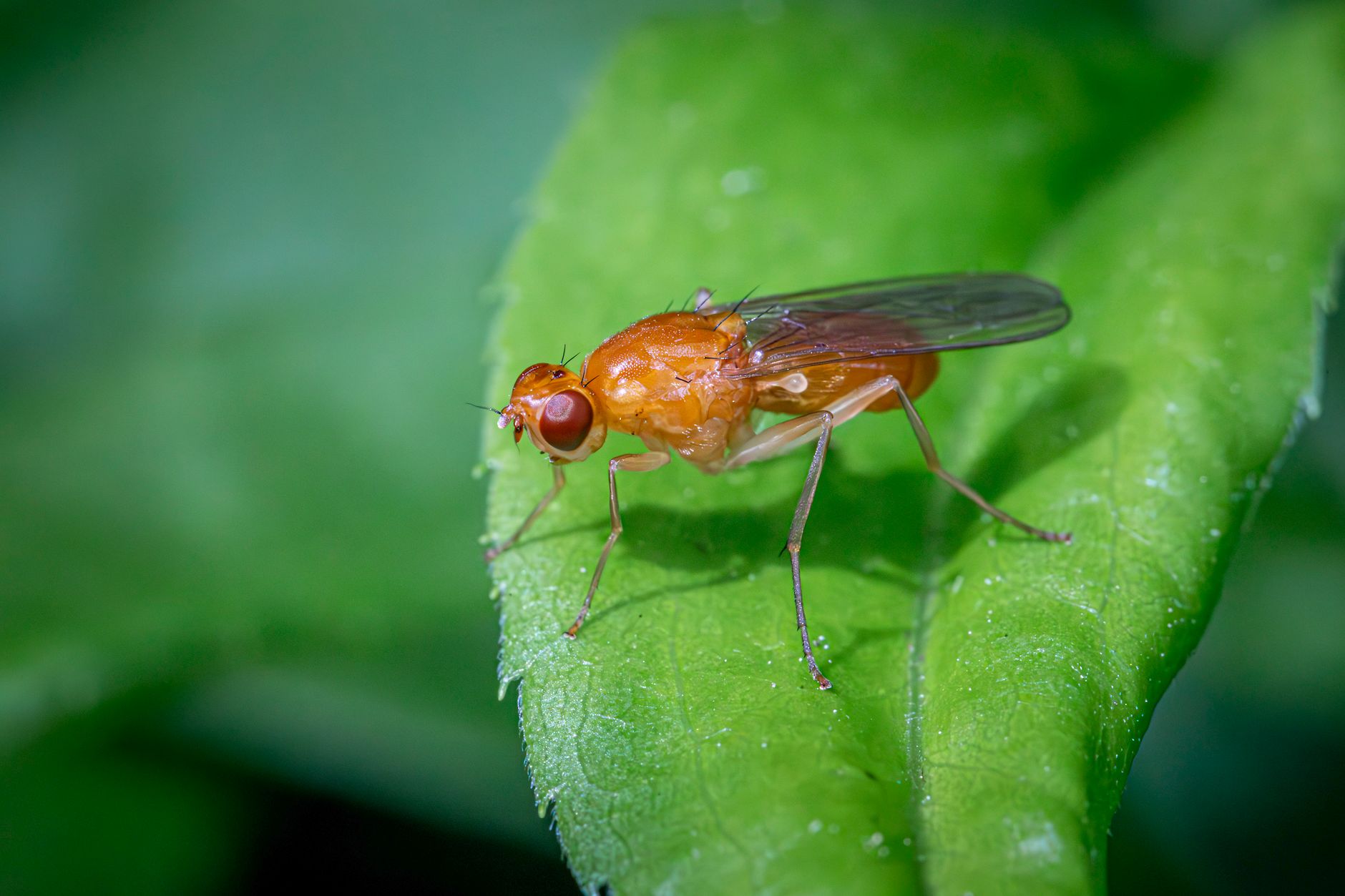
For neuroscience, this matters because the fruit fly is small enough to map but complex enough to matter. Drosophila melanogaster can learn, remember, navigate, court, fight, sleep, feed, choose and fly. It has a nervous system that is tiny compared with a mammal’s, but not simple in any everyday sense.
Why flies keep changing neuroscience
The new adult central nervous system map is part of a longer sequence. In 2020, researchers published a dense connectome of a large portion of the adult fly central brain. In 2023, another team published the complete synaptic-resolution connectome of a larval fruit fly brain, with 3,016 neurons and 548,000 synapses. In 2024, Nature papers described a whole adult brain wiring diagram and a female adult ventral nerve cord reconstruction.
Each map answered one question and exposed another. A brain-only map could show how sensory systems, memory centers and descending outputs are organized, but it could not fully show how those outputs meet the circuits that control legs, wings and internal organs. A nerve-cord map could show motor circuits in detail, but not the full brain context. Joining brain and cord lets researchers ask how the animal is wired as one nervous system.
There are still limits. The published Nature article notes that the manuscript was released in an unedited early-access form before final publication editing. More importantly, all connectomes of this kind remain imperfect reconstructions. They are datasets to be used, corrected, compared and tested, not sacred diagrams.
They are also not human brain maps. The human brain contains tens of billions of neurons; a fly’s central nervous system is tiny by comparison. But that is exactly why flies are useful. They are small enough for synapse-scale reconstruction and experimentally tractable enough that wiring predictions can be tested in living animals.
The larger lesson is conceptual. The nervous system is not a clean hierarchy with the brain at the top and a passive body below. In the adult fruit fly, the wiring suggests something more integrated: body-part feedback loops, long-range modules, internal-organ targets, endocrine links and brain regions that supervise rather than simply issue commands.
The map is of a fly. The challenge it poses is much broader: to understand an animal’s brain, scientists may have to stop treating the body as downstream machinery and start treating it as part of the computation.
Sources
- Bates et al., “Distributed control circuits across a brain-and-cord connectome,” Nature, 2026
- Dorkenwald et al., “Neuronal wiring diagram of an adult brain,” Nature, 2024
- Azevedo et al., “Connectomic reconstruction of a female Drosophila ventral nerve cord,” Nature, 2024
- Winding et al., “The connectome of an insect brain,” Science, 2023
- Scheffer et al., “A connectome and analysis of the adult Drosophila central brain,” eLife, 2020