

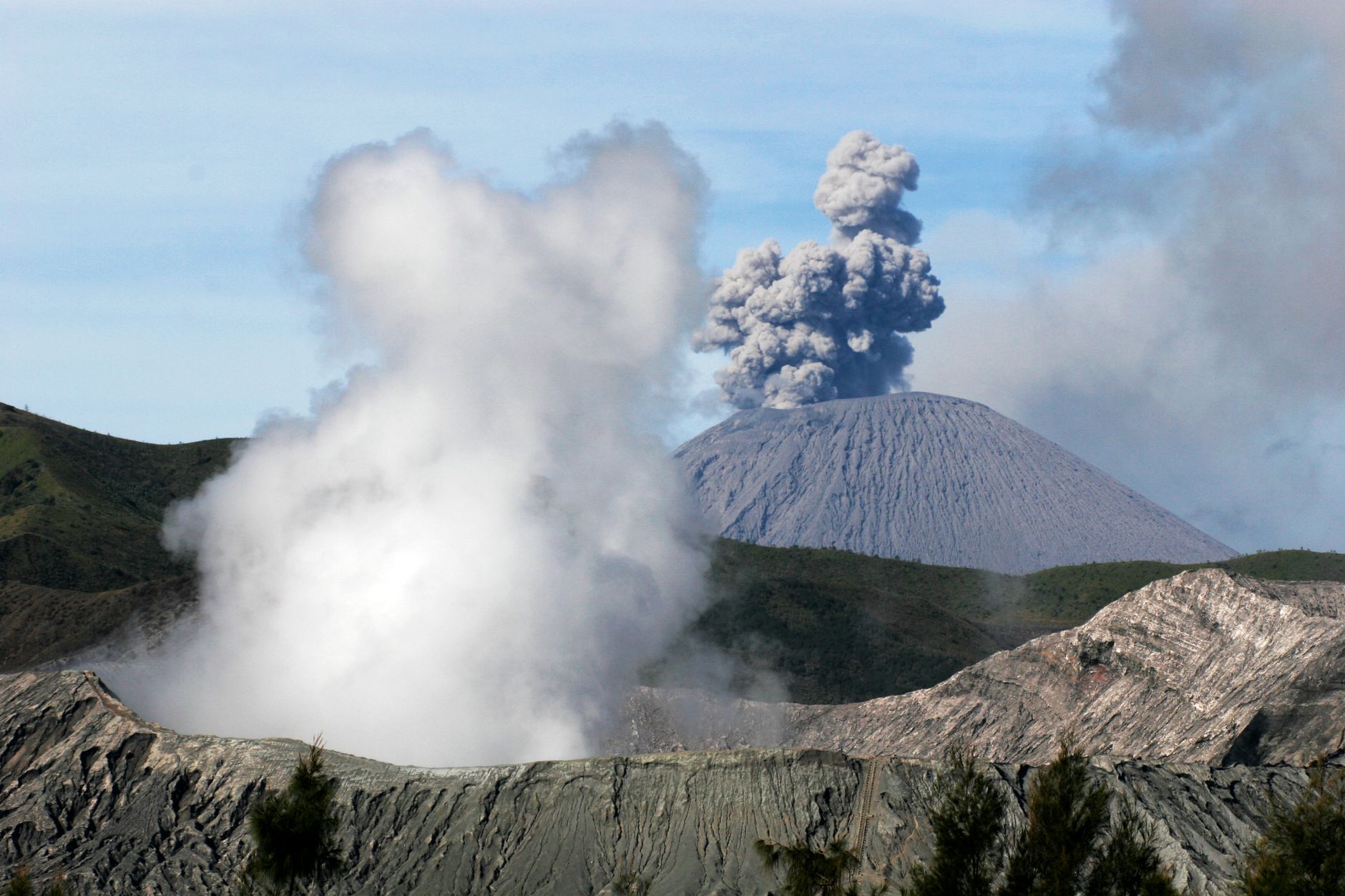
Krakatoa is often described as the loudest sound ever recorded, but that sentence needs a small historical correction before it becomes useful. No one in 1883 placed a calibrated microphone beside the volcano. The evidence comes from human reports, ship logs, damaged ears, barometer traces and the later work of scientists trying to reconstruct what the atmosphere did after the island exploded.
Even with that caution, the scale is difficult to soften. On August 27, 1883, the climactic eruption of Krakatau, the Indonesian volcano more commonly written in English as Krakatoa, destroyed much of the island in the Sunda Strait between Java and Sumatra. The Smithsonian Global Volcanism Program says the caldera collapse destroyed Danan and Perbuwatan, left only a remnant of Rakata, and caused more than 36,000 deaths, most of them from tsunamis sweeping nearby coastlines.
The sound and pressure wave from the eruption became a global event. The Royal Society’s 1888 report, The Eruption of Krakatoa, and Subsequent Phenomena, devoted a full section to the “air waves and sounds” caused by the eruption. It described detonations heard over nearly one-thirteenth of Earth’s surface and sounds reported at Rodrigues, in the Indian Ocean, more than 2,500 miles from Krakatoa.
A sound heard across an ocean
The most repeated version of the story says the eruption was heard about 4,800 kilometers away on Rodrigues, where people reportedly thought the noise came from distant gunfire. Other reports placed the sound in Australia and across large parts of the Indian Ocean region. These were not quiet distant rumbles in the poetic sense. They were loud enough, at extreme range, to be interpreted as artillery or naval activity.
The Royal Society report was careful about the limits of the evidence. It judged some far-distance sound reports more firmly than others, noting that sounds were certainly heard at Ceylon, now Sri Lanka, about 2,000 English miles from the volcano, and probably at Rodrigues, about 3,000 English miles away. That careful wording matters. The 4,800-kilometer figure survives because it is plausible and widely repeated, but the primary historical record distinguishes certainty from probability.
Closer to the volcano, the blast was not merely heard. It caused injury. Popular summaries often cite the British ship Norham Castle, roughly 40 miles, or about 65 kilometers, from Krakatoa, where the pressure wave reportedly ruptured the eardrums of crew members. In modern terms, the event is less like a loud concert and more like a sudden atmospheric blow, a pressure front strong enough to move through bodies, ships and instruments.
The barometers told a second story
What makes Krakatoa scientifically unusual is not only that people heard it. It is that instruments around the world felt it. Barographs, instruments that continuously record air pressure, picked up the atmospheric wave as it moved outward from the eruption and returned after circling the globe.
The Royal Society report collected observations from dozens of stations. It noted that the air wave traveled at roughly 674 to 726 miles per hour, close to the speed of sound under atmospheric conditions. The report also discussed a gasometer trace in Batavia, now Jakarta, where a sudden and extraordinary pressure increase appeared shortly after the great explosion, followed by later oscillations.
This is where the familiar claim that the wave went around Earth several times comes from. Depending on how the passages are counted, modern retellings describe the atmospheric disturbance as circling Earth three and a half times or about four times. Several barographs recorded repeated arrivals over days, as the wave moved away from Krakatoa, converged near the far side of the planet, and returned.
The word “sound” becomes slippery at this scale. Near the source, part of the wave was audible, violent and damaging. Farther away, much of what instruments measured was an atmospheric pressure disturbance, including infrasound and long-period waves too low for human hearing. The eruption therefore belongs both to the history of sound and to the history of global atmospheric measurement.
How loud was it really?
You will often see numbers such as 180 decibels at a distance or more than 300 decibels near the eruption. These figures should be read as later estimates, not direct nineteenth-century readings. A decibel is not a simple object like a kilogram. It is a logarithmic comparison of pressure, and once a pressure wave becomes shock-like, the ordinary language of “sound level” starts to strain.
A classic paper by Gordon Woulff and Thomas R. McGetchin, published in Geophysical Journal International, treated volcanic acoustic noise as something that could be modeled from theory and field observations. That kind of work helps explain why later writers can estimate Krakatoa’s sound intensity, while also showing why the exact number depends on assumptions about distance, frequency, atmosphere and wave form.
That does not make the record meaningless. It means the honest claim is narrower: Krakatoa produced one of the strongest known natural acoustic and pressure-wave events in recorded history, and it is widely treated as the loudest sound historically documented by human reports and instruments.
Why Krakatoa still matters
The eruption also changed how people thought about global connection. Before satellites, before worldwide digital sensor networks, Krakatoa showed that a violent event in one strait could write itself into barometer traces across the planet. The atmosphere was not just local weather. It was a medium through which a single disturbance could travel, return and be recognized days later.
That lesson has a modern echo. After the January 2022 Hunga Tonga-Hunga Ha’apai eruption, a Science paper by Robin Matoza and colleagues described global seismoacoustic observations of atmospheric waves from the blast. Today’s instruments are far better than the barographs of 1883, but the basic idea is similar: a volcanic explosion can send waves through the air, the ocean and the ground, leaving records far from the volcano itself.
Krakatoa’s sound has survived partly because it is an arresting fact: a noise heard from thousands of kilometers away. But the deeper story is about measurement. The eruption turned the whole atmosphere into a recording surface. People heard it. Ships felt it. Barometers traced it. For days afterward, Earth itself kept carrying the signal around the globe.
Sources
- Royal Society Krakatoa Committee, The Eruption of Krakatoa, and Subsequent Phenomena (1888), Internet Archive
- Smithsonian Institution Global Volcanism Program: Krakatau
- Gordon Woulff and Thomas R. McGetchin, “Acoustic Noise from Volcanoes: Theory and Experiment,” Geophysical Journal International
- Robin S. Matoza et al., “Atmospheric waves and global seismoacoustic observations of the January 2022 Hunga eruption, Tonga,” Science