

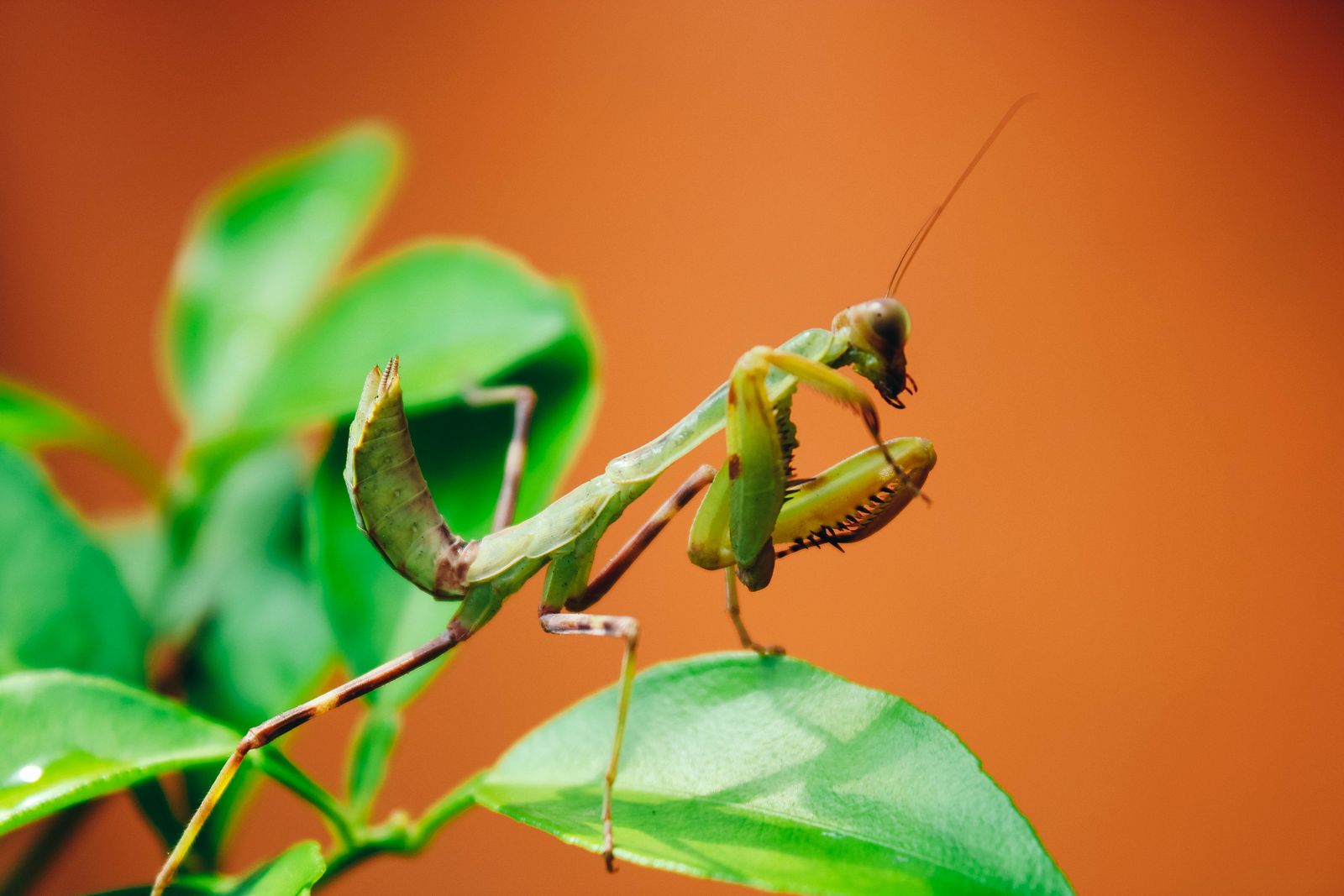
Two large Asian praying mantis species have established breeding populations across parts of Europe. The insects are reportedly eating native pollinators, killing native mantis males during mating, and pushing steadily northward as warming climates open new territory.
The species — Hierodula tenuidentata and Hierodula patellifera — have been present on the continent for roughly a decade. Their numbers have surged only recently, and biologists now say the window for containment through conventional means has effectively closed.

According to research led by Roberto Battiston of the Museum of Archaeology and Natural Sciences ‘G. Zannato’, the mantis species are expanding their range northward as climate conditions become more favorable. Battiston is the lead author on the paper documenting the invasion.
A predator with a reproductive edge
The Asian mantises are physically larger than Europe’s native Mantis religiosa, and they out-breed it. Each egg case, or ootheca, produces roughly 200 young — nearly twice the output of the native species. The egg cases themselves are small, only 2 to 3 centimeters long, and easily overlooked on tree bark, fence posts, or the wooden slats of garden insect hotels.
That reproductive arithmetic compounds fast. A single female whose ootheca survives the winter can seed a neighborhood. Multiply that across the warming suburbs of northern Italy, southern France, and parts of Central Europe, and the population curve bends sharply upward.
Mantises are ambush predators with catholic tastes. The invaders eat native insects, honeybees and other pollinators, and — more alarmingly for conservationists — protected small vertebrates including tree frogs and lizards.
Killing the competition, literally
The most striking impact on native mantis populations is not competition for food. It is sexual.
When native European male mantises attempt to mate with the larger invasive females, the encounters often end with the male being eaten before insemination. The invasive females are also killing native males in territorial disputes. The result is a slow demographic drain on Mantis religiosa populations wherever the two species overlap.
Cannibalism during mating is standard mantis behavior — female praying mantises regularly consume their partners across species. What the Battiston team describes is a mismatched version of that dynamic, in which the imported species is systematically consuming the reproductive capacity of the native one.
Climate change opens the door
The northward push is not incidental. Europe is warming faster than the global average, and the summer of 2026 has delivered another example: Spain, Portugal, France, and southern Britain sweltered through a heat surge in early July, with overnight lows in Madrid running nearly 9°C above the seasonal average.
Warmer nights matter for insects at least as much as hotter days. Mantises are cold-blooded. Longer stretches of frost-free weather extend the growing season for their prey and improve overwintering survival for egg cases. Urban heat islands accelerate the process, creating pockets of Mediterranean-like microclimates in cities well north of the species’ historical range.
The pattern mirrors what entomologists have documented for other range-shifting insects. European bark beetles, for instance, are projected to expand their distribution under warming scenarios, with cascading effects on forest ecosystems. Mantises are following a similar northward trajectory, only faster.
Cats, of all things, are the main predator
One of the odder statistics in the new paper: domestic cats account for 45% of recorded positive predation events on the invasive mantises. Birds, spiders, and other likely candidates are far behind.
That figure says less about feline hunting prowess than about where the data comes from. Most sightings are logged in gardens, on patios, and around houses — the same territory cats patrol. It also hints at how thoroughly these insects have moved into human-modified habitat rather than wild forest or meadow.
The researchers gathered more than 2,300 citizen science reports through GRIO, a monitoring network coordinated by William di Pietro and Antonio Fasano. Without that volunteer-generated dataset, the scale and pace of the invasion would have remained largely invisible to formal surveillance.
Why egg cases are the leverage point
Adult mantises are hard to catch and, by the time they are visible in late summer, have usually already mated. The oothecae are a different story. They are laid in autumn, glued to hard surfaces, and remain in place through winter — a stationary target for months.
Battiston’s team is urging the public to learn to identify the invasive egg cases and remove them during the cold months. A single ootheca destroyed in January is 200 mantises that never hatch in May.
Battiston emphasized the importance of citizen science programs for both monitoring invasive species and engaging the public in conservation efforts.
The identification is not trivial. Native Mantis religiosa egg cases are structurally different — smaller, more elongated, and often placed on grass stems rather than solid surfaces — but distinguishing them requires a decent field guide and some practice.
A pattern Europe keeps repeating
The mantis invasion fits a familiar template. Trade brings a species in, usually as a stowaway on ornamental plants or timber. Climate makes the destination more hospitable than it used to be. Urban environments provide unexpected refugia. By the time the species is officially designated invasive, it is already too established to eradicate.
Europe has been through this with agricultural pests, including efforts to protect Mediterranean crops from citrus-destroying invaders. The mantis case is different because the target is not agriculture but the wider food web — pollinators, small reptiles, amphibians, and native predatory insects that anchor local ecosystems.
Native mantises are considered biodiversity indicators. Where they thrive, the insect community around them tends to be healthy. Their decline is not just a loss of one species but a signal that something has shifted in the surrounding web of survival and extinction pressures.
What comes next
The researchers stop short of predicting where the northern limit of the invasion will settle. Climate projections suggest suitable habitat could extend into Germany, the Low Countries, and parts of southern Scandinavia within decades if current warming trends hold.
For now, the practical recommendation is narrow and unglamorous: walk through gardens and parks in winter, look for the distinctive 2-to-3 centimeter foam-like egg cases on tree trunks, walls, and insect hotels, and remove the ones that don’t belong. It is not a solution. It is a way to slow something that has already begun.