

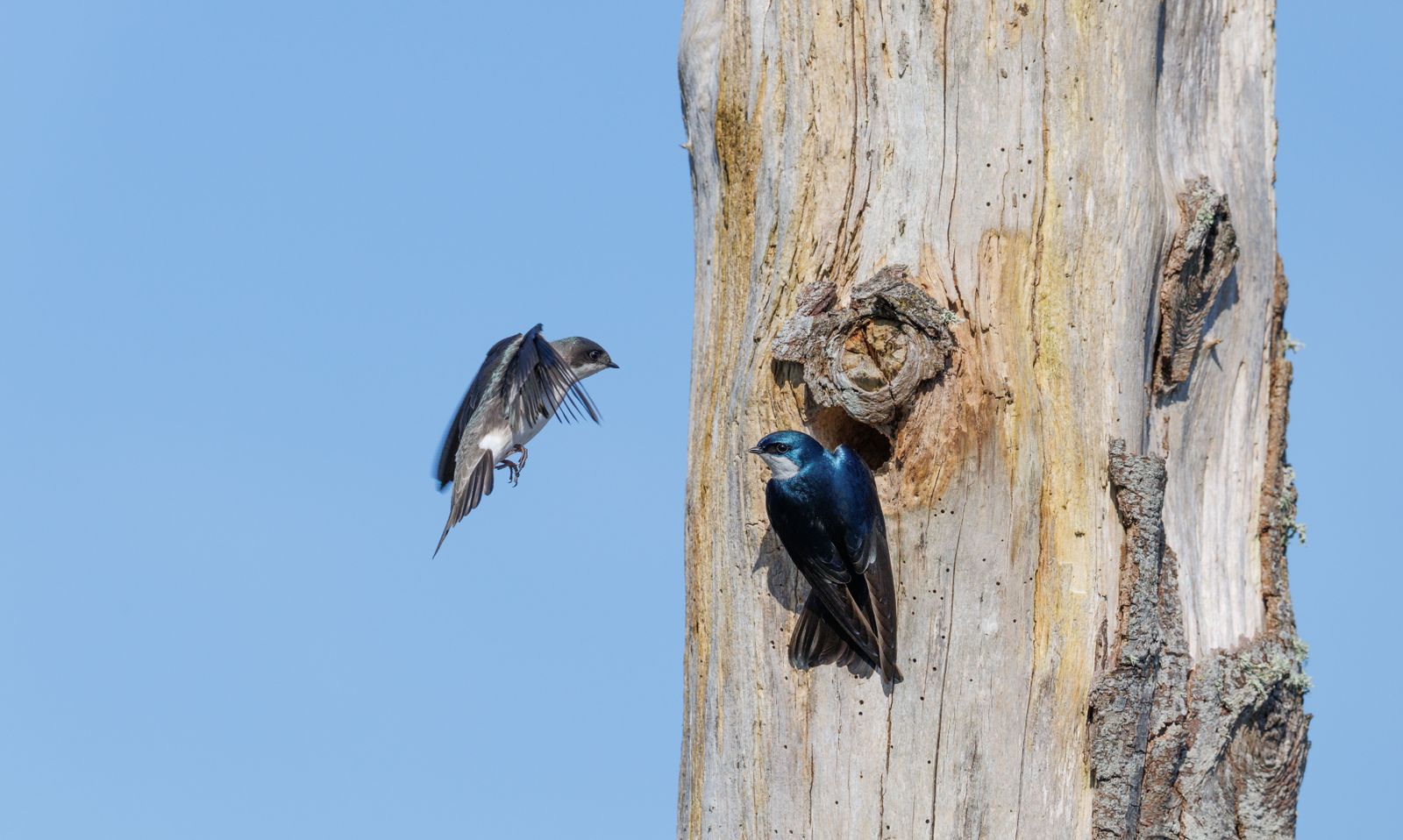
Taff and colleagues analysed long-term records from 123 tree-swallow populations and found that climate effects differed across latitude. Northern populations showed steeper abundance declines, while warming, temperature variability and the timing of breeding and insect availability can interact rather than operating as mutually exclusive causes.
The reason isn’t heat, exactly. It’s variability.
Northern populations are being hit by wilder swings in spring temperature — cold snaps that arrive after birds have already committed to breeding, killing the flying insects the chicks depend on. Southern populations, breeding in more thermally stable conditions, are riding out the same broad warming trend with fewer catastrophic nesting failures.
A bellwether species runs into trouble
Tree swallows have been a workhorse of climate-and-bird research for decades. They nest readily in boxes, tolerate human observers, and feed almost exclusively on aerial insects — a diet that ties their reproductive success tightly to weather. When a late-spring cold front knocks flying insects out of the air for three or four days, nestlings starve. When warm weather arrives early and holds, broods fledge.
That sensitivity has made the species a kind of living thermometer for North American songbirds. And the thermometer is now reading unevenly across latitude.

The pattern aligns with observations showing that inconsistent warming — not just higher averages — is what damages avian fitness. The signal is strongest where variability is climbing fastest, which in North America tends to be the higher latitudes.
Why the north gets hit harder
Three mechanisms appear to be stacking on top of one another for northern tree swallows.
The first is phenological mismatch. Swallows are cueing on day length and early warmth to begin nesting, but the insect emergence they depend on is governed by a different set of triggers — soil temperature, water temperature, and short-term weather. When the two signals decouple, chicks hatch into a food desert.
The second is cold-snap mortality. Warming, counterintuitively, is making late-spring cold events more consequential, because birds are breeding earlier and are further along in the nesting cycle when the cold hits. A four-day cold spell in mid-May now catches nestlings that in earlier decades would not yet have hatched.
The third is range-edge biology. Populations at the northern edge of a species’ range tend to have smaller effective population sizes, less genetic diversity, and fewer behavioral options — they can’t shift north again without running out of suitable habitat. Southern populations, by contrast, sit in the thick of the range, with more demographic slack to absorb bad years.
A pattern showing up across the continent
Tree swallows aren’t the only aerial insectivore in trouble. The guild — swallows, swifts, nightjars, flycatchers — has been declining across much of North America in recent decades. Aerial insect populations have declined across much of the temperate world, and the birds that specialize on them have followed.
What the tree swallow work adds is geographic resolution. Continent-wide decline statistics can hide the fact that some populations are collapsing while others are stable. The northern-versus-southern split suggests that conservation planning built on range-wide averages may be missing where the actual bleeding is happening.
Similar latitudinal splits have shown up in European migratory birds, with breeding populations facing the sharpest declines often being those most tightly coupled to conditions at specific non-breeding grounds — another case where averaging across a species masks acute regional vulnerability.
The insect problem underneath the bird problem
Any story about aerial insectivores eventually becomes a story about insects. Flying insect biomass has dropped sharply at some long-monitored European sites since the 1980s, and North American observations, though patchier, suggest similar trends. Pesticides, habitat loss, light pollution, and climate variability all contribute.
For a tree swallow raising four or five nestlings, the daily calorie math is unforgiving. Adults deliver hundreds of insect-loaded feedings per day during peak nestling growth. Cut the insect supply by a third and the brood is unlikely to fledge at full weight. Cut it by half during a cold snap and the brood is unlikely to fledge at all.
The northern squeeze is that both sides of that equation — the birds’ timing and the insects’ availability — are getting more erratic together.
What earlier springs are already doing
Long-running phenology datasets in Europe have documented some of the earliest springs on record in recent years, with butterflies, migrant birds, and flowering plants shifting weeks ahead of mid-20th-century baselines. The North American picture is similar, though noisier. Tree swallows in the northeastern United States are now laying eggs earlier than they did in the 1960s.
Earlier isn’t inherently worse. The problem is that earlier average laying dates and more variable year-to-year timing are arriving as a package. An advance in laying date buys nothing if one year in four brings a killing frost after hatching.
Implications for conservation
Wildlife agencies typically manage songbirds at the species level. The tree swallow findings argue for finer-grained thinking. If northern breeding populations are the ones absorbing the brunt of climate variability, then habitat protection, nest-box programs, and insect-friendly land management may need to be concentrated there — not distributed evenly across the range.
There’s also a research implication. Studies that pool data across latitudes risk washing out exactly the signal that matters. Population-specific monitoring, especially at range edges, is where climate impacts are most likely to show up first and most clearly.
A species still common, for now
Tree swallows remain one of the more numerous songbirds in North America. They are not endangered. That may be part of why the northern-southern divergence matters: it’s a chance to watch a climate response unfold in a species that still has population depth to study, before the pattern hardens into a listing decision.
The birds at the top of the map are running out of north to move to. What happens to them over the next two decades is a preview of what climate variability does to migratory songbirds when the escape hatch closes.