

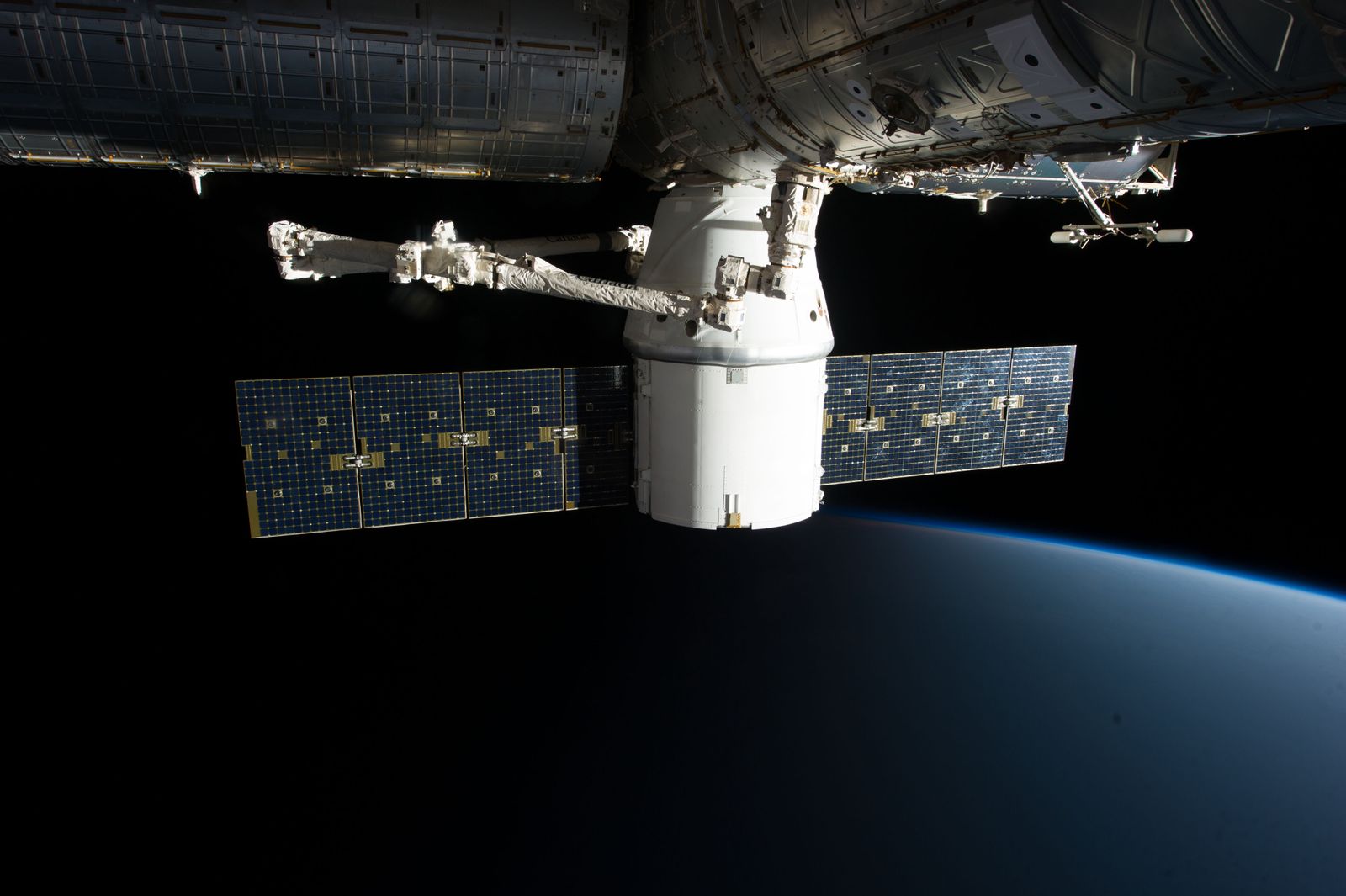
The International Space Station is falling. Right now, as you read this, the massive laboratory is losing altitude every day, sinking through the thin residual atmosphere at the top of Earth’s sky like a very slow stone. Left alone, it would be a smoking trail over the Pacific in a year or two. What keeps it up is not physics but plumbing: a Russian thruster bolted to the back of the station fires periodically, shoving the whole football-field-sized structure back into a stable orbit.
That is the deal that has kept a human being alive in low Earth orbit, without a single day’s interruption, for more than two decades.

The sky at 400 kilometers is not empty
The ISS orbits at an average altitude of several hundred kilometers — roughly the distance from London to Paris, laid on its side and pointed at the stars. At that height, most people picture the vacuum of space. It is not quite vacuum. There are still stray molecules of nitrogen, oxygen, and atomic oxygen up there, whipped into a hot, tenuous soup by ultraviolet light from the Sun.
The station plows through that soup at high velocity. Every solar panel, every radiator, every antenna is a sail catching a headwind that is almost — but not quite — nothing.
The drag is minuscule per square meter. The station is enormous. Multiply the two together and you get a steady, unrelenting brake. The station experiences measurable altitude loss each day, though the exact number swings with solar activity. When the Sun is angry, it puffs the upper atmosphere outward, and the station falls faster. When the Sun is quiet, it falls more slowly. Either way, it falls.
Why the Sun makes the station heavier
The thermosphere — the layer the ISS lives in — expands and contracts like a lung. During solar maximum, extreme ultraviolet radiation heats the upper atmosphere and pushes gas molecules higher. The density at the station’s altitude can double or triple. That means twice or three times the drag on the station, and twice or three times the altitude loss per orbit.
The current solar cycle has been active in recent years, which is why reboosts have been happening more often than they did in the quieter years around 2019. The Sun is quite literally making the ISS heavier to hold up.
This is also why Starlink satellites, which live at lower altitudes, burn through propellant at a rate their operators plan for years in advance. Below a certain threshold, drag is the tax you pay to stay in orbit.
The Russian engine that keeps America in the sky
The station has no engines of its own. The reboost job falls to whatever spacecraft happens to be docked at the aft port of the Zvezda service module — the same Russian-built module that has been leaking air and prompted astronauts to shelter in their Crew Dragon capsule during an evacuation drill.
Usually the reboost is done by a Russian Progress cargo freighter. Progress is an uncrewed, disposable spacecraft, about the size of a small van, that arrives every few months with fuel, food, and equipment. Once it has been unloaded, it stays docked and becomes, in effect, the station’s engine. When mission controllers in Moscow want to raise the orbit, they command the Progress to fire its main engines for anywhere from a few minutes to nearly half an hour.
A typical reboost adds velocity to the station. That tiny nudge translates, through orbital mechanics, into extra altitude. Do it regularly and the station stays in its operational corridor.

Why it has to be Russian
The docking ports on the American side of the station were not designed for propulsion. When Boeing, Lockheed, and their partners bolted the U.S. Orbital Segment together in the late 1990s and early 2000s, the assumption was that Russia would handle reboost forever. Zvezda’s aft port carries the plumbing and the structural reinforcement to take engine thrust. The U.S. ports do not.
That assumption held through two decades of otherwise fraying cooperation. Cygnus, the American cargo freighter built by Northrop Grumman, has demonstrated reboost capability — the first non-Russian vehicle to nudge the station’s orbit. But Cygnus can only add a fraction of what Progress delivers, and the primary job is still Russian.
This is one reason the air leaks in Zvezda are more than an inconvenience. That module is not just a corridor. It is the anchor point for the engines that keep the whole structure from falling out of the sky. NASA and Roscosmos have been debating how to handle the widening cracks.
The math of a slow fall
Here is the arithmetic that keeps flight controllers awake. Without regular reboosts, the station would steadily lose altitude over months. Below a certain threshold, atmospheric drag becomes exponential. Below that, the fall is measured in days, not months. Eventually, the structure begins to break apart from heating.
Skylab, America’s first space station, made this trip involuntarily in 1979. It reentered over the Indian Ocean and Western Australia after a solar maximum puffed the atmosphere up and dragged it down faster than NASA had modeled. The ISS is much heavier than Skylab. It would not go quietly.
Which is why, when the station is finally retired, the plan is not to let it fall. NASA has contracted SpaceX to build the U.S. Deorbit Vehicle — a spacecraft whose entire job is to attach to the ISS and shove it, hard and precisely, into a controlled reentry over the South Pacific.
Sixteen sunrises a day, and counting
The ISS completes one lap of the planet roughly every 90 minutes. The crew sees 16 sunrises and 16 sunsets in each 24-hour period. In the time it takes you to read this article, the station will have moved thousands of kilometers across the sky and dropped measurably closer to the ground.
You can see it yourself. On a clear night, it passes overhead as a steady, unblinking star, brighter than Venus, tracking west to east in a few minutes. Amateur trackers have built desktop pointers that use publicly available two-line element sets — the standard orbital data format — to keep an arrow aimed at the station in real time. The TLEs update every few hours, because the orbit is always changing.
That is the ghost in the machine of every ISS tracker: the orbit you calculated yesterday is not quite the orbit today. Drag has eaten a little more of it.
What lives at 400 kilometers
The station shares its neighborhood with a growing crowd. Starlink’s operational satellites orbit in the same general region. Chinese Tiangong flies at a similar altitude. Thousands of pieces of debris, ranging from flecks of paint to spent rocket stages, drift through the same shell of space.
The ISS has performed numerous debris-avoidance maneuvers over its lifetime, each one a small reboost or side-step commanded from the ground when the U.S. Space Surveillance Network flags a close pass. Those maneuvers also add altitude, which is why the reboost schedule is not a metronome. It is a running negotiation between drag, debris, and the delivery schedule of Russian cargo ships.
Low Earth orbit is becoming an increasingly important strategic environment, with the ISS as a key asset. A nuclear detonation in that shell of space would be catastrophic — such an event could destroy satellites and render orbits unusable for years.
The 1962 Starfish Prime test, a high-altitude nuclear detonation over the Pacific, destroyed a third of the satellites in orbit at the time. There were fewer than 100. Today there are more than 10,000.
The station’s weight problem
The ISS is massive — hundreds of tonnes. It is pressurized to one atmosphere across a volume larger than a six-bedroom house. Every gram of that mass is fighting the same drag every second. When Progress fires its engines, it is accelerating the whole thing — habitats, solar arrays, science racks, the trash bags in the airlock — and that is enough.
The propellant budget is tight. A Progress freighter carries fuel dedicated to reboost. Over a year, the station burns through substantial propellant just to stay level. Multiply that by more than two decades of continuous occupation and the sheer volume of Russian propellant hauled uphill to keep the American laboratory in the sky becomes one of the quiet, unglamorous facts of the space age.
What happens when the fuel stops
The station is scheduled to be retired in the early 2030s. Congress is debating extensions to give commercial companies more time to build replacements. Axiom, Vast, Blue Origin, and Voyager Space all have proposals to build private stations that NASA would rent room on, rather than own outright.
Whichever year the last hatch closes, the physics of the final descent will be the same. The deorbit vehicle will fire its thrusters not to raise the orbit but to lower it — a reverse reboost, dragging the station down into thicker air over the South Pacific until aerodynamic forces tear it apart. Aluminum will melt. Titanium fittings will glow. Most of the structure will vaporize at high altitude. A few dense components — gyroscopes, docking ring metal, some of the truss segments — will hit the water.
Until then, periodically, a Russian engine will fire in the dark above the Pacific, and the largest thing humans have ever built in space will climb back up the hill it has been falling down since the day it was assembled.
Somewhere overhead right now, it is falling. And soon, something will push it back.