

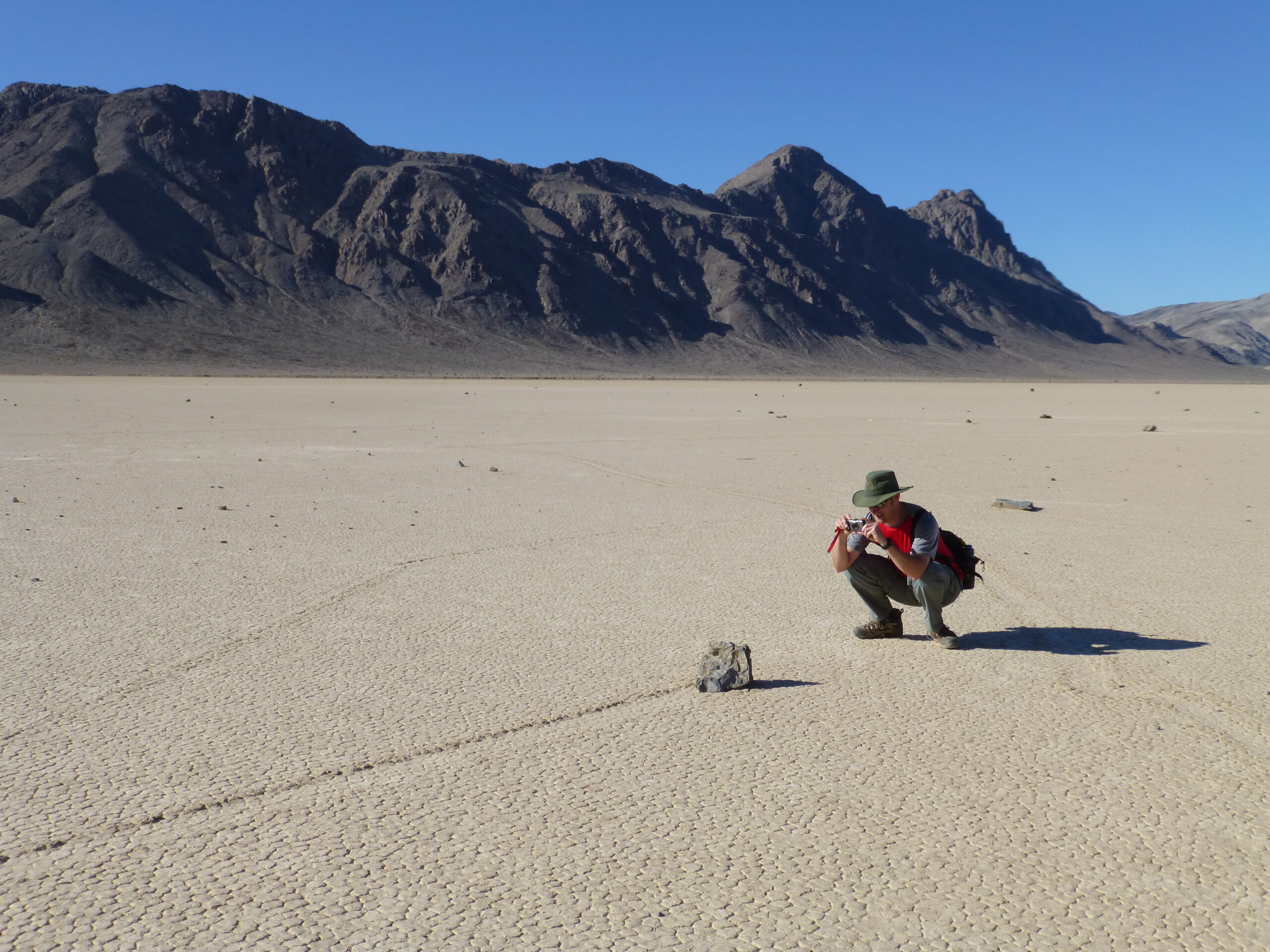
Across a dry lakebed in one of the hottest places on Earth, heavy rocks leave long trails in the mud as if they have travelled under their own power. Some paths run straight for hundreds of metres. Others bend, cross or stop abruptly. For decades, researchers could inspect the tracks left behind at Racetrack Playa in Death Valley, but nobody had scientifically documented the stones while they were actually moving.
The answer finally arrived during a rare winter combination of rain, freezing nights, morning sun and light wind. Cameras and GPS instruments recorded rocks sliding across the wet lakebed at walking pace or slower, pushed by enormous sheets of ice only a few millimetres thick.
The rocks were not lifted and carried on ice rafts. Instead, broad floating panels of melting ice pressed against rocks that remained in contact with the soft mud. A breeze that would barely attract attention could move a sheet tens of metres across, giving it enough area to push multiple stones at once.
A mystery written into the mud
Racetrack Playa is a remarkably flat basin in a remote valley between the Cottonwood and Last Chance ranges. Rain occasionally floods the fine sediment, forming a shallow temporary lake. When the water evaporates, the mud dries into a hard mosaic of polygons. Rocks that tumble from the surrounding slopes end up scattered across this surface.
Many of those stones have trails extending behind them. The National Park Service describes the Racetrack as a dry lakebed famous for rocks that have travelled as far as 1,500 feet, or about 457 metres. Some weigh hundreds of kilograms.
The tracks proved that movement occurred, but the desert rarely supplied witnesses. Events required enough rain to cover part of the playa, cold nights to freeze the water and the right wind and temperature as the ice began to thaw. Rocks could remain stationary for years. By the time visitors arrived, the water and ice had disappeared, leaving only a stone and its unexplained groove.
Proposed explanations included hurricane-force winds, dust devils, slippery algae, seismic vibrations and several versions of an ice mechanism. Ice was a strong candidate well before the decisive observation, but researchers disagreed about whether thick ice floated the rocks, whether frozen collars acted as sails, or whether sheets of ice shoved them along the ground.
An experiment designed to wait
In 2011, a research team led by Richard Norris and James Norris installed a weather station near the playa, positioned time-lapse cameras and placed 15 specially prepared rocks fitted with motion-activated GPS units. They expected that the experiment might wait for years before the right weather arrived.
In late November 2013, rain and snow created a shallow pond several centimetres deep across part of the playa. Overnight freezing produced a transparent layer of ice. On 20 December, the researchers arrived to find the pond still frozen, then watched as the late-morning sun began to weaken it.
The ice cracked into panels tens of metres across. Winds of roughly 4 to 5 metres per second, about 14 to 18 kilometres per hour, pushed the floating sheets across the water. The panels pressed against exposed rocks and slowly drove them through the soft mud below.
The team’s 2014 study in PLOS ONE reported the first direct scientific observation of the rocks in motion. The ice was only about 3 to 6 millimetres thick. The stones moved at roughly 2 to 5 metres per minute, slow enough to look almost still without a fixed reference but fast enough to carve visible tracks.
More than 60 rocks moved together
The largest observed event on 20 December involved more than 60 rocks. Some instrumented stones travelled up to 224 metres through multiple movements between December 2013 and January 2014. In one episode, rocks hundreds of metres apart started moving at about the same time, demonstrating that a broad environmental force was acting across the playa.
The GPS records, weather measurements, photography and direct observation all told the same story. According to the Scripps Institution of Oceanography’s account of the discovery, the researchers documented five movement events while the temporary pond existed, with some involving hundreds of rocks.
Not every stone moved together, even when neighbouring tracks appeared parallel. The ice fractured and thinned unevenly. One panel could push a group of rocks while another rock remained separated from it. Changes in wind and water flow altered the direction of travel. These details explain why some trails diverge, why a stone can stop while others continue and why apparently coordinated paths are not always identical.
A related study of trail formation during the same winter combined video, time-lapse imagery, meteorological measurements and GPS tracking. It found that fracture and local thinning of the ice could decouple individual rocks from the moving sheet, allowing only part of a group to travel during a given event.
Why such thin ice can move heavy stone
The mechanism works because the wind acts over the broad surface of an ice panel, not just the small face of a rock. A light breeze exerts little force on an isolated stone. Spread that pressure across a floating sheet tens of metres wide, however, and the total force becomes much larger. The shallow water supports the ice and allows it to move with relatively little resistance.
At the same time, the saturated clay beneath the rocks becomes slick enough for them to slide while remaining firm enough to preserve a groove. The ice does not need to be strong enough to lift a boulder. It needs only to stay sufficiently coherent to transmit force from the wind to the stone.
This distinction overturned the more dramatic versions of earlier ice theories. The observed process did not require thick slabs carrying rocks above the surface or violent winds sweeping them across the desert. The complete open-access record of the experiment describes “windowpane” ice beginning to melt in the late-morning sun while modest winds drove floating panels into rocks resting on the playa.
The solution depended on a rare sequence
Death Valley’s reputation for heat makes ice seem implausible, but Racetrack Playa lies at roughly 1,130 metres above sea level and can freeze during winter nights. The necessary sequence remains unusual. There must first be enough precipitation to form a pond. The water must freeze into a broad sheet, then begin thawing while enough liquid remains beneath it to let broken panels float. Finally, wind must arrive from a useful direction before the pond vanishes.
That rarity is why generations could see fresh tracks without seeing them form. It also shows why a plausible explanation is not the same as a demonstrated one. Ice and wind had been discussed for decades, but only continuous instruments and the good fortune of researchers being present during the right morning linked the forces to specific movements in real time.
The mystery is solved at the level of the observed events, though not every historical trail must have formed in precisely the same way. Rock size, water depth, wind, ice geometry and the condition of the mud can vary. Researchers have also examined movement by wind alone under some circumstances. The 2013 and 2014 observations nevertheless provided a complete, measured mechanism capable of producing the Racetrack’s signature trails.
The site remains fragile. Footprints and tyre marks made while the playa is wet can persist and interfere with both the landscape and future rock movement. The National Park Service asks visitors not to move or remove stones and provides an official photographic record of a sailing stone and its track.
What looked like a desert impossibility turned out to require no extraordinary force. A shallow pond, a night of freezing temperatures, sunlight, a thin sheet of ice and an ordinary breeze were enough. The rocks seemed to move in secret not because the process was violent, but because it was quiet, slow and exceptionally rare.