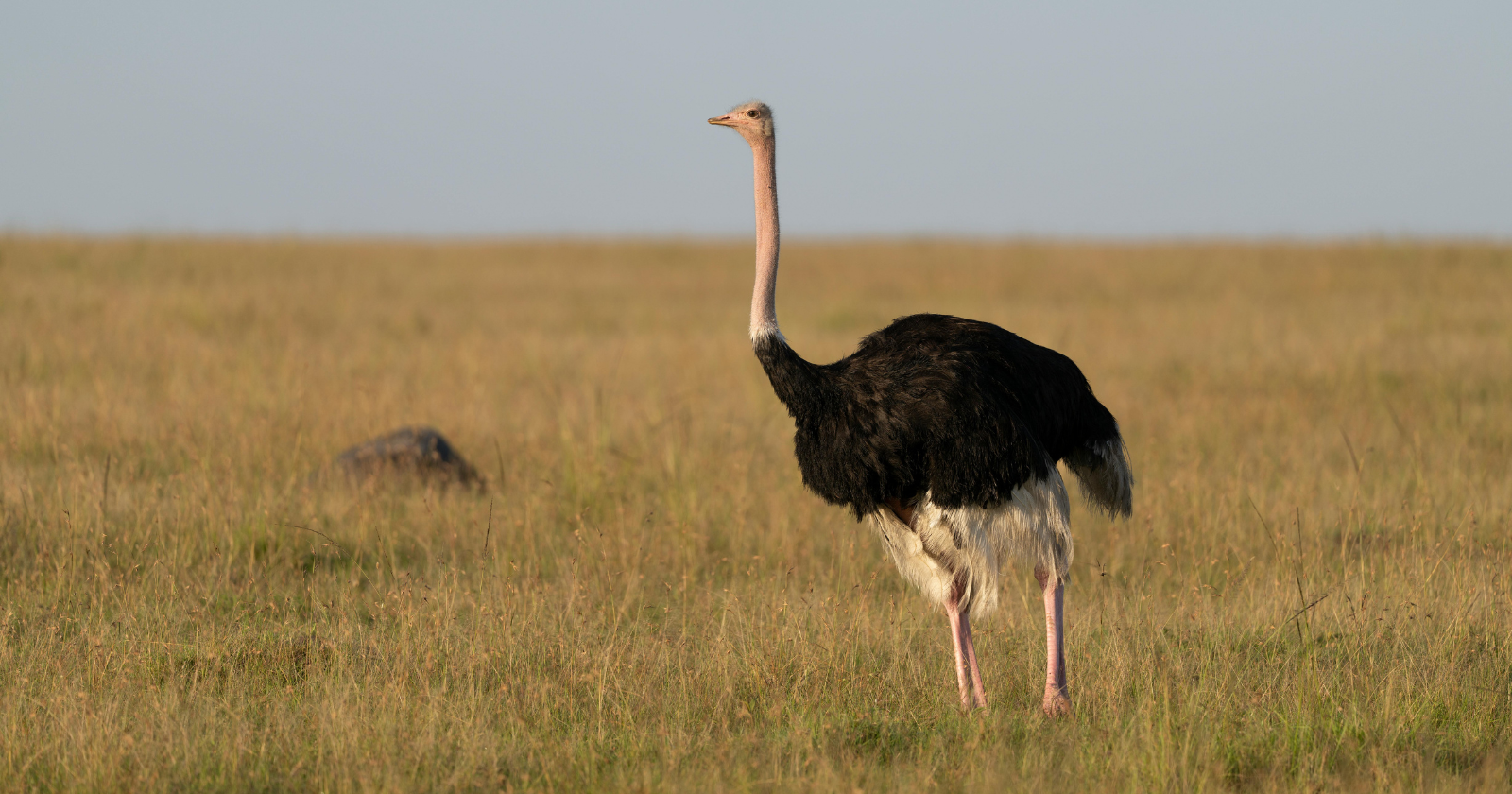
The bird with the most famous survival trick has never actually done it. An ostrich with its head packed into sand wouldn’t be hiding — it would be smothering itself.
The two things ostriches really do are stranger, and more useful, than the legend.
A claim that cannot survive first contact with biology
The image is simple and it sticks: a frightened ostrich, head plunged into the sand, body left comically exposed. It shows up in cartoons, in sayings, and in office metaphors about denial. It is also impossible. A head packed into sand cannot draw breath, and a big bird cannot hold that pose without suffocating. National Geographic Kids puts it plainly: “Ostriches don’t bury their heads in the sand—they wouldn’t be able to breathe!”
There is a second problem. An ostrich in danger has a much better option than hiding. It is the fastest-running bird alive, reaching about 70 km/h (43 mph). A bird that can sprint that fast has little need for a hole in the ground.
What people actually watched: eggs being turned
So where did the image come from? The likeliest answer is the nest. Ostriches scrape a shallow dip into open ground, and the bird lowers its head into that dip many times a day to reach the eggs.
What the head is doing down there is careful work. The bird uses its beak to turn and reposition the eggs several times a day. Glinda Cunningham of the American Ostrich Association told National Geographic that “if you see them picking at the ground from a distance, it may look like their heads are buried in the ground.” The nest helps the effect along. These scrapes are shallow, broad depressions cleared into open ground, and a head dipped into one really does drop out of a distant viewer’s line of sight.
The second behaviour: going flat to vanish
The other source of the myth is a defence that works by disappearing rather than running. When a quick escape isn’t possible, the bird drops. The Cleveland Zoological Society describes it: “when an ostrich senses danger and cannot run away, it will flop to the ground and remain still, attempting to blend in with the terrain.” It stretches its neck flat along the earth and holds still, letting its colour blend into the dry ground.
From any real distance, a motionless ostrich pressed to the ground with its neck stretched out could look like a bird that has lost its head. The neck lies in a low line the eye struggles to pick out against sand and scrub. The illusion is close to the obvious first reading.
Why a small head on a huge body finishes the trick
Both behaviours fool us for the same reason: the ostrich’s shape. It is the largest living bird, standing over 2.8 m (9 ft) tall and weighing up to 150 kg (330 lb) in the biggest males, per Birdfact. That huge body carries a small head on a thin neck. Drop the head low, whether into a nest or flat against the ground, and the part that vanishes is tiny while the part left behind is unmistakable. The eye sees the big pale body, cannot find the head, and fills in the story it already knows.
What the myth actually records
The head-in-the-sand ostrich is a misreading that hardened into fact. Two real behaviours, turning eggs in a scraped ground nest and flattening to hide, both drop the head out of sight while the body stays fully visible. Add a small head on the largest bird alive, and a distant observer needs no cartoon to reach the wrong conclusion. The legend persists because it was an easy mistake to make. The bird tending its eggs, or lying dead-still against the ground, was doing something more considered than the myth ever gave it credit for.