

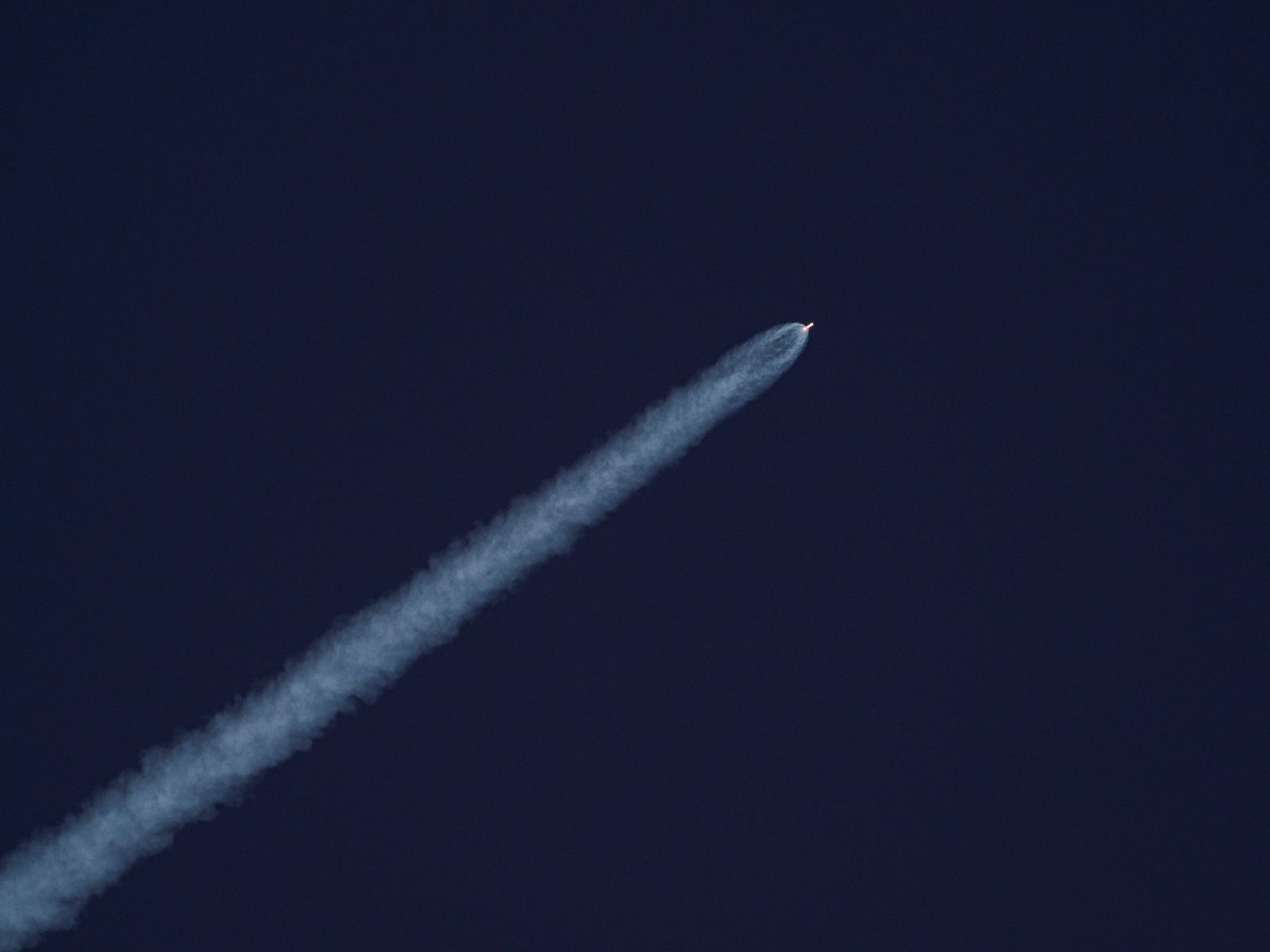
India joined an exclusive club on Saturday when Hyderabad-based Skyroot Aerospace lifted its Vikram-1 rocket off a pad at Sriharikota and delivered six payloads into low Earth orbit, becoming the first private Indian company to reach orbit and making India only the third country — after the United States and China — with a domestic private-sector orbital launch capability.
The seven-storey vehicle left the Indian Space Research Organisation’s spaceport at 12:05 local time and flew for roughly 16 minutes, reaching an altitude of about 450 kilometres before releasing its payloads, according to the BBC. Skyroot announced on social media that the test flight had successfully reached orbit.

The mission, called Aagman — Sanskrit for “arrival” — is the first of two planned test flights this year, with commercial service slated to begin in 2027. It arrives at a moment when India’s civil space program is stacking up ambitious targets of its own, including a crewed orbital flight next year, a Venus orbiter by 2028, and a national space station by 2035.
A rocket named for a founder, built by his successors
Vikram-1 is named for Vikram Sarabhai, the physicist widely regarded as the architect of India’s space program. Skyroot itself was founded in 2018 by Pawan Kumar Chandana and Naga Bharath Daka, two former ISRO engineers who left the agency to build launch vehicles for the small-satellite market. The company recently crossed a $1.1 billion valuation, making it India’s first space-tech unicorn, Phys.org reported.
The rocket is small by orbital-class standards. It can carry payloads of up to 350 kilograms, aimed squarely at the smallsat operators who currently rely on rideshare slots on larger vehicles and often wait months, sometimes years, for a launch that goes to roughly the orbit they want.
Chandana has described the company’s business model as providing on-demand access to space, comparing it to ride-sharing services versus traditional mass transit.
What flew on Aagman
Six payloads rode Vikram-1 to orbit. They include a robotic arm designed to test techniques for capturing space debris, an Earth-observation camera, and satellites from Indian and international customers, among them a German firm. The debris-capture experiment is a small but pointed signal about where the small-launch industry sees future demand — a topic examined in Science Blog’s earlier reporting on the economics of orbital cleanup.
Two payloads are symbolic. One is a lotus flower carved from lab-grown diamonds, produced by Cosmos Diamonds and named Cosmic Bloom. The other is a tiny gold rocket carrying three micro-sculptures, each smaller than a grain of rice, of Sarabhai, Nobel laureate physicist C.V. Raman and aerospace engineer and former Indian president A.P.J. Abdul Kalam.
Chandana said the payloads were tributes to India’s space pioneers, acknowledging the foundation they built for today’s private space industry.
Why India’s private sector is only now reaching orbit
The gap between India’s civil space achievements and its private launch industry has been striking. ISRO landed a spacecraft near the lunar south pole in 2023, put an orbiter around Mars on its first attempt, and operates one of the cheapest heavy-launch services in the world. Yet until 2020, private companies were effectively barred from building and flying their own rockets.
That year, the Indian government opened the sector, allowing private firms to develop launch vehicles and satellites and to use ISRO’s ground infrastructure. The stated goal is to lift India’s share of the global commercial space market from about 2 percent today to roughly 10 percent by 2030. More than 400 space startups have registered since the policy change, Al Jazeera reported, though Skyroot remains the only one to have reached unicorn status — and now, orbit.
Skyroot’s suborbital Vikram-S flight in November 2022 was the first private Indian rocket to leave the atmosphere. Saturday’s launch closes the much harder gap between suborbital and orbital flight, a threshold that separates a hobby-scale industry from a commercial one.
The smallsat market Skyroot is chasing
The company’s closest analogue is Rocket Lab, the U.S.-New Zealand firm whose Electron rocket has spent most of a decade proving that small dedicated launchers can carve out a market alongside SpaceX’s rideshare model. Rocket Lab has also become a preferred contractor for defense customers who need to launch on short notice; last month it delivered a satellite for the U.S. Space Force’s Victus Haze mission just 16 hours and 42 minutes after receiving notice, according to Space.com.
Small dedicated launches are more expensive per kilogram than rideshare slots on a Falcon 9. What customers pay for is control — a specific orbit, a specific inclination, a specific date. For operators building constellations that need replacement satellites in precise planes, or for defense customers who cannot wait for the next Transporter mission, that control is worth a premium.
Skyroot expects 70 to 80 percent of its business to come from customers outside India, in sectors including agriculture, fisheries, disaster response, telecommunications and national security. The company says its Hyderabad factory can produce one Vikram-1 per month.
What comes next
A second test flight is planned before the end of the year, with commercial launches scheduled to begin in 2027. Between now and then, Skyroot will have to prove what every new launch provider has to prove: that Saturday’s success was not a one-off. Orbital rocketry punishes small manufacturing errors severely, and the graveyard of small-launch startups is crowded — Virgin Orbit, Astra, ABL and others have folded or pivoted after early failures.
India’s regulatory environment adds another variable. The Indian National Space Promotion and Authorisation Centre, or IN-SPACe, was set up in 2020 to license private launches and broker access to ISRO facilities, but companies have complained about slow approvals and unclear rules on foreign customers and defense payloads.
If Skyroot can hold its promised monthly production cadence and win international customers away from Rocket Lab, Firefly and China’s growing roster of private launchers, the arithmetic on India’s 10-percent market-share target starts to look less aspirational. If it cannot, Saturday’s flight will still stand as a milestone — the moment India’s private sector proved it could reach orbit on its own hardware.
Either way, the country now has something it did not have a week ago: a commercial rocket that works.