

Revolutionary technology has rejuvenated rats using exosomes from young pigs. The potential for translation to humans beckons us, but progress has been slow. The medical field, including aging medicine, is dominated by corporate science, and there is no clear path to controlling the intellectual property associated with exosomes. Nevertheless, there have been some interesting and promising developments in the last year.
I believe that the body ages on a schedule. The schedule is governed by a biological clock — perhaps distributed through the body or perhaps localized in the hypothalamus. Information about age is distributed through the body via signal molecules in the blood, most probably encapsulated in exosomes. Somatic cells everywhere adjust their gene expression in accordance with the age state that is communicated to them by these signal molecules.
The body has an aging clock that broadcasts instructions to every cell, informing age-appropriate behavior, including self-destructive behavior like chronic inflammation and curtailment of ROS quenching. Evidence from parabiosis experiments suggests that when an old cell gets a young signal, the cell knows how to repair itself back to a younger state.
My best guess is that the body’s aging clock is partially distributed in the form of shortened telomeres and age-modified methylation patterns, partially centralized. The best candidate for the central coordinating agent is the suprachiasmatic nucleus, which is part of a neuroendocrine area of the brain called the hypothalamus.
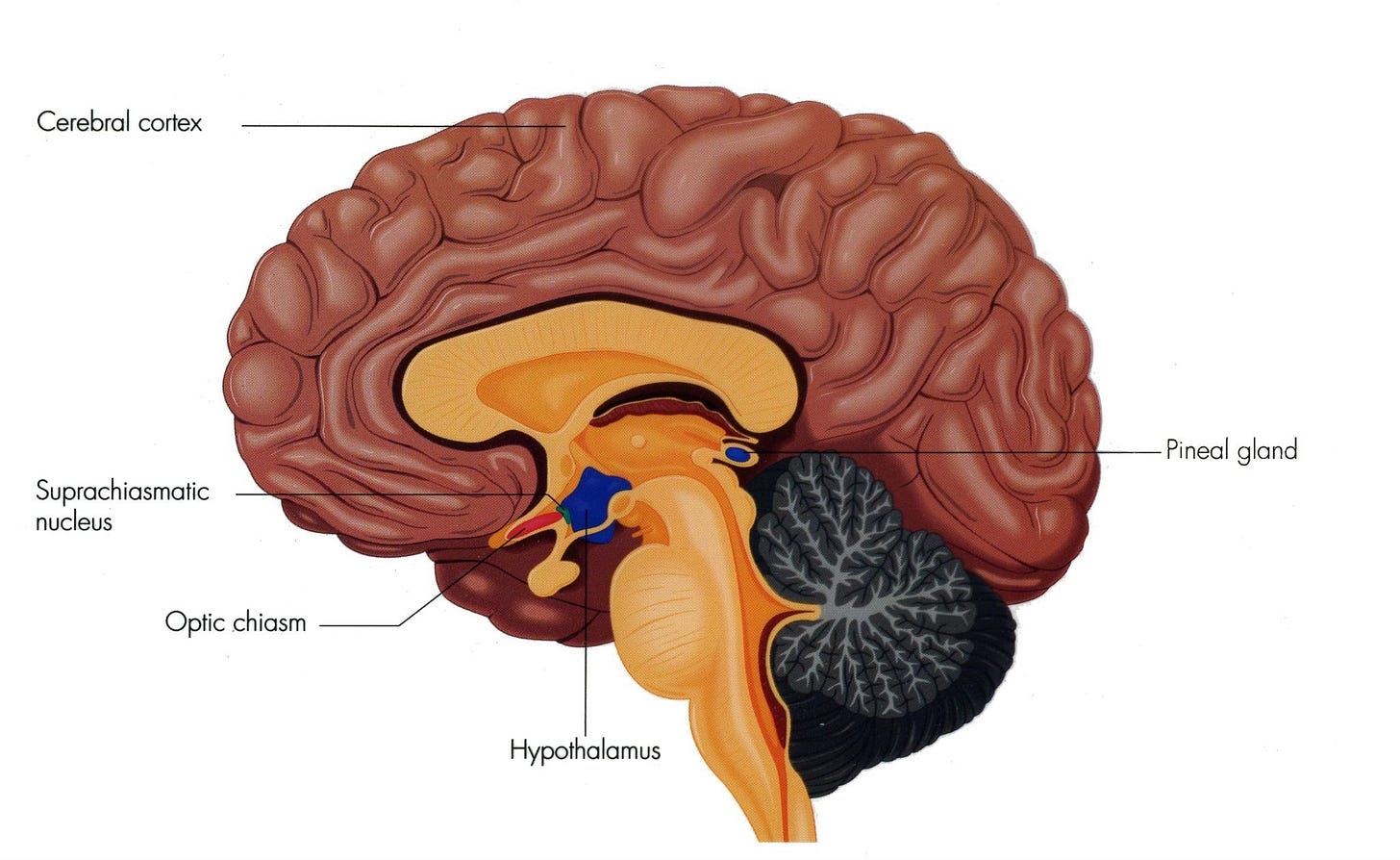
Image from Wikipedia, original artwork of 黄雨伞
Six years ago, I reported a breakthrough in rejuvenation technology, from Harold Katcher’s lab in Mumbai. A blood plasma fraction injected into the blood of old rats made them young again, by almost every measure. The plasma fraction was later revealed to be one size-class of exosomes.
Exosomes are natural lipid nanoparticles, emitted and received by cells all the time and traveling not only through the bloodstream but also through the air. Exosomes contain a mix of signal molecules — small RNAs, proteins and DNA fragments — that exchange information within a body, outside the body, even across species. The molecular information in exosomes is in a language that biologists are just beginning to decode. But we know enough to support the hypothesis that exosomes constitute a universal communication language across all biological species. So it was an inspired guess that led Katcher to test whether exosomes were the medium by which age information is communicated across the body.
Modifying exosome communication is not setting back the body’s clock, but it is the next best thing, intervening at the level where age information is communicated through the body.
In the paradigm where aging is an accumulation of molecular and structural damage, the only way to reverse biological age is to repair that damage at every level and in every cell.
In contrast, the programmed aging paradigm posits that the body always knows how to be old and knows how to be young. The body will respond appropriately to signals telling it what age to be (until the last stages when repair mechanisms are so degraded that they are not up to the task).
If we could reset the body’s clock[s], the body would take care of the rest. If we cannot, the next best thing is to modify the signal molecules in the blood to emulate the signals that would be coming from a younger clock.
I was optimistic six years ago that once the principle had been established, anti-aging technology would progress rapidly toward human applications. I’ve been calling for this research in my writings and at every conference where I speak. I’ve been disappointed.
Nevertheless, several research groups around the world have picked up this topic and produced some noteworthy recent results.
What is special about the SCN?
The Suprachiasmatic Nucleus is a neuroendocrine organ, meaning that it can both process information and send out hormonal signals. It is the area that coordinates time information for the 24-hour circadian clock. In contrast to circadian rhythms, the developmental clock is a complete mystery. We don’t know the mechanism that sets sexual maturity in motion, or what controls the timing of wisdom teeth. My presumption is that that same clock continues to schedule senescence.
Jim Larrick and Andy Mendelsohn identified the role of the hypothalamus in aging very early.
Dongsheng Cai at Einstein Medical College, NYC and Claudia Cavadas at University of Coimbra in Lisbon have done extensive work documenting the role of the hypothalamus in aging. Both Cai and Cavadas identified inflammation in the hypothalamus as a high-level cause of the stem cell losses that deprive the body of signals that maintain youth. The older, inflamed hypothalamus is the source of NFκB that is a well-known age accelerator.
Here is a review of what is known about the hypothalamus and aging.
Recent articles in this area
A Chinese research group extracted exosomes from the brains of young rats. The exosomes so derived were shown to have powerful effects in promoting healing of skin wounds (also in rats). [Link] Fibroblasts are a kind of stem cell for skin. The brain-derived exosomes reprogrammed senescent skin fibroblasts, restoring them to an active, useful state.
Endothelial cells line our blood vessels and play a crucial role in the etiology of cardiovascular disease. This article by a group at Columbia University reports success in making endothelial tissues younger and skin healthier and more elastic with (young) exosomes derived from umbilical cords, and conversely accelerated aging effects from injecting (old) exosomes derived from older mice. Experiments were performed on mice using a microneedle array to deliver exosomes under the skin, an advance from earlier techniques that involved a delicate operation finding veins in the base of the tail. The authors also report preliminary progress in characterizing the difference in chemical content between old and young exosomes.
This Chinese review article (published just this past spring) describes some of the experimental successes with exosome therapies. “Astrocyte and MSC-derived EVs deliver neuroprotective miRNAs, growth factors, and antioxidants that attenuate ischemic damage, promote angiogenesis, and support neuronal survival. Intravenous administration of EVs has been shown to reduce infarct volume and improve neurological outcomes in experimental stroke models. Beyond their pathogenic roles, EVs exert robust protective effects in ischemic stroke by coordinating angiogenesis, neurogenesis, and stabilization of the blood–brain barrier (BBB). Stem cell–derived EVs transport therapeutic proteins and regulatory RNAs that modulate angiogenic signaling pathways, thereby enhancing neovascularization within ischemic regions…Extracellular vesicles can transport intact mitochondria or mitochondrial components to injured cells, thereby rescuing cellular energy metabolism after stroke.”
Here’s a Korean review article on the nexus between the hypothalamus and aging. “Functional changes in a group of the hypothalamic neurons contribute to age-associated decline in energy homeostasis, hormone balance, circadian rhythm, and reproduction.” Lifespan, of course, is not a single programmed number but a flexible range, dependent on factors including the availability of food. These authors claim that the calculation of programmed lifespan is here in the neurons of the hypothalamus.
The research team of Vadim Fraifeld at Ben Gurion University has been studying the effects of youthful exosomes on senescent cells. Previously, senolytics have been used to remove senescent cells, lengthening lifespan in mice. Fraifeld finds that exosomes can transform senescent cells such that they no longer emit inflammatory cytokines that accelerate aging. [Link]
Looking to the future
This paper from Chile is the only one that is couched explicitly in the premise that aging is a life history program, implemented from a clock in the hypothalamus. It is an ambitious attempt to analyze and catalog some of the chemical species emitted by the young hypothalamus and responsible for rejuvenation. The chemistry is over my head, but the executive summary is that micro RNAs packaged in exosomes, are prime suspects. The same paper names the biochemical pathways that these RNAs are likely to affect. Genes they name include genes Cdkn2a, Rps27, Txnip, Cdkn1a and Btg2.
“Hypothalamic stem cells actively secrete exosomal miRNAs, and exosomes derived from htNSCs can attenuate age-related declines in cognitive abilities and muscle function when administered to mid-aged mice” [Ref] The referenced article is from Dongsheng Cai (2017) and reports accelerated aging when hypothalamic stem cells are ablated (in a mouse model). More impressive, the same paper reports life extension (also in mice) by transplanting young hypothalamic stem cells into the brains of middle-aged mice. The implication is that signals from these cells instruct the body to remain (or become) young.
The prospect of sourcing exosomes from young brain material is promising, but the path to human therapeutics is not clear. One possible path is to rejuvenate stem cells in the hypothalamus of an aged patient. This is exactly what works so well in mouse experiments, but it involves sacrifice of the donor mouse and highly invasive brain surgery in the recipient. A second, barely more feasible pathway is to extract exosomes derived from the brains of young donors and inject them into the bloodstream of the recipient. This strategy bypasses the brain surgery, but there is a need for many young donors and an ongoing series of exosome injections.
This study by a large Korean research group appears to offer a solution to the dilemma. (Though it is more than a year old, I found it only on BioRxiv, not yet in a peer-reviewed edition.) The authors report having induced human pluripotent stem cells to become young hypothalamic tissue in a cell culture. They transplant this tissue into mouse brains, and the mice are rejuvenated. They did not hold a population of treated mice long enough to confirm whether lifespan was extended.
But if they can do this, can they also culture the cells, harvest exosomes that they produce, and use these exosomes to de-age human subjects? This procedure seems to me to be our most promising path forward.
What remains to be done
Before human trials, we should be comparing exosomes from different sources (e.g. piglets’ blood, human umbilical cell cultures, mesenchymal stem cells, hypothalamic cells engineered from human pluripotent stem cells). We should be looking for optimal schedules and dosing in rats, and asking if removal of “old exosomes” synergizes with the addition of “young exosomes”. Nina Torres Zanvettor and Nicolas Chernavsky in Brazil are doing some of this work presently, on a shoestring budget, with a commitment to publishing all that they find in the open literature. I have heard that Harold Katcher is working with venture capitalists, doing experiments toward human translation, and I presume that his former partner, Akshay Sanghavi is on a similar quest. They are on a capitalist path, and protecting intellectual property. Some earlier work was done at the Smidt Heart Institute in Los Angeles and by the working group of Xi Chen in Nanjing. I presume they have continued to make important advances, though they have not published in several years.
What we have seen is that as each group gets close to a cure for aging, they go silent. I presume they are protecting their IP. What I propose instead is that all these groups (China, USA, Israel, Korea, Chile) come together and agree to divide the profits from whatever they create together, then share the information they have which, I’m guessing, is already adequate to rejuvenate humans.
Discussion
12 reader comments
Imported threads are marked Archive. New comments are welcome and moderated for spam.
Hi Josh,
I have followed your work and posts for quite some time, and it really feels as though you're getting very close to a coherent model of ageing.
One question I would be fascinated to hear your thoughts on is whether you've looked at attacking the process from both sides at once: first suppressing the chronic inflammatory signalling in the ageing hypothalamus particularly the IKKβ/NF-κB/NLRP3 axis to preserve or restore the hypothalamic stem cell niche, and then simultaneously replenishing youthful signalling via intranasally delivered neural/hypothalamic stem cell-derived extracellular vesicles or exosomes.
If hypothalamic inflammation is helping drive htNSC loss, and htNSCs in turn contribute youthful systemic signalling through EV/miRNA cargo, it seems conceivable that simply supplying exosomes may be less effective unless the inflammatory environment that caused the loss is also corrected. Conversely, reducing inflammation without restoring the lost signalling may only get us part of the way. The combination could potentially create the conditions for a genuine reset rather than just slowing further deterioration.
I'd also be very interested to know whether you've looked at theaflavin-3-gallate (TF2A). A Cell Metabolism study identified the age related loss of the hypothalamic stem cell lncRNA Hnscr, which normally helps stabilise YB-1 and suppress the senescence-associated protein p16. TF2A was identified through screening as a small molecule capable of stabilising YB-1 and partially mimicking this protective function. In mice, chronic oral TF2A treatment preserved hypothalamic neural stem-cell characteristics and improved several age-associated physiological measures.
It makes me wonder whether a future rejuvenation strategy could look something like:
suppress the inflammatory signal → preserve/reactivate the hypothalamic stem-cell machinery → restore youthful EV signalling → re-establish systemic youthful signalling.
Hi Josh,
The results of our pilot in humans using an autologous secretome are now published here: https://www.frontiersin.org/journals/aging/articles/10.3389/fragi.2026.1732426/full
The challenge is less the IP than to conduct clinical trials, one at a time, for a biologic and not a single molecule.
Best regards,
PE Sottas
It underlines yet again that iron accumulation as a major contributor to accelerated aging. I've kept my ferritin levels in the very low end for some years now, but that hurt my RDW (red blood cell distribution width), so its a tough balance to find the sweet spot, but it seems that around 50 µg/L is a reasonable level.
Hi Josh,
Happy to read you again. It would be interesting to know exactly what is contained in those EVs that seem to rejuvenate rates and mice. If it is miRNA, as you mention in your article, I was wondering if it could be produced in large quantities without involving piglets' blood or young donors’ hypothalamus, like it was done for le Covid vaccines.
I used to think in terms of "what is the active ingredient?" But in recent years I've come to the perspective that biological systems are run on complex chemical networks, fundamentally different from a human-designed mechanism.
In human machines, we expect one part to perform one function. Every chemical has a specific job to do. The system is managed by tuning chemical signals up or down, one at a time.
In biological systems, 100 chemicals perform 100 functions. To change one function, you don't modify one chemical, but modify the proportions of all 100. Think of a vector in a 100-dimensional space pointing to the single change that we wish to implement.
So I suspect that exosomes rejuvenate the body not because there's a single RNA specimen within the exosome that does the job, but because all the chemical components in the exosome work together to have the rejuvenating effect.
This is my theoretical bias, and I could be completely wrong. We need a lot of experiments with exosomes to determine what are the active ingriedient(s). In the meantime, I think the shortest path to human rejuvenation is to do the minimal extrapolation from what we know works in rats.
Another great article, Josh.
I knew you were on to something with the exosomes (like Katcher) and the decentralized balance that you talk about (telomeres, methylation, hypothalamus control) seems the most likely. I was really intrigued to see that paper on micro RNA coming from the hypothalamus, too.
I note below that someone talks about a Mr. Fahy claiming the clock is in the thymus. That's curious since it involutes throughout aging, but can come back in disease states. That doesn't seems as likely as something in the midbrain, but hey, anything is possible. It is funny that I am reading your blog this AM and quite literally thought yesterday about how mysterious it is that the body "knows" when to go through puberty (you gave the wisdom teeth example too).
Did Katcher say that someone would try a massive exosome infusion, which meant him (in the next year)?
Thanks.
Fahy produced impressive anti-aging results with a cocktail of 5 treatments targeted to the thyroid, but I believe the thymus is not the most influential of the body's aging clocks.
One of these really wealthy 50+ year olds needs to flood his system a few times with these exosomes from young mammals so we can see the results. If they work as strong as they appear to this might be the thing that can actually erase 10 years of aging appearance to other people who see you and give an even bigger effect on the organs etc.
Yes, I agree. Harold Katcher is the natural person to be doing this, as he has the most faith in the procedure and he's at a stage in life when he needs it. Last time I talked to him, he said this was about a year away.
Interesting article. Aging in humans is so complex.
It would be nice if we could unravel and tap into the process that takes place in the Turritopsis Dorhnii jellyfish.
Then again, I am still curious about whether or not their is an afterlife worth evolving into.
You claim that the body's aging clock turns out to be the hypothalamus, but Greg Fahy (who's working on the trimm-x experiments) claims the aging clock actually turns out to be the thymus. How are these interpretations different?
I have no disagreement with Greg, and neither of us would say there is ONE aging clock. Age reversal has been achieved in humans intervening through the thymus, and in rodents intervening through the hypothalamus.
Greg and I agree that the body keeps track of time and ages accordingly. How the clock works is an unsolved problem. It is homeostatic, meaning that if you set the clock back it tends to revert. This can only be true if there are multiple components, so that when you change one component, it checks with the other components and reverts.
My best guess is that the hypothalamus is the most salient component of the body's clock. This is based on work of Dongshen Cai and Claudia Cavadas.