

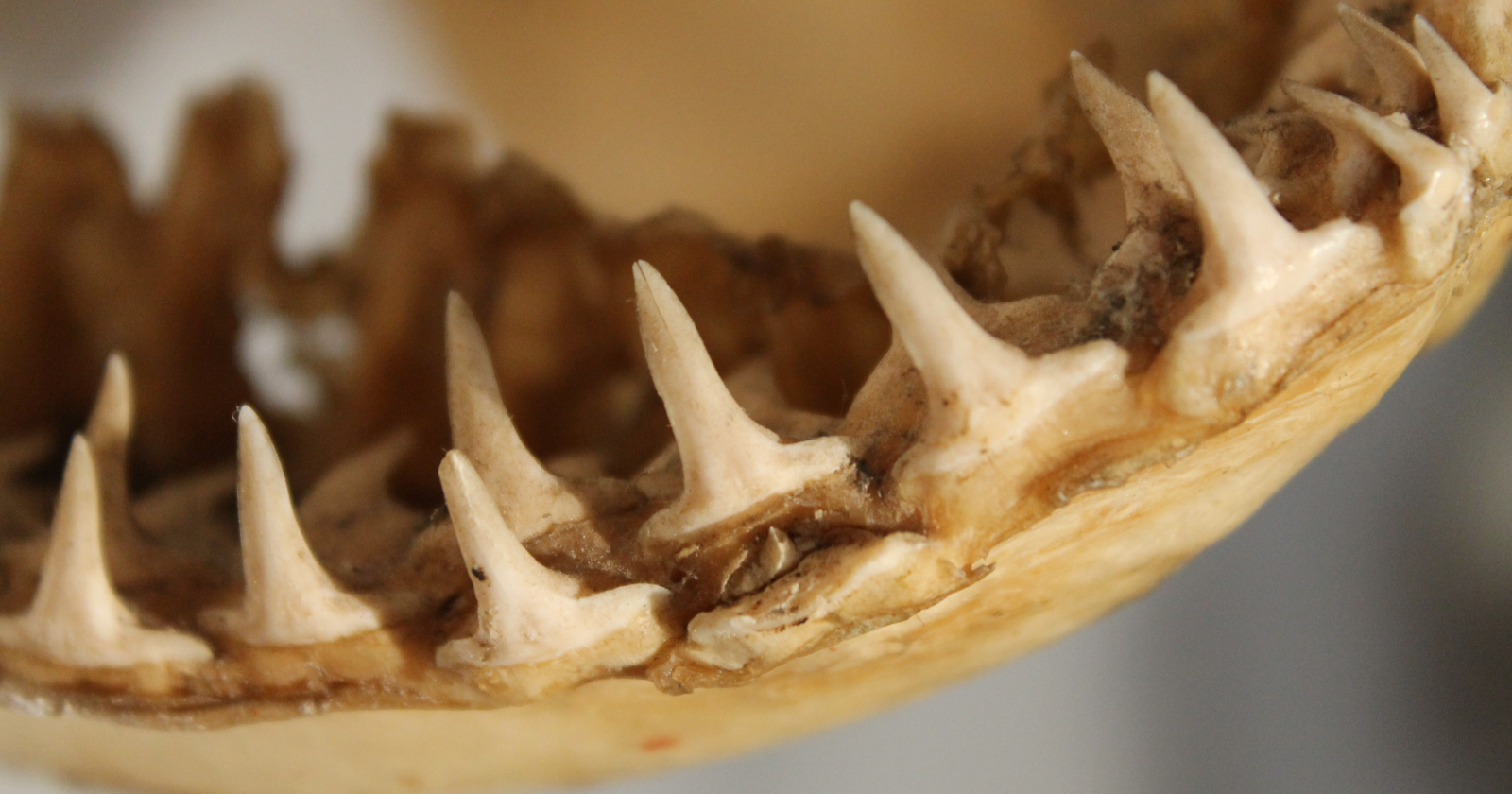
Paleontologist Lázaro W. Viñola-López, of Chicago’s Field Museum, was cleaning fossil jawbones from an extinct Caribbean rodent called a hutia when he noticed something that did not sit right. Inside several empty tooth sockets, the sediment that had filled the cavities over thousands of years was smooth and concave in a way ordinary sediment does not settle. Loose dirt filling a hole tends to be irregular. This looked shaped.
The material reminded him of a wasp nest. It turned out to be something that had not been documented before: fossilised nests built by solitary bees, packed inside the empty sockets where the hutia’s teeth had once been rooted, and in several other bone cavities from the same cave deposit. The find is described in a paper published on 17 December 2025 in Royal Society Open Science, led by Viñola-López and colleagues, titled “Trace fossils within mammal remains reveal novel bee nesting behaviour.”
What the CT scans actually showed
Rather than physically excavating the compacted sediment out of the bone, which risked destroying whatever structure it held, the team used micro-CT scanning, a form of X-ray imaging that builds a three-dimensional model of an object’s internal structure without disturbing it. The scans showed that the material inside the tooth sockets was not randomly packed sediment at all. It had the shape and internal structure of mud brood cells, the small chambers solitary bees construct to house a single egg, a stock of pollen for the larva to feed on, and, in several cases, ancient pollen grains still sealed inside by the mother bee before the cell was closed.
No bee bodies survived in the fossil record, so the researchers could not identify which species built the nests. What they could identify, from the structure of the cells themselves, was a distinct and repeated construction pattern, distinct enough that the team gave the trace fossil its own scientific name, Osnidum almontei, honouring Juan Almonte Milán, who discovered the cave. Naming a trace fossil rather than a species is standard practice in paleontology when the evidence is a behaviour, a burrow, a nest, or a track, rather than a body.
Reused, not built once
The detail that gives the discovery its texture is not that bees nested in a bone cavity once. In several of the tooth sockets examined, the CT scans revealed up to six generations of nests stacked on top of one another within a single cavity, evidence that female bees returned to the same cavity repeatedly over time, building a fresh set of cells inside the space left by the previous occupant. A single hollow socket, in other words, functioned as reusable real estate across multiple nesting seasons, not as a one-off shelter.
The nests were not confined to jawbones, either. The team also found the same kind of compacted mud cell structures inside a hutia vertebra’s neural canal, the channel that would have held the spinal cord, and inside the pulp cavity of a fossilised sloth tooth. Wherever an old bone offered a cavity of roughly the right size and shape, sealed from most weather and predators, bees appear to have used it.
How old, and how the bones got there
The bones come from a limestone cave on the Dominican Republic side of Hispaniola. The cave deposit is Late Quaternary in age, and reporting on the discovery has described it as roughly 20,000 years old, though that figure describes the age of the broader sediment layer the bones were recovered from rather than a single, precisely dated nesting event. The bones themselves are thought to have accumulated in the cave as owl pellets: undigested remains, including small mammal jawbones and vertebrae, regurgitated by owls that used the cave as a roosting site over what was likely a long span of time. That slow accumulation is what left a supply of clean, dry bone cavities available for bees to find and reuse across generations.
Why bone is an unusual place to find this
Solitary bees are well known to nest in a range of substrates: hollow plant stems, soil burrows, abandoned snail shells, and cavities in wood. Bone has not previously turned up in that list. The Hispaniola find is described in the paper as the first confirmed instance of bees nesting inside vertebrate bone cavities specifically. There is some precedent for insects and bone interacting in the fossil record more broadly. Fossil leafcutter bee nests and pupae have been recovered from the Rancho La Brea tar pits in Los Angeles, and a fossilised carder bee nest has previously been described at Taung in South Africa, but neither involved bees using the inside of an animal’s own skeleton as a nesting cavity.
What the finding does and does not establish
The paper is a description of a new trace fossil and a newly documented nesting behaviour, not a claim about how common this practice was among ancient bee populations, or about which specific bee lineage did it. Without preserved bee bodies, questions about species identity, and about how widespread this kind of bone-nesting behaviour was across the wider Caribbean or beyond it, remain open.
What the CT scans do establish clearly is that the cavities were reused repeatedly over time by whatever bees built them, and that hutia and sloth remains left behind in one cave were, for some stretch of the Late Quaternary, doubling as bee housing.