

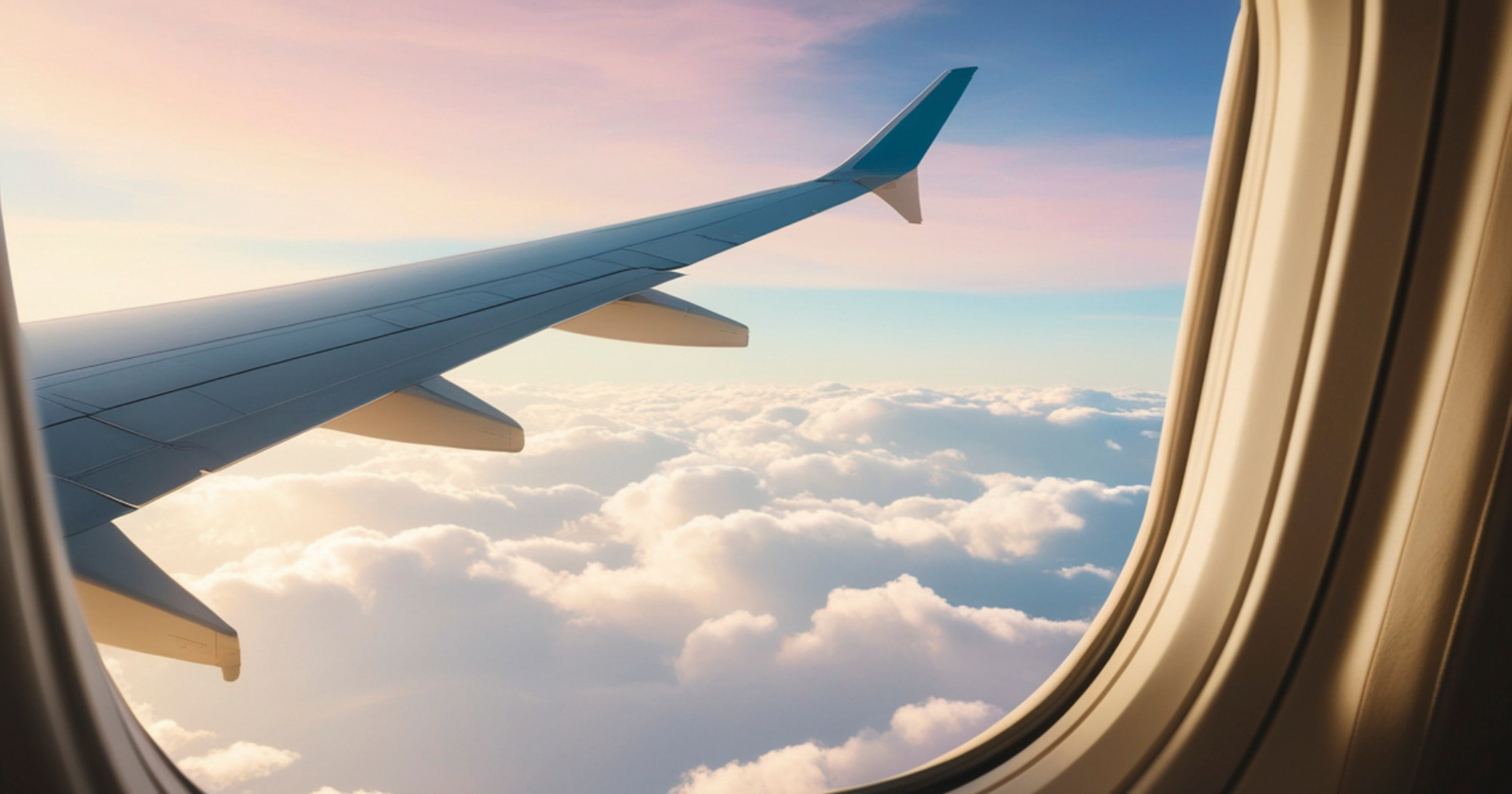
The specific numerical comparison, on the available evidence from four decades of aviation dosimetry research, holds up under examination. A passenger sitting in the contiguous United States at sea level, doing nothing more radioactive than reading a newspaper, absorbs cosmic radiation at a rate of approximately 0.06 microsieverts per hour. A passenger sitting in a commercial airliner at cruise altitude, doing exactly the same thing at approximately 35,000 feet, absorbs cosmic radiation at a rate of approximately 6 microsieverts per hour. The difference is a factor of approximately 100. A single seven-hour transatlantic flight delivers roughly the same cosmic-radiation exposure that six weeks of ground-level living would produce.
The dose depends on where the aircraft flies, at what altitude, and at what point in the solar cycle. On polar routes at high cruising altitudes, the specific numbers get substantially larger. On equatorial routes at lower cruising altitudes, they get substantially smaller. The physics that produces the difference is worth understanding, because it is the same physics that determines exposure on every commercial flight ever operated.
Where the radiation comes from
The primary source of cosmic radiation at aviation altitudes is not the Sun. It is a population of high-energy atomic nuclei, mostly protons and helium ions, that have been accelerated to speeds approaching the speed of light by supernova shockwaves and other high-energy astrophysical events far outside the Solar System. These are called galactic cosmic rays, and they arrive at the outer boundary of the Earth’s atmosphere continuously, day and night, from every direction, at an approximately constant rate that varies only with the 11-year solar cycle.
When a galactic cosmic ray strikes a molecule in the upper atmosphere, the collision produces a cascade of secondary particles: neutrons, protons, muons, electrons, and gamma photons, each carrying a portion of the original particle’s energy. The cascade descends through the atmosphere, spreading out as it goes and losing energy to further collisions. By the time it reaches sea level, most of the original energy has been absorbed by the atmosphere. At aviation altitudes, approximately one third of that atmospheric shielding is missing, and the passenger sitting in the aircraft is inside the cascade rather than shielded from it.
If you’re enjoying reading this, we came across a video that explains everything in more depth. Well worth a watch.
Click here to watch the video.
Why altitude matters
The atmosphere is not evenly distributed. Approximately half of its total mass sits below 5.5 kilometres. Approximately 90 per cent sits below 16 kilometres. Above the tropopause, at approximately 11 to 15 kilometres depending on latitude, the atmosphere thins out rapidly. Commercial aircraft cruise at altitudes between approximately 9,000 and 13,000 metres, or between roughly 30,000 and 43,000 feet, which places them near or slightly below the tropopause.
According to the CARI-6 dose calculation program developed by the FAA’s Civil Aerospace Medical Institute, the specific dose rate at aviation altitudes increases substantially with height. At 35,000 feet, the ambient dose equivalent rate at high latitudes is approximately 6 microsieverts per hour. At 41,000 feet, the equivalent figure is approximately 12 microsieverts per hour. The difference is not linear. Small increases in cruising altitude produce disproportionately large increases in radiation exposure, because the amount of atmospheric shielding above the aircraft is dropping at each step.
The historical extreme case was the Concorde, which cruised at approximately 60,000 feet at supersonic speeds. Concorde passengers absorbed cosmic radiation at approximately three times the rate of subsonic passengers at 35,000 feet, though the total dose per flight was reduced by the shorter journey time.
Why latitude matters
The Earth’s magnetic field deflects incoming charged particles. The specific geometry of the deflection depends on the angle at which the particle approaches the magnetic field lines. Near the geomagnetic equator, incoming charged particles must cross the field lines at a large angle, which deflects most of them away from the atmosphere before they can enter. Near the geomagnetic poles, the field lines run approximately vertically into the surface, and incoming particles can travel parallel to the field lines and enter the atmosphere with little or no deflection.
The specific consequence at aviation altitudes is that galactic cosmic radiation levels over the polar regions are approximately twice those over the geomagnetic equator at the same altitudes. A flight from Miami to São Paulo, which stays close to the equator, absorbs cosmic radiation at approximately 2 microsieverts per hour. A flight from London to Los Angeles, which arcs over Greenland and the Canadian Arctic, absorbs at approximately 6 microsieverts per hour. A polar route from New York to Tokyo can absorb 40 to 50 microsieverts in a single seven-hour segment.
The specific rule the aviation industry uses is that latitudes above approximately 45 degrees north or south are meaningfully higher-exposure than latitudes below that threshold. The FAA specifically requires airlines operating flights over polar regions to have action plans in place for reducing ionising radiation exposure during solar particle events, which are sporadic bursts of energetic protons from the Sun that can substantially increase in-flight dose rates for hours or days at a time.
What the regulators say
Aviation dosimetry is a regulated field. The International Commission on Radiological Protection, or ICRP, sets recommended dose limits for occupational exposure to ionising radiation, and those limits apply to airline flight crew as well as to workers in nuclear plants and medical radiology departments. According to a 2025 review published in the Journal of Radiation Research and Applied Sciences, the ICRP recommendation for aircrew is an effective dose of 20 millisieverts per year, averaged over any five-year period, with no more than 50 millisieverts in any single year. Full-time widebody flight crew on North Atlantic routes typically absorb between 2 and 5 millisieverts per year, well below the regulatory ceiling but well above the 1 millisievert per year limit set for general public exposure.
For pregnant flight crew who have declared their pregnancy to their airline, the FAA limits are substantially tighter. The maximum permissible dose for the remainder of the pregnancy is 1 millisievert total, with a monthly ceiling of 0.5 millisieverts. Airlines respond by reassigning pregnant flight crew to shorter, lower-latitude, or lower-altitude routes.
The comparison anchors
The individual dose from a single flight is small in the specific technical sense that no single flight will cause immediate detectable harm to any passenger. A dental X-ray delivers approximately 5 microsieverts. A single London to New York flight delivers approximately 37 microsieverts, or about seven dental X-rays. A chest CT scan delivers approximately 7,000 microsieverts, or approximately 190 transatlantic flights. The natural background dose from cosmic rays that reach the ground, terrestrial uranium and thorium, radon gas, and the potassium-40 that occurs naturally in every human body, averages approximately 3,000 microsieverts per year.
A 2025 study led by Hiroshi Yasuda at Hiroshima University’s Research Institute for Radiation Biology and Medicine, published in Frontiers in Public Health, calculated the average annual dose from international flights for the Japanese population using the JISCARD EX radiation model. The flyer-average annual per-capita dose from international flights was approximately 60 microsieverts, or approximately one-fiftieth of the natural background dose from all other sources combined. For frequent flyers logging more than 100,000 miles per year, the cumulative annual dose can exceed 2,000 to 4,000 microsieverts, comparable to the entire natural background exposure of the average human.
What this means
For the occasional traveller taking two or three flights per year, cosmic radiation exposure is a small addition to the natural background dose that every human absorbs from geology, biology, and the sky above. It is not, on the current best interpretation of the epidemiological evidence, a meaningful health risk for that population.
For the professional flight crew flying hundreds of hours per year on high-latitude widebody routes, the cumulative exposure is substantial enough that international regulatory bodies classify the profession as a radiation-work category, subject to the same monitoring and dose limits that apply to nuclear industry workers and radiologists.
The passenger looking out the window at 40,000 feet, watching Greenland pass below in the polar summer, is inside a cascade of subatomic particles produced by supernovae outside the Solar System.
Most of the passenger’s fellow travellers have no idea it is happening.
The physics does not care.