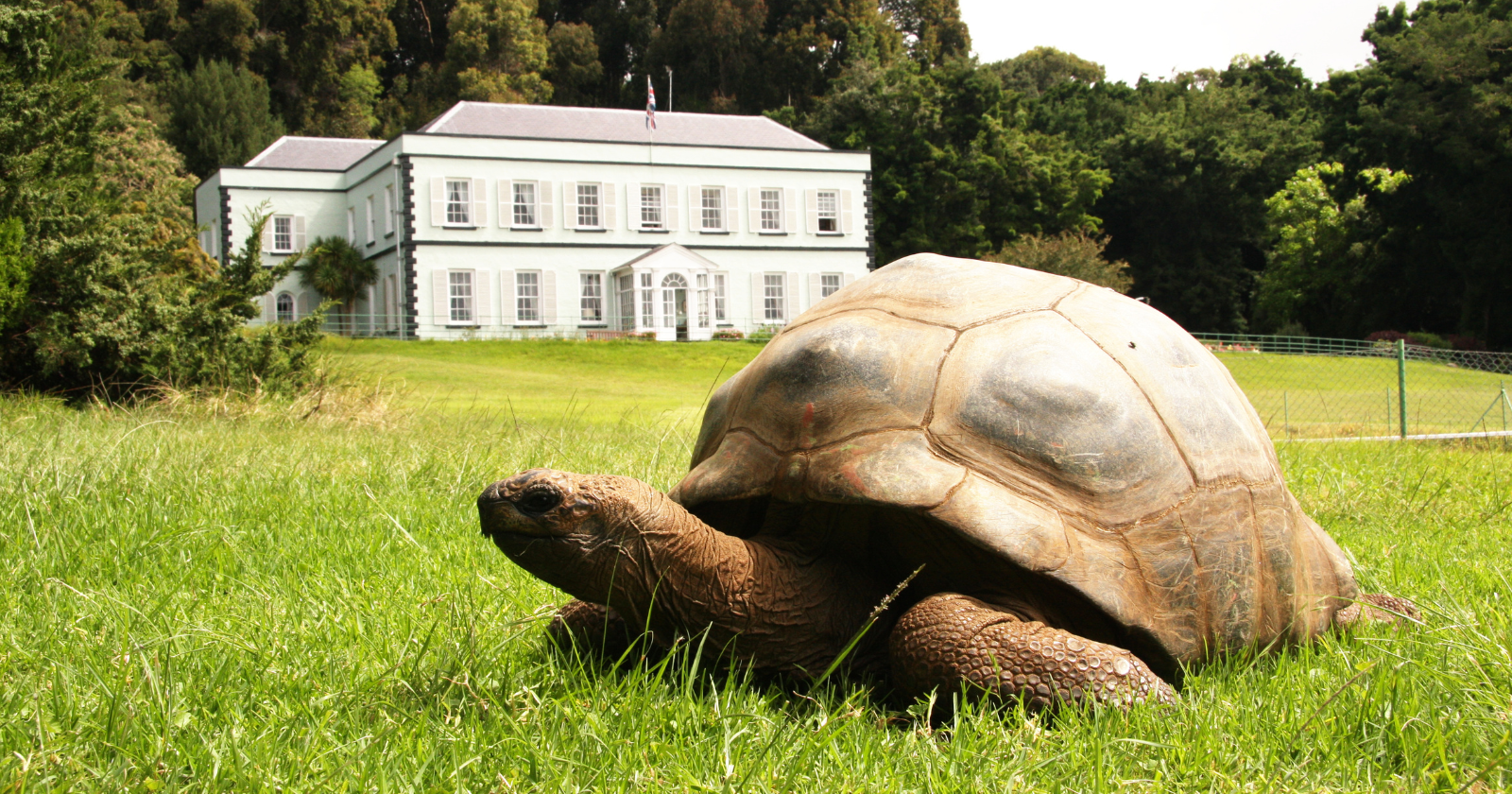
In 1832, no one had made a telephone call. Alexander Graham Bell would not be born for another fifteen years, and the first successful telephone call would not take place until March 1876. But somewhere around that year, on an island in the Seychelles, the animal we now call Jonathan hatched from an egg.
He is still alive in 2026, living on the grounds of Plantation House, the governor’s residence on the remote South Atlantic island of St Helena. Guinness World Records lists Jonathan as the oldest known living land animal and gives his age as at least 194.
That number lands differently when you hold it still for a moment. Photography had not yet been publicly introduced; the daguerreotype was formally announced in 1839. The telephone, electric lighting, powered flight, radio, television and the internet all arrived within the lifetime of one tortoise.
How we actually know his age
No one watched Jonathan hatch, so 1832 is an estimate rather than a documented birth year. The calculation works backward from his arrival on St Helena. Jonathan was brought from the Seychelles in 1882 as a gift to Sir William Grey-Wilson, who later served as governor of the island.
Jonathan was already described as fully mature when he arrived. Guinness has traditionally treated that as evidence that he was at least 50 years old, which places his hatch year around 1832. The organisation now notes that tortoises of his kind may continue growing until about 55 or even later, making 1832 a conservative estimate rather than an exact limit. He may be older than 194, although there is no way to establish by exactly how much.
The strongest visual evidence is an old photograph taken between 1882 and 1886. It shows Jonathan already fully grown, grazing on the grounds of Plantation House alongside several island residents. More than 140 years later, he is still living on those grounds.
In 2022, St Helena marked his estimated 190th year with an official birthday weekend culminating on 4 December. The date gives the island a day on which to celebrate him, but it should not be mistaken for evidence that anyone knows the precise day on which he hatched.
What nearly two centuries does to a tortoise
Jonathan is a Seychelles giant tortoise, classified by Guinness as Aldabrachelys gigantea hololissa. He weighs roughly 400 pounds, and some of his senses have deteriorated with age. Cataracts have left him virtually blind, while his sense of smell has greatly diminished. His hearing, however, remains excellent.
That combination affects how he is cared for. Jonathan can graze by himself, but he may not notice food simply placed on the ground. His carers therefore hand-feed him about once a week with fruit and vegetables to supplement his calories, vitamins and minerals. He responds to familiar voices, particularly when he associates the person calling him with food.
His appetite remains keen. Among his reported favourites are cabbage, cucumber, carrots, apples and seasonal fruit. He is especially fond of bananas, although his former vet Joe Hollins has noted that they tend to gum up his mouth.
His age has not ended his interest in the other tortoises sharing the grounds. Hollins has said that Jonathan still has a good libido and is frequently seen mating with his companion tortoises Emma and sometimes Fred. Guinness summarises his lasting interests rather neatly as sleeping, eating and mating.
What his longevity may tell us
Jonathan has lived well beyond the roughly 150-year lifespan commonly associated with his kind. That does not mean science has a complete explanation for how he has survived for so long. His age is an extreme example even among animals already famous for longevity.
Giant tortoises have nevertheless become valuable subjects for ageing research. A genomic study of Lonesome George and the Aldabra giant tortoise identified lineage-specific genetic variants affecting DNA repair, inflammatory processes and genes connected with cancer development. The researchers described the findings as clues to evolutionary strategies associated with increased lifespan, not as a complete solution to the problem of ageing.
The study did not examine Jonathan himself, and it would be too strong to claim that one set of genes explains his survival. Longevity is likely to involve a combination of inherited biology, slow metabolism, environmental conditions, diet, medical care and luck. What Jonathan provides is not a finished answer but an extraordinary living case.
Still here, on the same lawn
Jonathan has outlasted generations of the humans nominally responsible for him. In 2022, Guinness noted that 31 governors had come and gone since he was given to Sir William Grey-Wilson. Their portraits, policies and terms of office became history while Jonathan remained outside, grazing the Plantation House grounds.
He has also become part of St Helena’s identity. His image appears on the island’s money and stamps, and visitors have included royalty and other dignitaries. In June 2026, Guinness named him one of its record-holder Icons. Governor Nigel Phillips said Jonathan had been regarded for generations as “a local icon, deeply embedded in the island’s identity and collective memory”.
That fame has produced stranger consequences. On 1 April 2026, false reports spread online claiming Jonathan had died. The following morning, the St Helena Government confirmed that the reports were untrue and published a photograph of him at Plantation House.
I keep turning this over. Generations of governors, veterinarians and Plantation House staff have already arrived and departed while Jonathan remained on the same lawn. The people responsible for him change, and the routines are handed on. For now, he is still there, grazing beneath the trees, listening for the voices that bring his weekly food and carrying on with a life that began before anyone had ever made a telephone call.