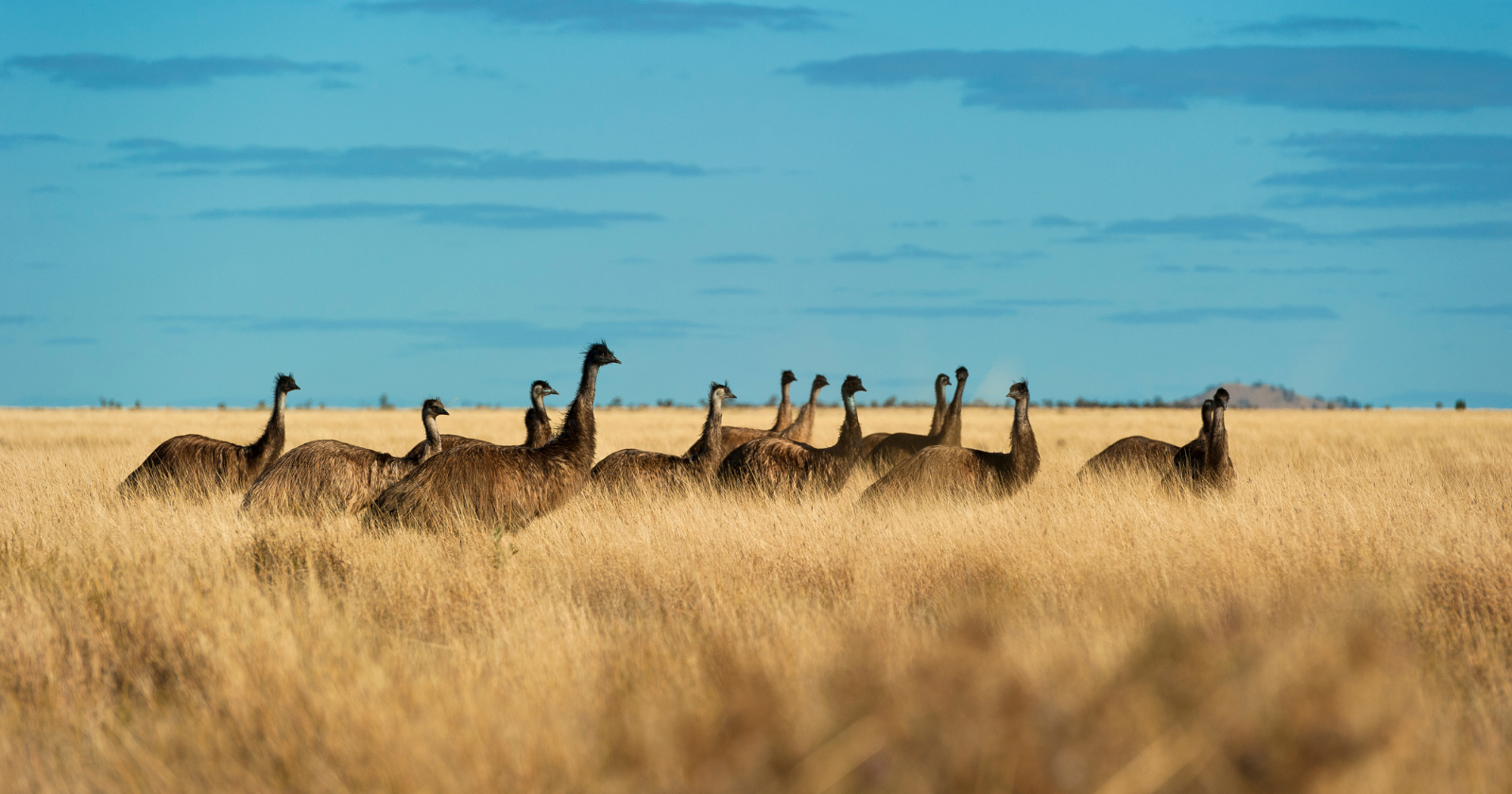
In late 1932, a small military detachment travelled to the Campion district of Western Australia with two Lewis machine guns and approximately 10,000 rounds of ammunition. The unit was commanded by Major G.P.W. Meredith of the Royal Australian Artillery.
Its target was a flightless bird—thousands of them, in fact.
After the breeding season, amid hot, dry conditions and scarce water farther inland, large numbers of emus moved into the wheat-growing districts around Campion and Walgoolan. Contemporary estimates placed their number at about 20,000. They trampled crops, damaged fences and frustrated farmers.
The farmers asked the government for help. The government sent guns.
What happened next is the reason people still tell the story. The birds did not stand together and absorb sustained fire. When shooting began, they scattered into smaller groups and ran.
Emus can sprint at about 48 km/h, which turns a bird that appears easy to hit while standing still into a fast and unpredictable target. During one promising ambush, a machine gun jammed. In a separate attempt, the soldiers mounted a Lewis gun on a truck, but the emus outran it and the ride was so rough that the gunner could not fire effectively.
The operation was conducted in two phases. Defence Minister Sir George Pearce withdrew the detachment on 8 November, only days after the shooting began, as poor results and public ridicule mounted. The soldiers returned several days later, however, and continued operating until they were finally recalled about a month later.
By then, Meredith reported that his men had fired 9,860 rounds and achieved 986 confirmed kills—almost exactly ten rounds per bird. Those were the commander’s own reported figures rather than the result of an independent count, and later claims about additional birds dying from wounds are harder to verify.
Meredith was later credited with one of the great backhanded compliments in the history of pest control. A 1953 newspaper retrospective, published more than twenty years after the campaign, described him as praising the emus’ “bullet-carrying capacity.” It also attributed to Meredith the observation that the birds could face machine guns with the “invulnerability of tanks.”
Because that wording survives through a much later newspaper account, it should not be treated as a verbatim transcript recorded on the battlefield. Even so, it captures the genuine problem facing the gunners: wounded emus could remain mobile, while uninjured birds dispersed before the soldiers could maintain concentrated fire.
The same 1953 account quoted an unidentified “Army observer” describing the flocks as though they were conducting an organised defence. He claimed that each group appeared to have “its own leader,” a large bird that kept watch and warned the others when the soldiers approached.
That should not be mistaken for evidence that the emus were consciously applying military tactics. It reads more like men projecting strategy onto ordinary animal behaviour. The birds needed no battle plan. Vigilance, speed and a tendency to scatter were enough to make them exceptionally difficult targets.
The press and Parliament quickly recognised the absurdity of the situation. The spectacle of modern machine guns being used against large flightless birds attracted ridicule, while the first withdrawal was publicly reported rather than quietly concealed. Looking back in 1953, the Sunday Herald observed that “the incongruity of the whole thing” had even generated public sympathy for the emu. That was one newspaper’s retrospective description rather than a scientific measure of public opinion, but it captures the tone the episode eventually acquired.
The more serious consequence was examined by historian Murray Johnson, author of the principal scholarly study of the campaign. Johnson considered it “highly probable” that the shooting actually worsened some crop damage. Each time the guns opened fire, frightened birds scattered through the maturing wheat while trying to escape.
The method intended to protect the crop may therefore have driven panicked emus through more of it.
What produced larger numbers was much less dramatic. Authorities continued using bounty schemes, which had already existed before the military operation, and increasingly relied on exclusion fencing. During six months in 1934, farmers lodged 57,034 emu bounty claims—vastly more birds than Meredith’s machine-gun detachment had reported killing. Barrier fencing also became an important part of efforts to keep emus and other animals out of agricultural districts.
My read is that the emus won without ever meaning to fight. They did not outthink the soldiers, coordinate an army or outrun machine-gun bullets. They simply ran faster than a truck could pursue them across rough ground, split into smaller groups and refused to behave like the concentrated target the plan required.
That was enough to expose the weakness in an operation built on the assumption that overwhelming firepower could solve an ecological problem. The military campaign killed hundreds of birds, but it did not remove the wider population or provide farmers with a lasting answer. The guns were recalled, the phrase “Great Emu War” endured, and the birds became the unofficial victors in one of history’s strangest attempts at pest control.