

Hypothesis: Perception of the environment is a primitive capability of all living things, preceding sense organs, which only refined and reliabilized the perception
In speaking of “perception”, I refer to direct knowledge of the environment, not mediated by any signals that present-day science knows how to measure. This is a radical hypothesis which has the advantage of being eminently testable. There is already evidence suggesting that plants and even microbes know what is around them without sense organs or nervous systems.
I had heard about cases of “blindsight”. Children are reported to be able to read with their fingers. Blind cyclists who navigate traffic. Then, last winter, I read about Dalia Burgoin, who can see colors and shapes, identify objects, read text — all with her eyes completely covered. In April, I had the opportunity to take a course which Dalia led, and I experienced all these abilities as she demonstrated them.
Dalia claims that we all have this ability to a greater or lesser extent, and it has atrophied from disuse and denial. I was not able to learn blindsight in the week-long course, but some of my classmates did.
Educated, Western humans learn that this is impossible, but telepathy and clairvoyance are experienced and understood as natural human senses in many indigenous cultures. A. P. Elkins published a book [1949] about his experience with medicine men (“karadji”) in the aboriginal populations of Australia. He claimed they are able to transmit thoughts over hundreds of miles, diagnose illnesses, and “see” events at distant places and times. In 1969, Loren McIntyre, a Nat Geo journalist, became lost in the Amazon jungle of Peru and lived two months with the Mayoruna tribe. He had no knowledge of their language, nor did they have any knowledge of his. Years later, he wrote a book about communicating with his hosts telepathically, a mode which they regarded as routine. In this century, Robin Rodd writes about shamans of the Piaroa peoples in Venezuela, and the powers of knowing and healing that they derive from ayahuasca ceremonies.
Animals are reported to have easier natural access to psychic abilities than humans. They know when a storm or an earthquake is coming. Rupert Sheldrake wrote a whole book about pets who know when their owners are coming home. He went to great lengths to demonstrate that this ability does not depend on sound or on schedule.
In a Scientific Reports article by Silvia Guerra [2019], pea plants were shown to respond to a nearby post, toward which they aimed their tendrils until they found the support. A picture of a support was substituted, but the plants were not fooled. In a New Yorker video, Michael Pollan narrates the pea plant’s quest in a time-lapse photography. Two plants, equidistant from a post between them, vie for the support. They look like fly fishermen casting for trout. But when the plant on the left reaches the pole and latches on, the plant on the right gives up and looks elsewhere. How does it know?
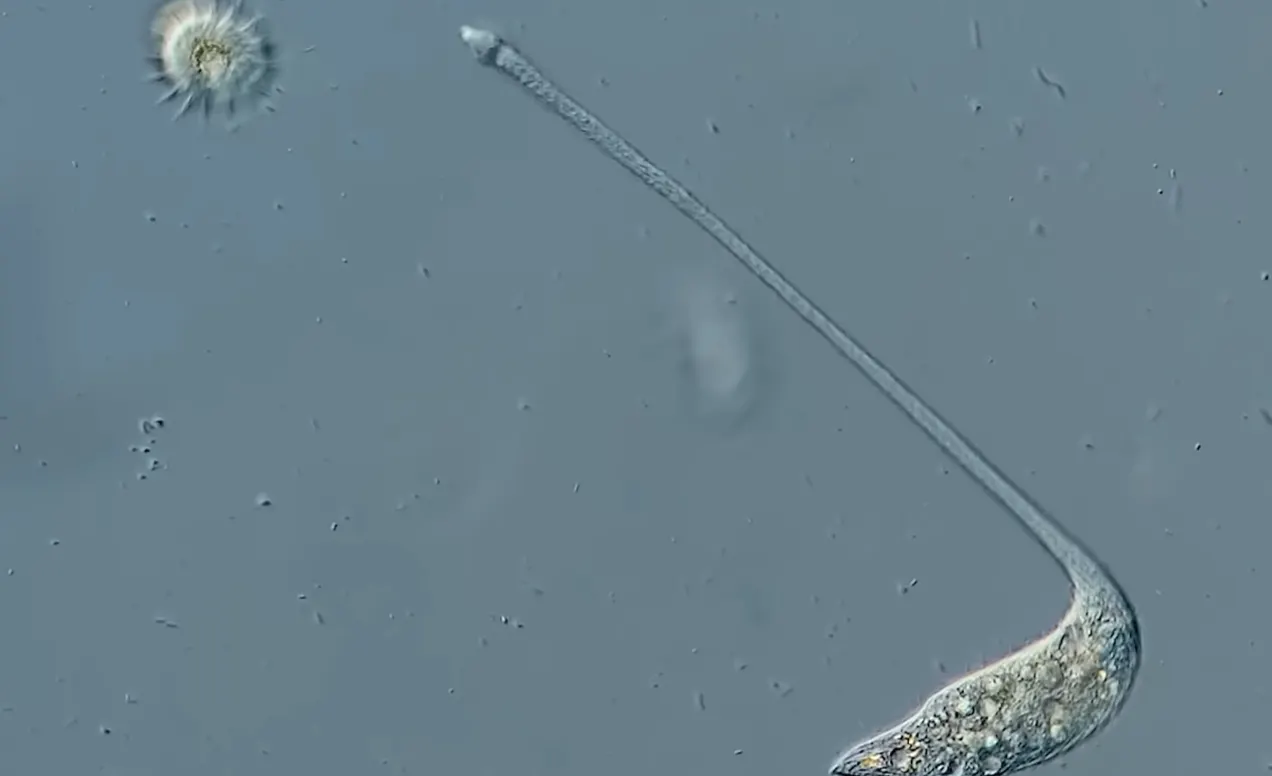
The single-celled ciliate Lacrymaria olor hunts for microbial prey by creating a “neck” which extends out in search of food. Is the neck flailing at random? Is it exquisitely sensitive to chemical gradients which tell it where to look? Or does Lacrymaria have a sixth sense which helps to guide its search in the direction where dinner is more likely to be found?
Since the pioneering work of Suzanne Simard in the 1990s, evidence has accumulated that plants have cooperative relationships, sharing nutrients and warning one another of pests via chemical signaling. Monica Gagliano has pioneered experiments in which she demonstrates that plants “know” what other plants are growing in their environs, even in the absence of chemical cues. In this study, chilli seeds germinate more quickly in the neighborhood of a basil plant, even when all chemical signals and even light and sound communication is blocked. A year earlier, she had demonstrated that chilli seeds are less likely to germinate in the presence of fennel plants, which are territorial and emit chemicals to poison their neighbors. The inhibitory effect was still strong when all chemical signaling between the two was blocked.
Proposed worm experiment
C. elegans roundworms have chemical sensors, which we might analogize to smell or taste, but they lack eyes and ears. In the proposed experiment, worms are placed at the center of an agar plate with a food source at one point on the periphery. Crucially, it must be arranged that there is no chemical signal at the location where the worms are. That is to say, there must be no chemical gradient suggestive of the food source. If the worms nevertheless move toward the food source, this is an indication that they have access to knowledge about their environment independent of their senses.
Variant #1 Worms are placed on an agar plate with a Y maze. At the top of the Y, the paths join, and there sits a food source. But the left path is blocked with a barrier that chemicals can cross but the worms cannot. This way, the chemical gradient is equal on both arms of the maze, and this can be confirmed with chemical sensors. Will the worms nevertheless choose the right arm preferentially, “knowing” that they can get to the food via the right arm but not the left?
Variant #2 The task of the worms might be made easier if they have telepathic ability. On the left is a colony of worms happily consuming abundant food. On the right is a colony of starved worms, with no food at all. Do the subject worms in the middle choose to move in the direction of the well-fed worms?
Variant #3 Confound the worms with a false chemical gradient suggesting that the food source is on the left, while the real food source is on the right.
Variant #4 Place a separate Petri dish with food on the right of the dish containing the target worms, another dish on the left with no food. There is no possibility of the worms reaching the separate dishes, and no possibility of chemical signals traveling between the dishes. Do the worms tend toward the dish with food?
Variant #5 Similar to #4 except add “telepathic” worms to the dishes on the right and left. The worms in the dish on the right are well-fed and on the left they are hungry. Do the worms in the middle receive information from the telepathic worms and modify their course as a result?
Recap
It’s my reasonable outrageous hypothesis that “life knows what it needs to know”, that this is a primitive ability as old as life itself, and that the chemical senses, sensitivity to touch, light and sound, arose only much later to enhance the indigenous knowing. This is a stronger version of “biopsychism”, in which all living things have consciousness, and it is related to philosophical traditions in which consciousness is the foundation of reality.
Discussion
6 reader comments
Imported threads are marked Archive. New comments are welcome and moderated for spam.
I had one recently, I had a feeling or thought I was going to win a jackpot at a certain machine on that day's visit to the casino, and what happened was quite interesting. With just handful of plays, I got a jackpot at another machine, then when I went to the machine I had a feeling of getting a jackpot, also in a handful of plays, very few, I got the jackpot too.
Given the odds of a jackpot are very rare, and the odds of getting two jackpots back to back on different machines with just a few plays is astronomical, I think that is impressive for the gut feeling of getting a jackpot having been so accurate.
Seems like much more than a coincidence, IMO.
I hope your profitable intuitive winning streak continues and that you to trust it when it intrudes into your thoughts.
This type of information is always intriguing but so easy to dismiss. Perhaps too easy.
Are anomalous events a coincidence or a synchronicity?
It is difficult to trust when synchronicity appears to apply. Sometimes it is truly uncanny when too often a person mentions an unusual name or topic and then it is repeated by a newscaster seconds later. Is it a message?
Why do people often dream of far away people about a week before they die, even though the person was healthy to their knowledge. When the person is older, it is easy to opine that it was most likely their time. But when it's a child or a teen..,.......
Why do different lights in my kitchen sometimes blink a few times when I am down in kitchen alone thinking of a favorite but long dead relative.
Surely it was my imagination. Was it a lose bulb, or the electric company dimming power briefly, even if no one in any other part of the house experienced it. I torture myself with logical explanations.
Rarely but sometimes, the lights blink interactively. For example, sometimes, while my voice echoes in the mostly empty room I command, If that light blink was from you, blink twice. It does. Whoa!
Then when requesting that the light blink once for yes to a question, the light obligingly blinks once. That game may continue briefly, but it is always too brief to prove anything,
I can attest to the fact that both dogs and cats appear to know when someone they like is about to come to the door.
Or, when the dreaded veterinarian, whom they sorta' like but prefer to avoid, was about to arrive to give them a checkup.
One cat pulled a Houdini when the veterinarian was on her way. Every time, without fail, about five minutes before the Veterinarian would show up, the cat would disappear. It was a good thing I had already found all her hiding places.
All my dogs have on occasion stood near the front door, staring expectantly, for ten minutes, before someone they know would ring the doorbell.
Did they hear the rhythm and purr of a particular car's motor?
That is what I thought but at times the person would be riding in a stranger's car, or be using a new vehicle. Could they be picking up their scent from miles away? Possibly, if the wind is right. Telepathy, maybe?
One of my more unusual experiences was when my father-in-law died.
About a week before, I had a dream that a Leathery angel-like creature with fragile bat wings and no recognizable face flew toward me. Rising above me, it tapped my head with one of its pretty wings briefly as it whooshed by as if to say pay attention!
What did it want?
A few days later my father-in-law sent me a Christmas gift. It was something very thoughtful. It fit my personality so intuitively well. I was profoundly affected by his sensitive gift choice.
I immediately wrote a thank you note, addressed it, put the shiny red envelope near the garage door with the intent to mail it. Each day I saw it there, but kept forgetting to drop it off at the post office. Then finally, after three days, It did get mailed.
A few days later at 3 a.m. a hospital doctor who had often treated my father-in-law at his office called to say he had died in an ambulance on the way to the emergency room.
His doctor who just happened to be there, was kind enough to emphasize that by all accounts it was a good death, quick, painless, and peaceful. Surrounded by good-hearted emergency personnel who were trying to keep him alive.
The next night we went to secure his house. Before going in, I opened the overflowing mailbox. In it, glinting accusingly in the streetlight was the thank you note I had sent in the red envelope.
Seeing it crushed me.
I lamented that my father-in-law had not seen my thank you note and missed it by only one day.
I browbeat myself about failing to mail it more quickly. Then I stuffed everything back in the mailbox telling my husband that I would grab all the mail on the way out to bring home after we checked the house.
Inside the house I continued to be upset by the fact that my father-in-law never received my thank you note as we searched through several drawers looking for needed paperwork and records.
In one drawer that neither of us had opened yet, I rummaged through a pile of white envelopes and white 8x10 sheets of paper, at the very bottom of that deep drawer, I found a sealed red envelope, with my handwriting on it.
I stared at it puzzled. Then opened it.
It took me a few moments to realize that it was the thank you note I had written to my father-in-law but had waited a tad too long to mail.
Both my husband and I were stunned. He had watched me stuff that distinctive envelope back into the mailbox with the rest of the mail. He commented on it several times.
It could have been that I absentmindedly held onto it. Still, I don't think I did. I purposely stuffed it back into the crowded mailbox because I was angry at myself for not mailing it sooner and that red envelope was a glaring reminder of that delay.
I wish I new for sure, but I like to indulge in the comforting thought that the envelope with the note was put in that drawer somehow by my father-in-law's spirit as a way to say, "stop fretting, I read your carefully crafted thank you note."
The lesson I learned was to always respond quickly to another person's kind gesture.
That's a great story, Heather. Because I'm a statistician, I react viscerally to numbers that would make others glaze over. So the overwhelming statistical evidence for telepathy gives me permission to believe that there are more things on heaven and earth that are dreamed of in Horatio's philosophy.
For several years, I said to myself that I needed a personal experience with a miracle because the statistical evidence wasn't reaching me at a deep enough level. Five years ago, I was riding my bike and a car going the opposite way pulled into my lane, gunned the engine, and hit me head-on. No one survives a head-on collision between a bicycle and a speeding car. My survival was the miracle I had always wanted, and for icing on the cake, my spine, my brain, and all my internal organs were spared. Surgeons pieced my legs together, and I spent the last week climbing in the White Mountains.
Thank you, Josh and I agree. Just because we can not see something clearly, visually or intellectually, does not prove that it does not exist.
I do remember your terrible accident. All who were posting here at the time, were extremely concerned. Meditations and prayers were sent your way.
Your recovery is nothing short of a miracle. And the fact that it is such a robust recovery is amazing.
Perhaps all the valuable information you share is a large part of the reason, you dodged a an armor piercing bullet, coupled with your healthy lifestyle and a strong stubborn paranormal will to recover.
I hope you enjoyed the White Mountains and the huts, in New Hampshire.
Mount Washington is celestial.
Heather, thank you for your presence on this blog for many years, and thank you for remembering my personal miracle. Yes, climbing mountains is so much more meaningful to me when I think of the expertise of the doctors who cannibalized my right leg to fill in gaps in my left, and the brilliance of my own body's healing.