

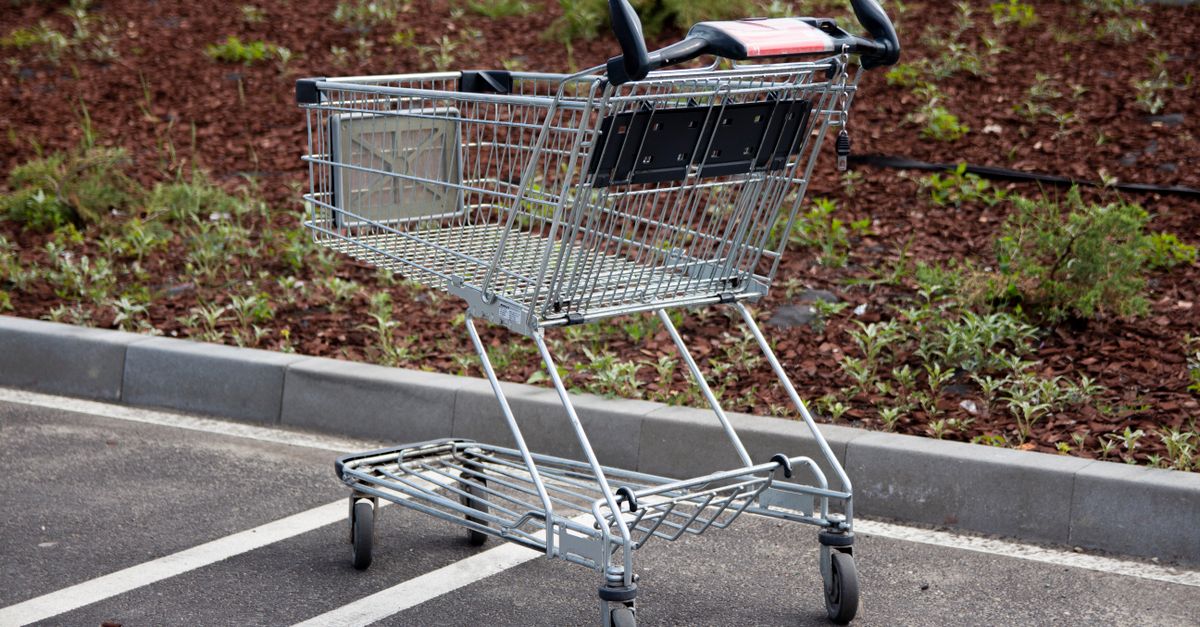
You have probably met the shopping cart theory, even if not by name. It is the online argument that returning your cart to the corral is the purest test of a person’s character, because there is no reward for doing it and no punishment for skipping it. Nobody makes you. So whether you do it, the theory says, reveals who you really are.
It is a satisfying idea, and I have some sympathy for it. But as a read on character it is far shakier than it sounds, because the psychology of small, unenforced good deeds says they are driven much more by the situation than by the soul.
I am a writer, not a psychologist, so treat this as a careful reading of the research rather than expert testimony.
The theory, and its appeal
The shopping cart theory frames the humble cart as a perfect moral litmus test: a good person returns it simply because it is the right thing to do, while someone who needs a rule or a reward to behave will leave it stranded in a parking space. It spread online precisely because it feels like it exposes something true.
The trouble is the assumption underneath it, that a behavior with no external pressure must be coming from within. Decades of social psychology suggest that is not how these small behaviors work.
Behavior follows the situation more than the person
People take their cues from what everyone around them is doing. In a well-known 2008 study in the journal Science, Kees Keizer and colleagues ran a series of field experiments on how disorder spreads, and one of them used a supermarket parking lot.
The researchers put flyers on parked cars and watched whether people littered them. When the parking lot was tidy, about a third of people dropped the flyer on the ground. When the same parking lot was strewn with abandoned shopping carts, that figure jumped to well over half. The sight of other people’s stray carts roughly doubled the rate at which strangers littered something completely unrelated.
That is the whole shopping cart theory turned on its head. Whether you tidy up after yourself is powerfully shaped by whether others have, not just by your private virtue. Add in the mundane forces the theory ignores, how far away the corral is, whether it is pouring with rain, whether you have a fractious toddler strapped in the car, and the act starts to look less like a verdict on your character and more like a product of your circumstances.
The clearest evidence that situation rules here is what supermarkets themselves do about it. Across much of Europe, and at chains like Aldi, carts are locked together and released by a small coin deposit that you get back only when you return the cart and clip it to the next one. Return rates under that system are close to universal. A trivial incentive, a coin most people would not stoop to pick up off the pavement, flips the behavior almost completely. That is very hard to square with the idea that returning the cart springs purely from who you are. Stores do not treat it as a test of character. They treat it as a design problem, and solve it with hardware.
And “no one is watching” is doing a lot of work
The theory leans hard on the idea that returning the cart is unobserved, a private act with no audience. That premise is weaker than it seems, in two ways.
The first is that a parking lot is not actually private. It is full of other people, any of whom might see you. The second is that we are extraordinarily sensitive to even the faint suggestion of being watched. In a much-cited 2006 experiment by Melissa Bateson and colleagues, an honesty box for tea and coffee in a university break room took in nearly three times as much money in the weeks when a photograph of eyes was posted above it than in the weeks when the image was of flowers. Nobody was really watching in either case. A picture of eyes was enough to shift behavior.
If a poster of eyes can do that, the busy, semi-public setting of a parking lot is hardly the pressure-free vacuum the theory imagines. The audience is real, even when you are not thinking about it.
What returning the cart does and does not tell you
None of this means the act is meaningless, and I want to be fair to the kernel of truth in the idea. Returning your cart is genuinely prosocial, it does follow a social norm without anyone forcing it, and people who reliably follow small norms do tend to follow others. As a loose, noisy signal, it points in a real direction.
What it is not is a clean X-ray of anyone’s soul. The signal is swamped by situation: by what other carts are doing, by distance and weather and how frazzled the person is, by the quiet sense of being seen. Reading a stranger’s whole moral worth off their cart is exactly the kind of over-reading of a tiny behavior that psychology keeps cautioning against, the same reflex I have written about in how we mistake surface signals for deep character.
So by all means return your cart. It is a decent, small, cooperative thing to do, and doing it probably makes the next person a little more likely to do the same. Just do not mistake it for a window into anyone’s soul, including your own. On a different day, in a messier parking lot, in the rain, you might surprise yourself.
