

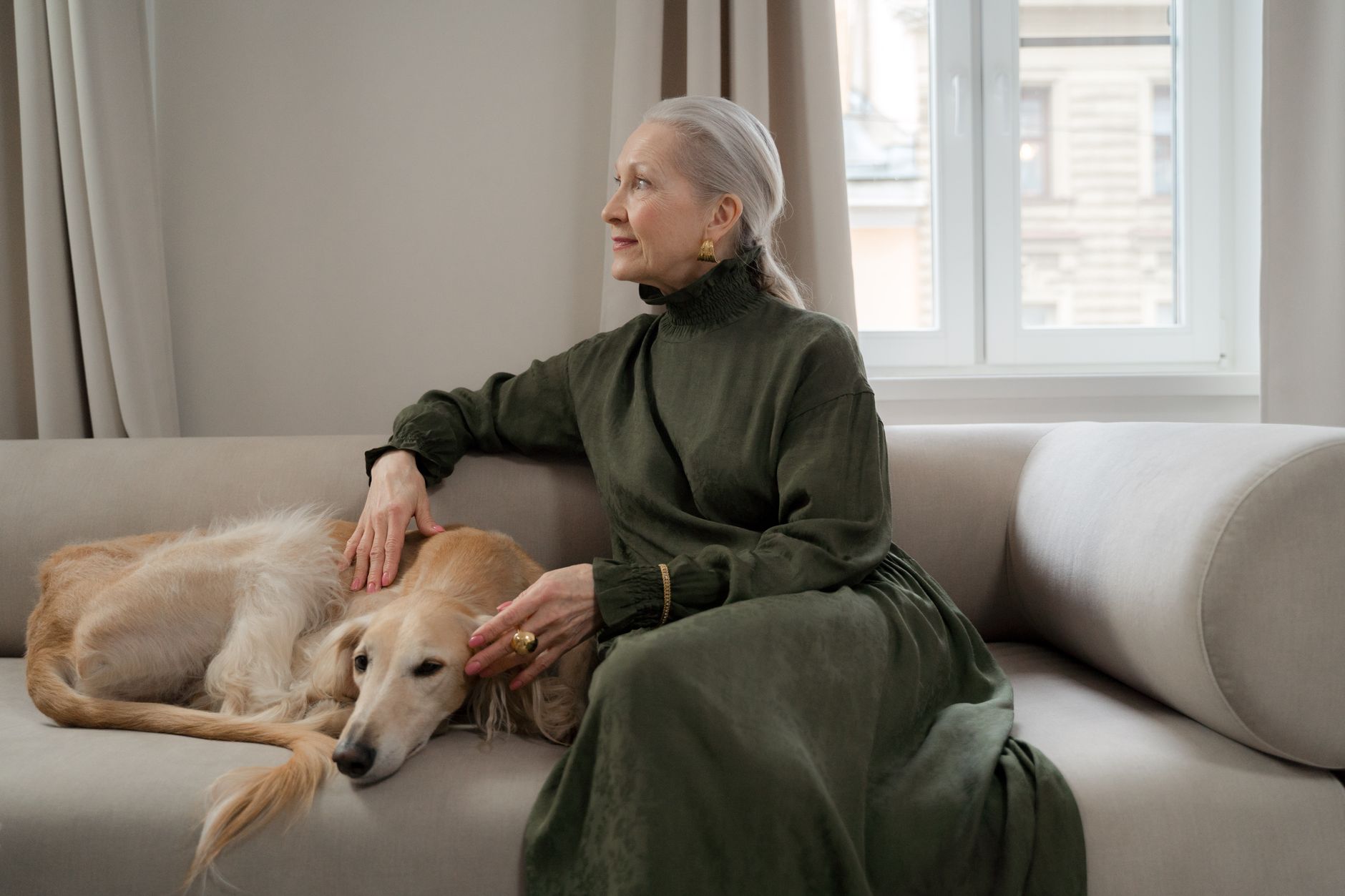
A dog can read the room with unnerving speed. A clipped voice, a hurried walk or an owner who cannot settle may be followed by pacing, watchfulness or a head pressed quietly against a knee.
It is tempting to turn that familiarity into a sweeping claim: dogs do not merely notice how we feel today, they absorb our emotional lives over years.
The real research is intriguing, but more precise. A widely shared version of the story blends separate studies from two universities. Researchers at the University of Vienna examined owner-dog pairs in short laboratory sessions. The study that found matching longer-term cortisol patterns came from Linköping University in Sweden, sampled dogs and owners twice within one year, and measured hormone concentrations in hair rather than following behaviour for several years.
That correction does not make the result less interesting. It makes clear what was actually discovered: life shared closely enough can leave related biological patterns in two different species.
What the Vienna team actually tested
The 2017 Vienna study involved 132 owners and their dogs. Each pair completed two 90-minute sessions that included separation and reunion, an unfamiliar room, practical challenges, play and mildly threatening situations. Researchers collected saliva from both partners before and after different tests, then related changes in cortisol to questionnaires about personality, attachment and interaction style.
This was a sophisticated study of how a relationship may shape stress regulation. It found that characteristics of both dog and owner were associated with cortisol variability, with the human partner appearing more influential. But the University of Vienna experiment was conducted in laboratory sessions. It did not track the pairs’ ordinary behaviour for years, and it was not designed to compare their chronic emotional states.
Saliva was appropriate for that question because it captures cortisol over a relatively short window. To ask what happens over longer stretches of shared life, another team used a different biological archive.
The longer-term finding came from Sweden
In the Swedish study, published in 2019, researchers recruited 58 women and their dogs: 33 Shetland sheepdogs and 25 border collies. The group included companion animals as well as dogs trained for agility or obedience competition.
Hair was collected from dogs and owners in September or October 2017 and again in February 2018. The three centimetres nearest the skin were analysed for cortisol, giving the researchers two retrospective windows corresponding broadly to summer and winter. The dogs also wore activity collars for a week, while owners supplied information about routines, training and personality.
The central result was consistent at both sampling points. As owners’ hair cortisol concentrations increased, their dogs’ concentrations tended to increase too. The association appeared in summer and winter and was stronger among female dogs and competing pairs. The Linköping University researchers called this long-term stress synchronisation.
Measured activity and reported training frequency did not explain the pattern. That closed off one simple possibility: that the dogs merely accumulated more cortisol because more active owners exercised them harder.
Hair is a longer record, not an emotional diary
Cortisol is part of the body’s system for mobilising energy and responding to challenge. It is not a chemical synonym for sadness, worry or a bad life. Exercise, excitement, illness, temperature and daily rhythms can all matter.
As hair grows, some cortisol becomes incorporated into the shaft. A sample can therefore provide a more integrated measure of hormonal activity across weeks or months than a saliva sample taken at one moment. That is the clever feature of the Swedish design.
It is also where careful language matters. A review of hair cortisol in animals found it useful as a longer-term marker, while noting that age, sex, body region, hair characteristics and season can affect readings. Hair cortisol can show that two physiological patterns covary. It cannot reconstruct what either member of the pair felt on a particular Tuesday.
So “long-term emotional state” is stronger than the measurement allows. The defensible phrase is longer-term cortisol output, interpreted in the context of stress physiology.
Synchrony does not reveal which way influence runs
The authors suggested that dogs were mirroring their owners because owner personality was associated with dog cortisol while dog personality had little effect. That is a plausible interpretation, not a demonstrated one-way transmission.
An owner and dog share a home, schedule, neighbourhood, social world and many of the same disruptions. The person chooses when the household wakes, walks, trains, travels and receives visitors. A demanding period at work might change the owner’s physiology while also shortening walks or making routines less predictable. The dog’s response could arise through voice, posture and scent, but also through those practical changes.
Other experiments show why the picture should remain open. In a study of 68 pairs, owners were made mildly anxious about being evaluated during a walk. Researchers found no corresponding significant rise in their dogs’ cortisol or heart rate. A separate household study involving 25 women, 45 dogs and 55 cats found no overall owner-dog correlation in hair cortisol.
Those results do not erase the Swedish finding. They show that synchrony may depend on breed, context, relationship, measurement and sample, rather than acting like a universal emotional Wi-Fi signal.
Where the “several years” detail may have come from
Vienna did produce notable longitudinal dog research, but on a different question. A team at the University of Veterinary Medicine Vienna tested more than 200 border collies across the lifespan and retested a subset after roughly four years. That study examined how canine personality changes with age, including activity, novelty seeking and problem orientation.
It did not test whether an owner’s chronic emotions were copied by the dog. The university name, the repeated behavioural testing and the Swedish cortisol result appear to have been fused into a single cleaner story.
This happens often when science travels. Several related findings become one ideal experiment, complete with a larger sample, longer timeline and firmer conclusion than any actual paper contains. Tracing the methods back to their sources restores the messiness, and the meaning.
The useful lesson is about shared systems, not blame
The easiest takeaway would be a new burden for dog owners: stay calm or you will make your pet stressed. The research does not justify that guilt. It cannot tell an individual owner what a single cortisol value means, prove that human distress caused canine distress, or show that ordinary negative emotion is harmful.
A better lesson is that a dog and owner form a system. Tone, touch, training, predictability, rest, conflict and recovery happen inside a relationship. Looking after canine welfare therefore means noticing patterns rather than policing every mood: persistent changes in appetite, sleep, sociability, vigilance or behaviour deserve context and, when needed, veterinary attention.
Future studies will need broader breeds and households, more repeated samples, independently assessed human wellbeing and simultaneous records of routine and behaviour. That would help separate emotional signalling from the many environmental threads binding two lives together.
Dogs probably do notice far more of us than we realise. The evidence does not show that they store a faithful copy of our feelings for years. It shows something quieter: over months of shared life, the biology of one partner can move in step with the other, even when science is still working out why.
