

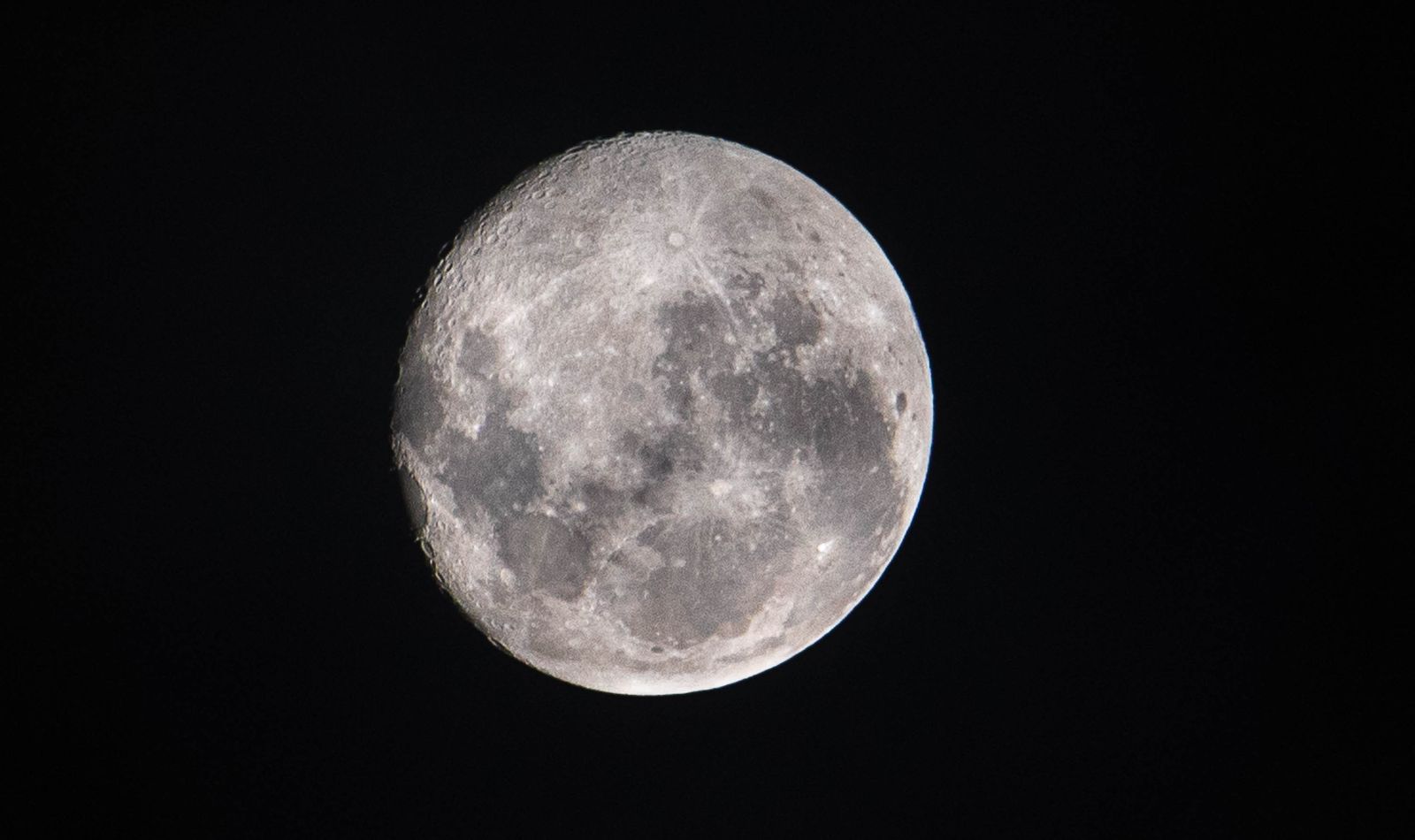
Somewhere in the Sea of Rains, on a stretch of basalt that has not felt sunlight interrupted by a shadow in fifty-five years, an eight-wheeled Soviet machine the size of a large bathtub is still parked where its controllers left it in the autumn of 1971. It weighs 756 kilograms. It has a pressurized magnesium tub for a body, a hinged lid lined with solar cells, and a French-built retroreflector bolted to its front, angled at the Earth. In April 2010, a NASA laser-ranging team at the Apache Point Observatory in New Mexico aimed a pulse of green light at the coordinates where they thought the rover might be sitting, and on the first attempt, after four decades of silence, photons came back.
The rover is Lunokhod 1, the first machine to drive on another world. It landed on 17 November 1970, aboard the Luna 17 spacecraft, and over 322 Earth days it covered 10.5 kilometres of the lunar surface, returned around 20,000 photographs, and conducted hundreds of soil-mechanics tests. Then its controllers in Simferopol, in Crimea, lost contact, closed the file, and for reasons that had as much to do with Cold War secrecy as with lunar dust, more or less forgot exactly where it had come to rest.
A bathtub on wheels, driven from Crimea
Lunokhod 1 does not look like a spacecraft in the American idiom. There is no sleek fairing, no cylindrical instrument bay. It looks like a laundry tub someone bolted to a chassis of eight independently sprung wire-mesh wheels, then dropped a hinged convex lid over the top. The lid was the point. Closed during the fourteen-Earth-day lunar night, it protected the electronics from temperatures of around minus 150 degrees Celsius. Opened during the lunar day, its inner surface, coated with solar cells, powered the rover, while a small polonium-210 heat source kept the interior warm.
The vehicle carried two forward-facing television cameras with a 50-degree field of view, four high-resolution panoramic telephotometers, a soil-mechanics penetrometer, an X-ray spectrometer, and, mounted on the front, a corner-cube laser retroreflector supplied by a French team. That last instrument is the reason this story has a second act.
The five-person driving team sat in a windowless room outside Simferopol, staring at a slow, flickering television feed that updated every few seconds. Signal delay from Earth to Moon is around 1.3 seconds each way, which meant that every command, every steering correction, arrived on the lunar surface after the rover had already moved past whatever prompted the command. The drivers learned to think in delays, which is a strange thing to ask a human brain to do.
10.5 kilometres, 322 days, 20,000 photographs
The mission was originally planned for three lunar days, roughly three Earth months. It lasted eleven. Between November 1970 and September 1971, Lunokhod 1 traversed 10.5 kilometres of Mare Imbrium, surveyed roughly 80,000 square metres of terrain, and sent back around 20,000 images including 200 panoramas. KQED’s summary of the off-Earth distance rankings puts Lunokhod 1 at 6.5 miles, which is the same 10.5 kilometres in imperial dress, and still a respectable showing on the all-time list even now.
Its successor, Lunokhod 2, would drive nearly four times farther in less than half the time, and would hold the off-world distance record for four decades until NASA’s Opportunity finally passed it on Mars in 2014. But the first rover set the shape of everything that came after: solar-powered, teleoperated, insulated against the night, patient.
In September 1971, after surviving eleven lunar nights, the isotope heater ran down. The interior temperature collapsed during the twelfth night. When the Sun came up on 30 September, the rover did not answer. On 4 October, ten years to the day after Sputnik, mission control formally declared Lunokhod 1’s mission complete.
The parking spot they lost
Here the story gets stranger than the engineering. The Soviet Union had a public map of where Lunokhod 1 had gone, but the map was imprecise, the tracking data was closely held, and the final resting coordinates, as opposed to the landing coordinates of Luna 17, were never nailed down in a way that Western scientists could use. For decades, laser-ranging teams could bounce pulses off the retroreflectors left by Apollo 11, 14 and 15, and off Lunokhod 2, whose location was better constrained. Lunokhod 1’s mirror was, in practical terms, missing.
This mattered scientifically. Lunar laser ranging, the practice of timing how long a pulse of light takes to travel to the Moon and back, is one of the most precise tests of general relativity available. Each additional retroreflector at a known location improves the geometry of the measurement. The Apollo mirrors cluster near the equator. Lunokhod 2 sits in Le Monnier crater. A working reflector at Mare Imbrium, well to the northwest, would widen the baseline considerably.
The break came from an unrelated instrument. NASA’s Lunar Reconnaissance Orbiter, launched in 2009, began returning high-resolution images of the lunar surface. In March 2010, Arizona State University planetary scientist Mark Robinson and his team spotted, in an LRO image of Mare Imbrium, a small bright object with a very long shadow, and next to it, a set of parallel tracks curving away across the regolith. The tracks led to the Luna 17 lander. The bright object was Lunokhod 1, sitting where it had stopped in 1971.
The first shot in forty years
A team led by Tom Murphy at the University of California, San Diego, running the APOLLO laser-ranging experiment at Apache Point in New Mexico, took the new coordinates and fired. On 22 April 2010, on their first attempt, they got roughly 2,000 photons back, a signal so strong it startled them. Astronomy Magazine’s account of the retroreflector’s recovery quotes Murphy noting that the Lunokhod 1 reflector was returning signals several times brighter than Lunokhod 2’s, possibly because its lid had protected the mirror from lunar dust settled over decades.
The angle mattered too. Lunokhod 1 had come to rest, by luck, with the retroreflector pointing almost directly at Earth. It had been sitting there, aimed and ready, for the entire time anyone had assumed it was lost.
What the return signal was actually measuring
A laser pulse fired from Apache Point spreads, over the roughly 384,000 kilometres to the Moon, into a spot several kilometres across. Of the pulse, only a tiny fraction strikes the corner-cube array on Lunokhod 1’s front panel. The array reflects each incoming photon back along its incoming path, which is the geometric trick of a corner cube. That returning beam spreads again on the way back, so of the initial pulse of perhaps 10^17 photons, the detector at Apache Point counts a handful.
Timing those returning photons to the picosecond gives the Earth-Moon distance to within a few millimetres. Do this over years, at multiple sites on the Moon, and you can test whether Einstein’s general relativity holds in a system as clean as two gravitationally bound bodies. So far, it does.
The Soviet lineage the West did not always see
Lunokhod 1 was designed under the direction of Georgy Babakin at the Lavochkin design bureau, working within the broader lunar and planetary program that Sergei Korolev had built and led until his death in 1966. The rover flew four years after Korolev’s funeral, and it flew in a Soviet space program that had, by then, quietly conceded the crewed Moon race to Apollo. The Lunokhods were the alternative case: robotic, patient, and, in the argument the Soviets were making, cheaper and safer.
That case has aged reasonably well. Every Moon rover that has followed, from China’s Yutu 2 on the lunar far side to India’s Pragyan near the south pole, has been a robotic descendant of Lunokhod 1 more than of the Apollo Lunar Roving Vehicle. The Apollo buggies were extensions of astronauts. The Lunokhods were the astronauts.
Still there, still aimed
The rover has now been parked in Mare Imbrium for longer than most people alive today have been driving. Its wheels are locked in the regolith at coordinates 38.2378 degrees north, 324.9949 degrees east. The lid is still open. The retroreflector is still aimed at Earth.
Every few months, a laser pulse from New Mexico or from the Grasse station in France reaches the front panel and comes back, carrying a measurement of the Earth-Moon distance accurate to a few millimetres. The rover is not doing anything else. It is, in the strict sense, doing physics by sitting still.
The photons that returned in April 2010 had left Apache Point 2.5 seconds earlier. They struck a mirror that had been placed there by engineers, some of whom were no longer alive, working for a country that no longer exists. The measurement they carried back was the same measurement the mirror had been designed to make in 1970. It had just taken forty years for anyone to ask the question again.