

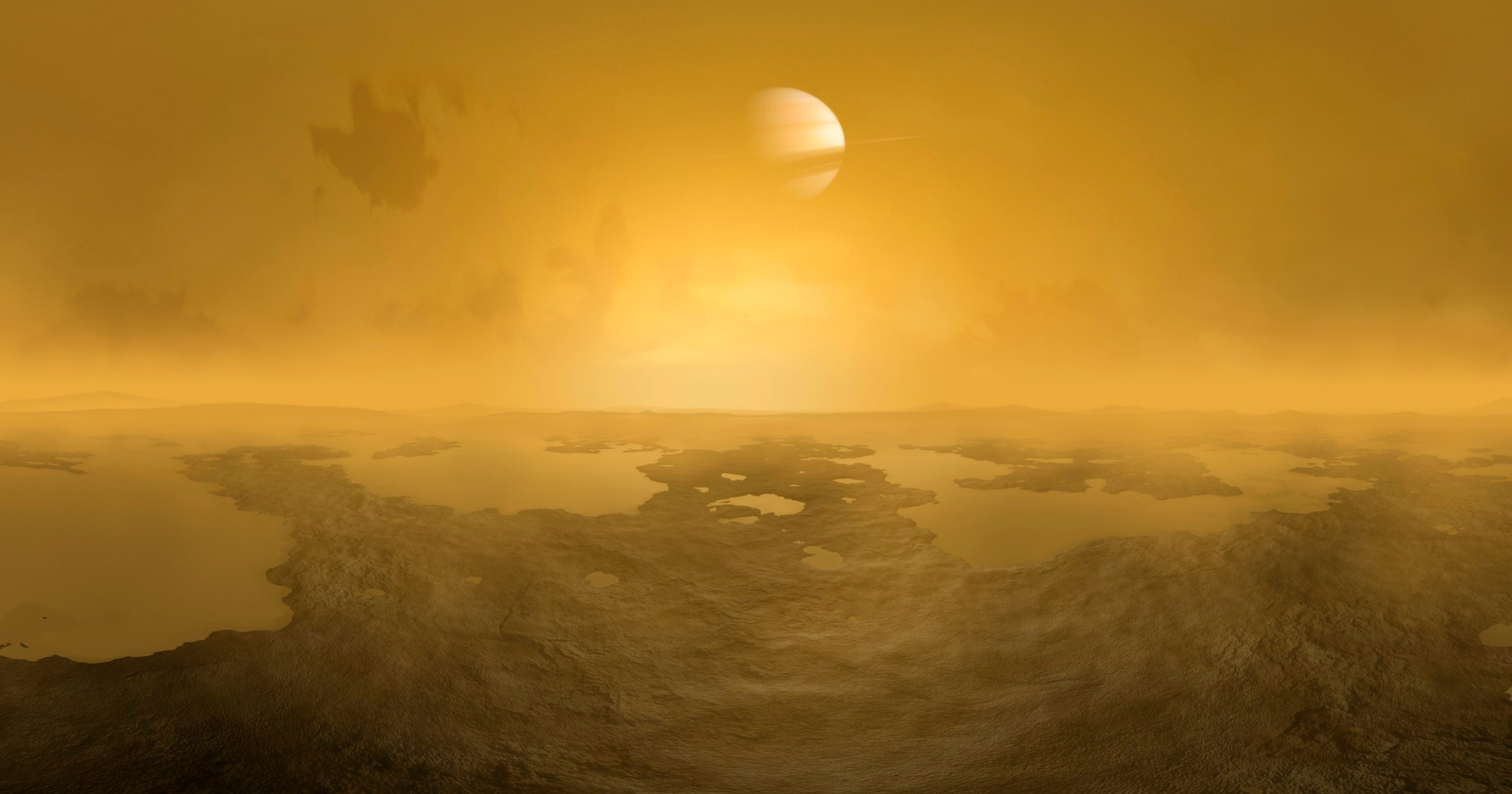
Nine hundred million miles from Earth, in the outer solar system, Saturn’s largest moon runs a full weather cycle.
Methane evaporates from surface lakes. It condenses into clouds. It falls as rain — slowly, in droplets larger than any raindrop on Earth. It gathers into rivers that flow across ice-covered valleys, cuts channels into the frozen surface, pools into shallow lakes and small seas. Then it evaporates back up into the atmosphere and begins the cycle again.
Titan is the only place besides Earth where liquid falls from the sky and shapes the landscape it lands on. Everything about the system looks familiar until you catalogue what it is actually made of. And the specific system running that cycle should not, by every reasonable calculation, still be running at all.
The specific inversion
The parallels between Titan’s hydrology and Earth’s are close enough to feel eerie once you actually catalogue them.
Titan has clouds. It has thunderstorms. It has weather fronts and seasonal precipitation. It has rivers that carve valleys, then flow into deltas, then empty into lakes and small seas. Cassini radar sounded one of those seas — Ligeia Mare, in Titan’s northern hemisphere — at approximately 160 metres deep, deep enough that the radar signal passed through the methane and bounced off the seafloor. The imaging revealed shorelines with the same specific shapes that water bodies produce on Earth: peninsulas, bays, islands, drowned river mouths.
Everything looks familiar until you remember what it is made of. The rain is liquid methane and ethane. The rock the rain falls on is frozen water, cold enough to be as hard as any Earth mineral. The atmospheric pressure at the surface is 1.5 times Earth’s. Gravity is about one-seventh. Raindrops on Titan fall in slow motion, drifting down at roughly the pace of falling snow, in droplets larger than any raindrop on Earth.
Every role in Earth’s water cycle is present. The specific materials filling each role have been swapped for something colder and stranger. And the system works — has been working, apparently, for a very long time.
That last part is where the science gets uncomfortable.
The chemistry that shouldn’t work
Methane in Titan’s atmosphere is being destroyed continuously.
Ultraviolet light from the Sun and high-energy particles from Saturn’s magnetosphere break methane molecules apart, splitting them into hydrogen and various hydrocarbon fragments that rain out as heavier organic compounds — the specific chemistry that produces Titan’s famous orange haze. This process has been running for the entire 4.5 billion years the moon has existed.
The half-life of methane in Titan’s upper atmosphere, based on the measured destruction rate, is somewhere between 10 and 100 million years. This is a rounding error compared to the age of the solar system. Whatever methane Titan started with should have been broken down and rained out as heavier organics hundreds of times over by now.
Titan should be a dry, methane-free ball of water ice covered in a thick layer of accumulated organic sludge. Instead, it has an atmosphere that is roughly 1.4% methane, an active weather system driven by that methane, and lakes filled with liquid methane and ethane at its poles.
Something is putting the methane back.
Where it might be coming from
This is the specific scientific puzzle Titan actually presents.
The leading hypotheses fall into three categories, all of them speculative to varying degrees. The first is cryovolcanism — the possibility that Titan has active geological processes releasing methane from its interior into the atmosphere, analogous to how Earth’s volcanoes release carbon dioxide and water vapour. Some Cassini imagery has been interpreted as showing possible cryovolcanic features on Titan’s surface, but the identifications remain contested and no active cryovolcano has been directly observed.
The second is stored methane in Titan’s crust. A recent proposal, laid out in The Planetary Science Journal, suggests that Titan has a crust of methane clathrates — cage-like structures of water ice with methane molecules trapped inside — that has been slowly releasing methane into the atmosphere over billions of years. If this is right, the current methane cycle is being fed by a slow leak from a large subsurface reservoir.
The third is primordial storage in the interior. Titan may have accreted with substantial methane during its formation and be gradually releasing it from a deep interior reservoir that has nothing to do with the crust.
The three hypotheses have very different implications. If methane is being volcanically outgassed, Titan is geologically active in a way we do not yet fully understand. If it is stored in crustal clathrates, the current cycle is finite and will eventually run down. If it is primordial, the moon is more fundamentally strange than most models allow.
Cassini could not distinguish between these possibilities. The next mission is being built specifically to try.
What Dragonfly will look for
NASA’s Dragonfly mission, currently in development, is scheduled to launch in July 2028 and arrive at Titan in 2034. It is a rotorcraft — a car-sized, nuclear-powered flying laboratory that will operate in Titan’s dense atmosphere by using rotor blades to fly between multiple landing sites over the course of several years.
The mission’s primary scientific goals include measuring the specific chemistry of Titan’s surface at multiple locations, characterising the composition of surface materials, and looking for prebiotic organic chemistry that might indicate conditions relevant to the origin of life. But one of its secondary targets is directly relevant to the methane puzzle: identifying the specific sources of atmospheric methane, whether from active cryovolcanism, subsurface reservoirs, or something else.
If Dragonfly can find a site where methane is currently being released — a vent, a fissure, a specific outgassing region — it will provide the first direct evidence of how Titan’s cycle is being sustained.
The mission will not answer the biggest question about Titan, which is whether the specific chemistry running on its surface could support any form of life. Methane-based biochemistry is speculative and no consensus exists on whether it is even possible. But Dragonfly will at least resolve the more immediate mystery: what is keeping the whole system running.
Somewhere on Titan tonight, methane rain is falling in slow motion through a nitrogen atmosphere onto valleys of ice, filling shallow lakes, evaporating back into orange clouds. It has been doing this for a very long time. Something we do not yet fully understand is topping up the atmosphere as the sunlight above quietly breaks it apart. In another decade, if the mission holds together, we may finally know what.
