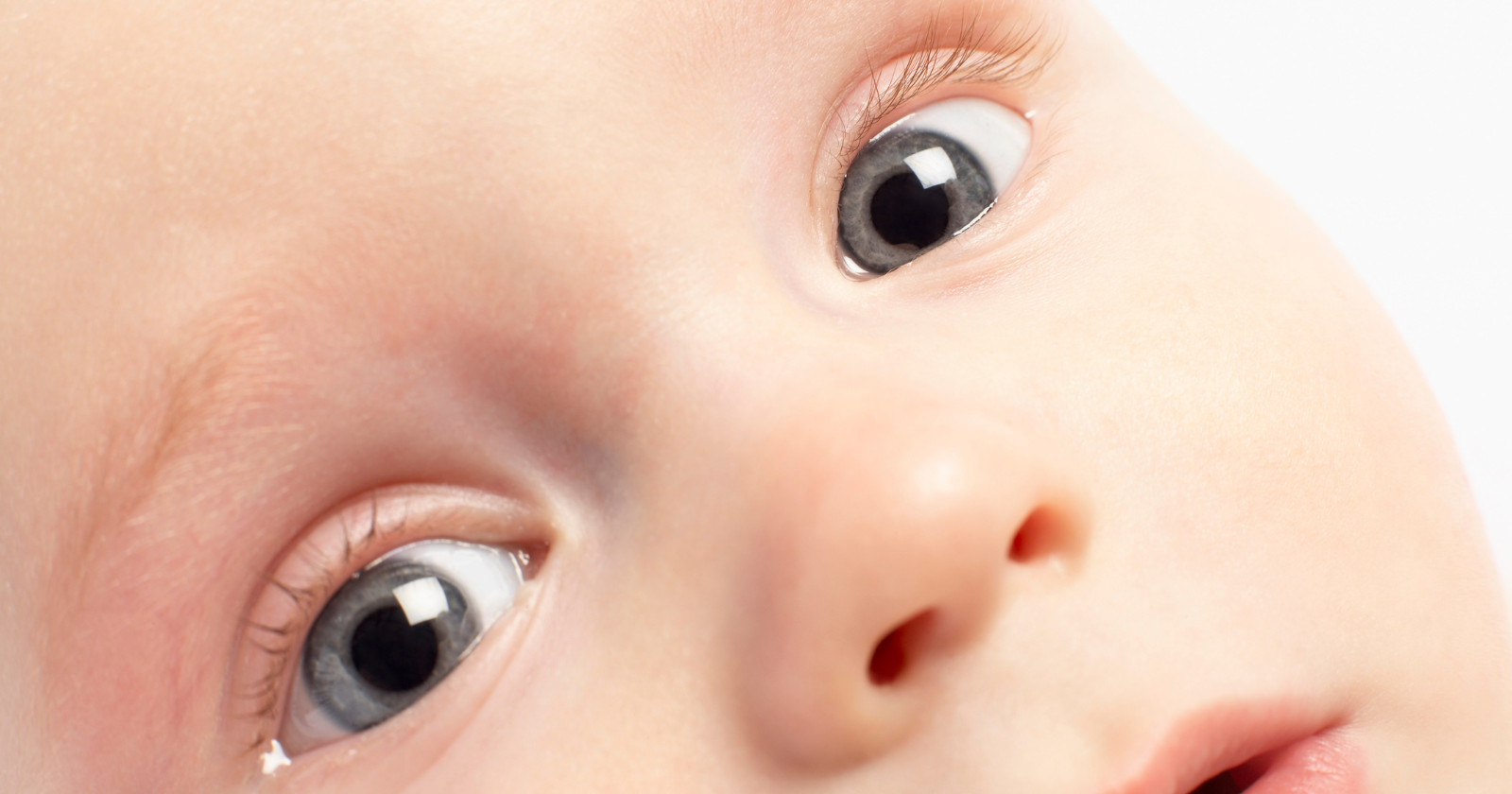
Show a six-month-old a photograph of a spider and something happens that the baby gets no say in. The pupils widen. Nobody in the room would notice, but an infrared camera catches it every time.
What the eye tracker actually saw
Sixteen babies in Uppsala, average age 183 days, sat on a parent’s lap about 60 centimetres from a screen. Their parents wore sunglasses covered in opaque plastic, so they could not see the images and could not leak a reaction. Pictures appeared one at a time for five seconds each: eight spiders, eight flowers, shuffled together. Every fourth image, a little starry sky with chirping birds popped up to keep the baby interested.
Every spider had been matched to a flower for colour, for size on screen, and for brightness. That last one is easy to underrate. Pupils shrink in bright light too, so the researchers levelled brightness across every image before measuring anything else.
Flowers and fish were picked as comparisons for a fairly mundane reason. Their shapes and surfaces are close enough to spiders and snakes that the two can be matched without the images looking ridiculous, which is harder than it sounds once you start considering the alternatives. Sample size, sixteen infants per experiment, was fixed in advance by a power calculation, before any data came in. Half the babies met the spiders first and half met the snakes, so plain fatigue cannot explain the pattern.
Spiders produced an average pupil dilation of 0.14 millimetres. Flowers produced 0.03. Stefanie Hoehl of the Max Planck Institute for Human Cognitive and Brain Sciences and her colleagues at Uppsala University published the result in Frontiers in Psychology in October 2017, under the frankly excellent title “Itsy Bitsy Spider…”.
A tenth of a millimetre is invisible to anyone without a machine, and it held up statistically.
Why the pupil is such a useful snitch
Why would a photograph make a muscle inside someone’s eye move at all? When the brain’s noradrenaline system fires (the low-level alarm circuitry that sharpens attention before anyone consciously decides anything), the pupil opens a fraction. Hoehl said the neurotransmitter involved primes the nervous system for vigilance and alertness, as Live Science reported at the time.
What gets measured, then, is arousal, a broader and vaguer state than fear. The babies stayed perfectly content throughout. Something in them simply shifted up a gear, an effect that peaked about two and a half seconds after each picture appeared, which is where the researchers set their measurement window.
Then the snakes made a mess of it
Snakes did not cooperate.
In the second phase of that session, the babies also saw snakes paired with colour-matched fish. Here the numbers went flat: 0.16 millimetres for snakes, 0.16 for fish. Two explanations were live. Either infants react to animals in general, some broad life detector rather than a threat detector, or the snake response bled onto the fish, which sat in the same shuffled deck and had been matched closely for colour, size and luminance.
So the team ran it again with 32 fresh babies split into two groups, one seeing only snakes and the other only fish. Snakes averaged 0.29 millimetres. Fish averaged 0.17.
Monkeys had been dropping hints for decades
A young rhesus monkey with no prior experience of real snakes will still freeze and shriek at a toy one after watching another monkey do the same. Michael Cook and Susan Mineka demonstrated this, writing in the Journal of Experimental Psychology: Animal Behavior Processes: monkeys shown edited videotapes of a peer recoiling from a toy snake acquired a fear of snakes, while monkeys shown the identical performance aimed at artificial flowers acquired nothing whatsoever.
Two decades later, Quan Van Le, Lynne Isbell and their co-authors went looking for the hardware. Recording from the pulvinar of macaques raised without ever meeting a snake, they reported in the Proceedings of the National Academy of Sciences that individual neurons fired faster and harder at snake photos than at monkey faces, monkey hands or geometric shapes.
Human infants had already been caught staring. David Rakison and Jaime Derringer found that five-month-olds looked longer at spider-shaped arrangements than at scrambled versions of the same parts, a finding published in Cognition in 2008. Five months old, no meaningful experience of anything with eight legs, and the shape still held their attention.
The word researchers use is preparedness
Martin Seligman coined it in 1971 and it does a lot of quiet work. The claim was never that a newborn is frightened of spiders, only that the wiring arrives pre-tilted, so the lesson takes hold faster whenever it turns up.
That framing also explains an awkward gap in the numbers. Clinical phobias of spiders and snakes run at roughly one to five per cent of people, yet more than a third of children and adults will happily tell you they find both creatures revolting, in a part of the world where almost none of them will ever be bitten. A tilt that common, and a phobia that rare, suggests most of us grow out of the head start through ordinary safe exposure. Spiders keep turning up in the laundry and failing to kill anyone.
Keep the scale in view, though. Three experiments, 48 infants, one Swedish city, one paper. Prepared learning has decades of support behind it, and the pupil result should be read as a single study rather than a settled conclusion.
In coverage by Smithsonian, Hoehl argued that an inherited stress reaction of this kind predisposes children to learn these animals as dangerous or disgusting, and that other factors, such as a parent losing their composure at the sight of one, can turn a mild bias into a genuine phobia.
Which makes arachnophobia a collaboration. Biology supplies the flinch. Everything after that gets taught down a channel that was already open and waiting: the shriek, the rolled-up magazine, the flat refusal to go anywhere near the shed.