

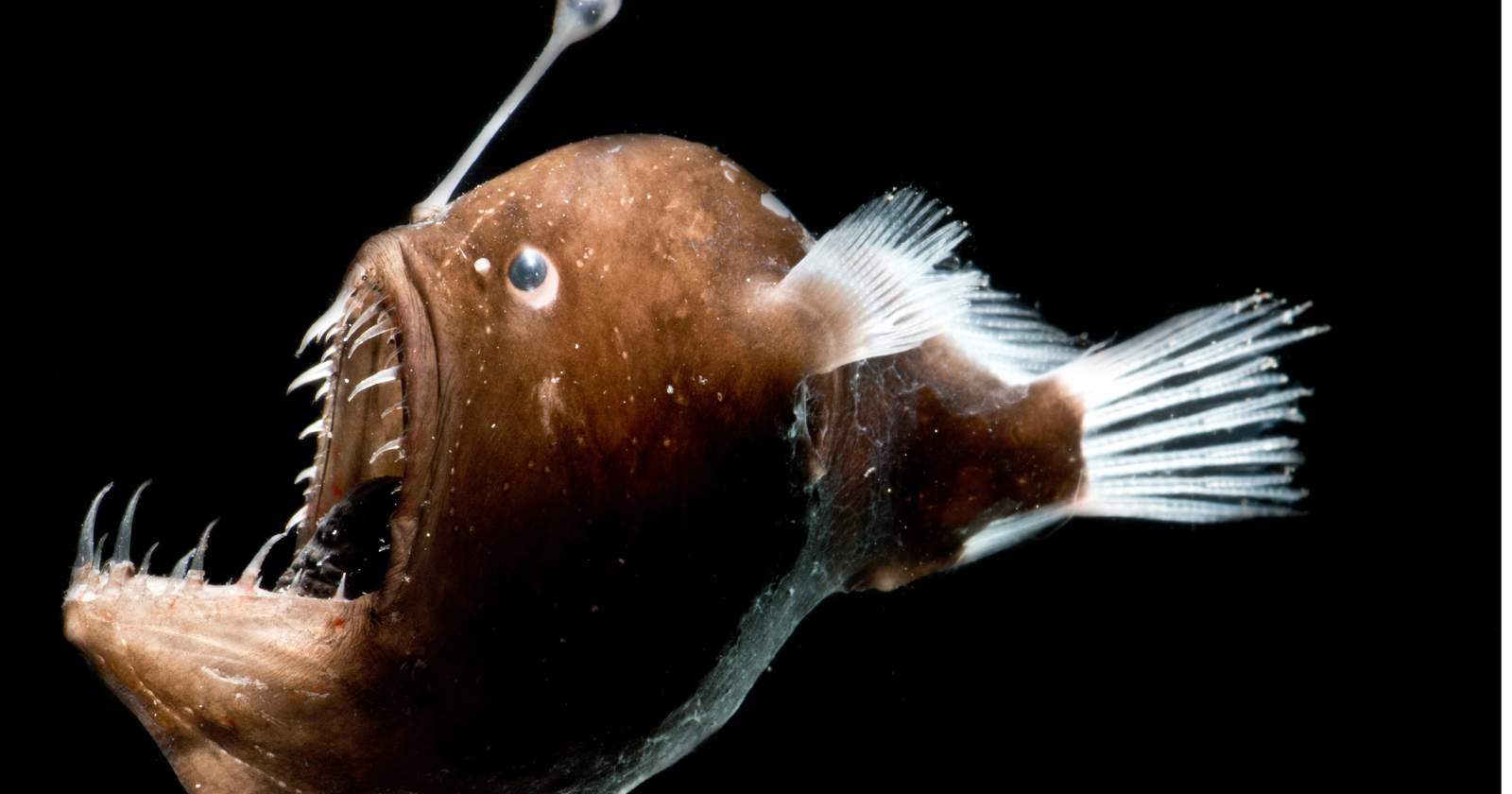
Eight hundred metres down, in water that is functionally black, a fish the size of a fist is swimming around with her husband welded into her flank.
He found her in the dark, bit down, and never let go. What happened next is where things get strange, because his body then set about dissolving the wall between them.
The male turns up with almost nothing
Male deep-sea anglerfish are small in a way that reads like a typo. In the northern giant seadevil, Ceratias holboelli, females can be more than sixty times the male’s length and roughly half a million times his weight, a size gap catalogued by the University of Washington ichthyologist Ted Pietsch in his monograph on oceanic anglerfishes. No glowing lure. No dinner. His jaw teeth fall out during metamorphosis and get replaced by pincer-like denticles on the snout and chin, hooks built for exactly one job.
What he does have is sensory kit tuned to finding her. Enormous nostrils in some families, big forward-facing eyes in others, depending on whether his species tracks a chemical signal or a light show.
Then the biting.
His body dissolves into hers
Latching on is only step one. Writing in Nature in 1975, Pietsch reported that attachment is followed by a fusion of skin tissue and eventually a joining of the two circulatory systems, after which the male depends entirely on her blood for food. A review of anglerfish reproduction and immunity published in the journal Life describes the chemistry involved: he releases enzymes that break down her tissue around his mouth, joining the two animals anatomically.
Over the following months he loses his eyes, nearly all of his fins and most of his internal organs, until little more than a permanent attachment and a pair of testes is left of him. He also grows far bigger than any free-living male of his species, because whatever she eats, he now eats too.
Biologists call the arrangement parabiosis. Researchers on the immune study, as reported by ScienceAlert, point to one other natural example: identical conjoined twins. Outside that pairing, anglerfish sexual parasitism is the only known case of it happening on its own. Pietsch has documented females carrying as many as eight of them at once.
Why she doesn’t reject him
Graft one animal’s tissue onto another and the immune system usually starts a war. Human transplant patients take drugs for the rest of their lives to stop exactly that.
Anglerfish went the other way and threw out the weapons. Jeremy Swann, Thomas Boehm and colleagues at the Max Planck Institute of Immunobiology and Epigenetics, working with Pietsch, sequenced anglerfish genomes and reported in Science that species whose males attach only temporarily have lost functioning aicda genes, which fine-tune antibodies. Those with permanent attachment go further still, and some have lost working rag genes altogether, gutting the adaptive immune system every other vertebrate leans on. They appear to run on innate immunity alone.
That is one paper on a handful of species, and its authors say plainly that how the surviving immunity actually works remains unknown. Collecting usable specimens took them roughly a decade, because anglerfish hauled up from the abyss arrive dead.
Most anglerfish never do this
The gruesome version has become the whole group’s reputation, which overstates things badly. In a survey published in Ichthyological Research, Pietsch found permanently attached males in only 5 of the 11 deep-sea anglerfish families, 10 of 35 genera, and 23 of about 160 known species. Plenty attach briefly and let go. Plenty never attach at all.
He also turned up the record holder. A mature male Photocorynus spiniceps of 6.2 millimetres, stuck to the back of a 46 millimetre female, is recognised by Guinness World Records as the smallest sexually mature vertebrate ever measured.
Nobody watched it happen until 2016
All of the above came out of dead fish in jars, starting in 1924, when Charles Tate Regan worked out that the lump on a big female’s side was a shrivelled male. Then, in August 2016, Kirsten and Joachim Jakobsen took a submersible down a deep wall off Sao Jorge in the Azores, spotted something with an odd shape, and filmed a mated pair of fanfin anglers for 25 minutes. Pietsch, who received the footage afterwards, told Science that he had never seen anything like it.
The male in that footage was freshly attached rather than fully fused. He moved about freely on his mount, apparently untroubled by what was coming.
That leaves an obvious tally. He gave up his body and every option he ever had. She got a permanent sperm supply, no further courtship to bother with, and a partner physically incapable of walking away. Evolution rarely bothers with fairness. It just runs with whatever works, over and over, for as long as it keeps working.