

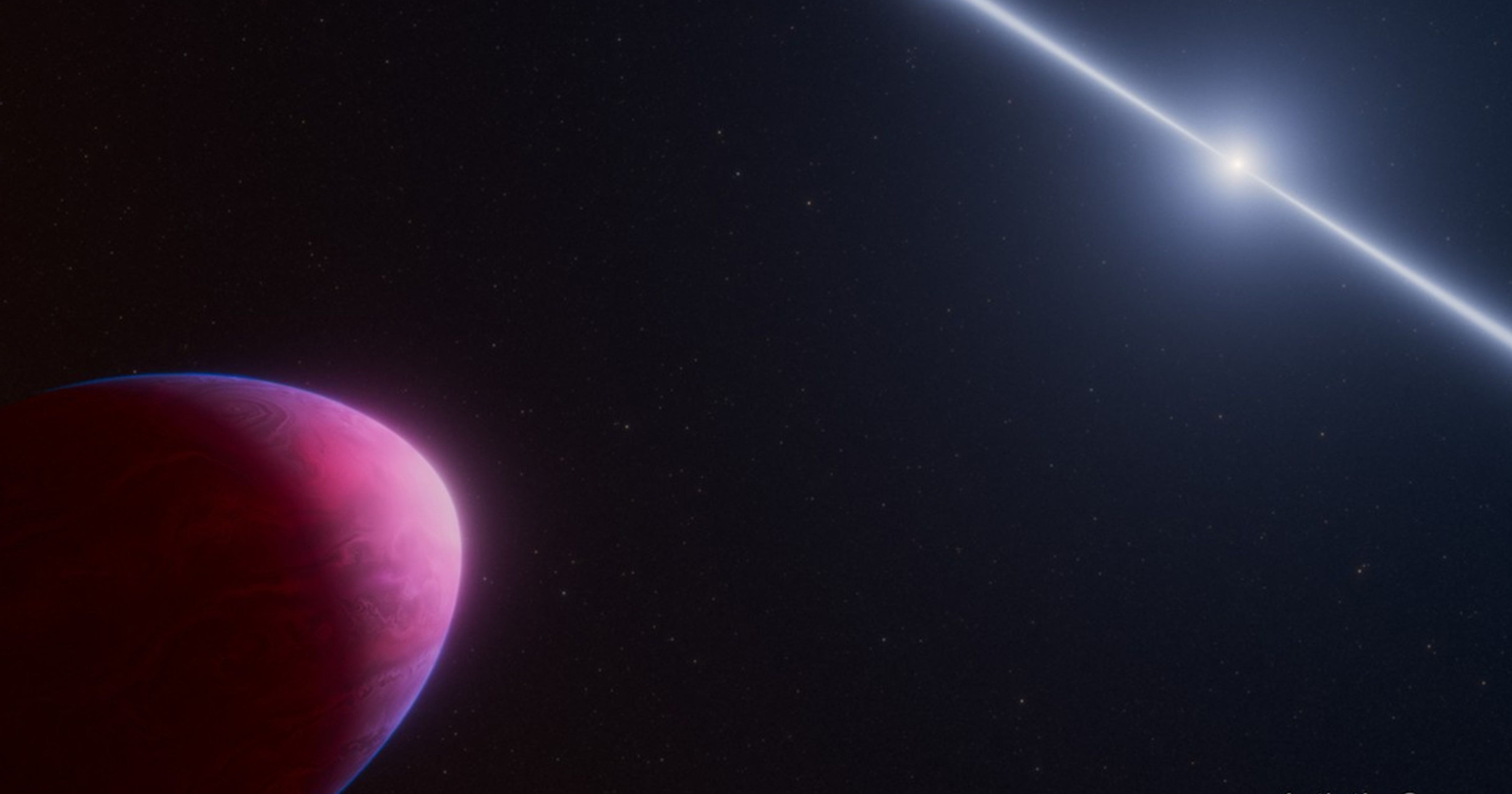
About 2,000 light-years away, a planet roughly the mass of Jupiter completes a full orbit in 7.8 hours, circling so close to the collapsed star at its centre that the star’s gravity has stretched it into a lemon shape. When the James Webb Space Telescope examined its atmosphere, it found something that has not turned up in any of the roughly 150 exoplanet atmospheres characterised so far: molecular carbon, in a system that appears to be missing almost all of its nitrogen and oxygen.
The planet, catalogued as PSR J2322-2650 b, orbits a millisecond pulsar, a neutron star spinning hundreds of times a second, left behind after a massive star’s core collapsed. The finding comes from a paper, “A Carbon-rich Atmosphere on a Windy Pulsar Planet,” led by Michael Zhang at the University of Chicago with co-authors Peter Gao, Maya Beleznay, Roger Romani and around twenty other collaborators, accepted by The Astrophysical Journal Letters in December 2025.
An unlikely place to find a planet at all
It is worth being precise about what “collapsed star” means here, because it matters for why this system is strange. A pulsar is not a cooling ember like a white dwarf. It is the compact, rapidly spinning remnant of a star that ended its life in a supernova, and it sheds intense high-energy radiation as it spins. A planet sitting roughly 1 million miles from an object like that, closer to its star than Mercury is to the Sun by a wide margin, sits inside an environment that ordinary planet-formation models do not obviously account for. Whether PSR J2322-2650 b formed alongside the pulsar or arrived there some other way, through capture, migration, or survival of a companion star that was gradually stripped down to this remnant, is not settled by the current paper. Zhang has weighed the question in his own terms: “Did this thing form like a normal planet? No, because the composition is entirely different. Did it form by stripping the outside of a star, like ‘normal’ black widow systems are formed? Probably not, because nuclear physics does not make pure carbon.” A “black widow” system, in pulsar astronomy, is one where the pulsar’s radiation has slowly stripped material from a companion star. Zhang’s point is that even that familiar process does not obviously produce an atmosphere this pure.
The planet’s mass is estimated at somewhere between 1.4 and 2.4 times Jupiter’s, with a radius close to Jupiter’s own. Tidal forces from the pulsar have distorted its shape enough that researchers and NASA’s own materials describe it as lemon-shaped rather than the more common oblate, slightly flattened shape seen in other tidally stressed worlds. Some earlier catalogues placed this pulsar system closer, around 750 light-years, based on an older distance estimate from its 2017 discovery; the 2,000 light-year figure used in coverage of this JWST result reflects a more recent estimate, and it is worth flagging that distances to pulsars derived this way carry real uncertainty.
What Webb actually found in the atmosphere
Most characterised exoplanet atmospheres, whatever their temperature, turn up some combination of familiar molecules: water, methane, carbon dioxide, carbon monoxide. This one did not. Zhang has described the result plainly: “Instead of finding the normal molecules we expect to see on an exoplanet, like water, methane, and carbon dioxide, we saw molecular carbon, specifically C3 and C2.” Those are chains of two and three carbon atoms bonded together, a form of carbon chemistry that does not show up in the atmospheres Webb has examined elsewhere.
The reason this specific chemistry stands out is what it implies about everything else in the atmosphere. At the planet’s estimated equilibrium temperature of around 1,900 kelvin, molecular carbon of this kind can only persist if there is almost nothing else around to react with it. The paper reports a carbon-to-oxygen ratio above 100 and a carbon-to-nitrogen ratio above 10,000, figures that only make sense if the atmosphere has been stripped of the vast majority of its nitrogen and oxygen. Zhang has made the same point in plainer terms: producing molecular carbon at all means the atmosphere first had to lose almost everything else, essentially all its oxygen and all its nitrogen.
An open question, not a solved one
What caused that depletion is the part the paper does not resolve. Co-author Roger Romani has floated one possibility: that the companion object may be cooling in a way that allows carbon to crystallise and float upward through its interior, concentrating carbon near the surface while other elements settle elsewhere. Even Romani frames this as tentative rather than confirmed: “Something has to happen to keep the oxygen and nitrogen away. And that’s where there’s controversy.” No mechanism proposed so far, according to Zhang, cleanly accounts for an atmosphere this skewed, and the paper describes the composition as ruling out every known formation pathway for a planet like this one, not confirming a new one.
That distinction is worth sitting with. A result that “rules out existing explanations” is a genuinely useful scientific outcome. It is not the same as a result that hands over a new explanation, and coverage of this planet risks blurring the two. The honest summary is that Webb has found an atmosphere nobody predicted, made of chemistry nobody expected, around a type of star where surviving planets are already unusual, and nobody currently has a mechanism that accounts for all of it at once.
Why one measurement carries this much weight
This is a single paper, based on one set of Webb spectroscopic observations, of one planet. The carbon detection itself appears robust: the spectral signatures of C2 and C3 are distinctive enough that misidentifying them as something else is unlikely.
What is far less certain is the causal story behind the numbers, why this particular pulsar planet ended up so completely stripped of nitrogen and oxygen when other exotic planetary environments have not produced anything comparable.
Independent modelling of pulsar-planet formation, and ideally a second object with a similar chemical signature, would do more to settle the question than any amount of further analysis of this one target.
The next useful step is theoretical: a formation model that can actually produce carbon-to-oxygen and carbon-to-nitrogen ratios this extreme, tested against what is known about pulsar environments and planetary interiors. A second detection of a similarly depleted atmosphere, around this pulsar’s companion or another one like it, would also matter more than additional observations of the same planet.
Until either arrives, PSR J2322-2650 b stands as a single, well-measured anomaly: a real atmosphere, a real and unusual chemistry, and a mechanism that has not yet been identified.