

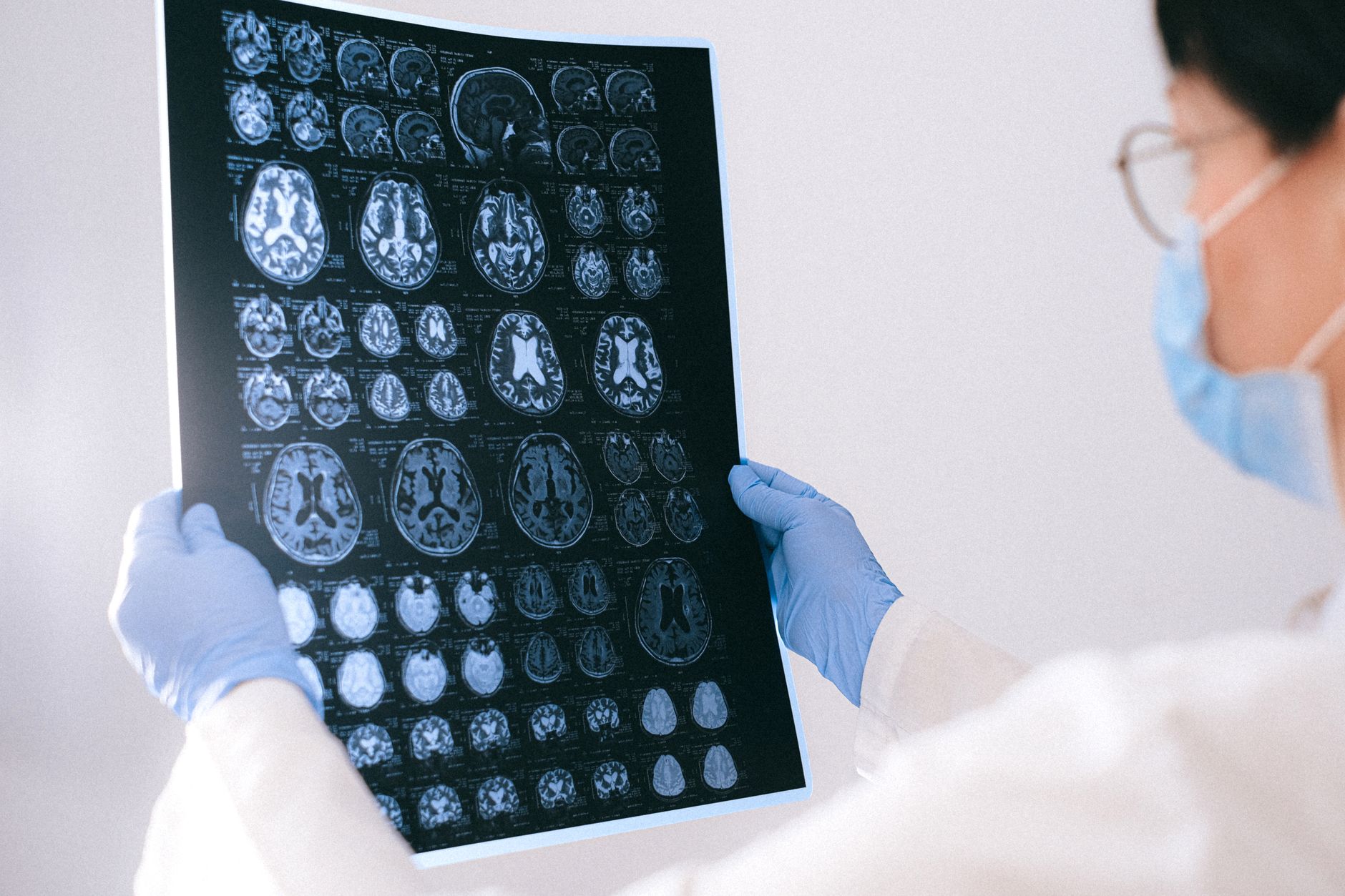
The simplest version of a brain-and-intelligence hypothesis is easy to picture. A larger brain can contain more neurons. More neurons provide more biological machinery. More machinery should mean a higher intelligence score. Each step sounds plausible, but the last one did not survive a rare direct test.
In a Cerebral Cortex study of post-mortem tissue from 50 Danish men, researchers estimated the total number of neurons in the neocortex and compared those estimates with intelligence scores recorded when the men were young. The correlation was almost exactly zero. This is one study, not settled consensus, but it argues against a strong, simple relationship between total neocortical neuron count and IQ in this sample.
The result does not say that neurons are unimportant. Thought cannot happen without them. It says that counting the units, without describing their organization or activity, may reveal surprisingly little about how well a human brain performs on an intelligence test.
Why more neurons looked like a reasonable answer
Brain size and intelligence do have a positive association. A 2015 meta-analysis of brain volume and IQ combined 88 studies, 148 samples and more than 8,000 people. It estimated a correlation of 0.24, equivalent to roughly 6 percent of the variance in scores. That is a real but modest group-level relationship, not a basis for judging an individual’s intelligence from the size of a scan.
Larger brains also tend to contain more neurons, glial cells, white matter and other tissue. It was therefore reasonable to suspect that neuron number might be the microscopic quantity behind at least part of the volume result.
The question had remained largely unanswered because MRI can estimate the shape and volume of a living brain but cannot count its billions of individual cells. Direct counting requires preserved tissue, careful sampling and a way to estimate the whole from tiny sections. Researchers also need a reliable cognitive score recorded before the donor died. Brain collections with both kinds of information are extremely rare.
How the researchers turned tissue into a count
The team began with 52 brains and excluded two for technical reasons. The final sample consisted entirely of Danish men who died between ages 20 and 52 from various non-neurological causes. The authors excluded cases with conditions including dementia, diabetes, hypertension, major psychiatric disturbance and drug abuse. Four men had a history of alcohol dependence and six had cancer, but their neocortical cell totals did not differ significantly from the rest of the sample.
The intelligence scores came from Børge Prien’s Prøve, a test used to evaluate Danish military conscripts. The men took it at ages 18 to 20. Because they were born between 1937 and 1962, the researchers converted raw scores using norms from the relevant testing year, adjusting for the generational rise in test performance known as the Flynn effect. The sample’s mean IQ was 96, with a standard deviation of 14.
For the anatomy, the team used stereology, a set of sampling methods designed to produce unbiased estimates of three-dimensional structures from tissue sections. They sampled the frontal, parietal, temporal and occipital lobes and identified cells by their appearance in stained tissue. The biological variation in total neuron number across the brains was about 12 percent, while the researchers aimed for counting precision of about 4 percent.
The work extended well beyond neurons. The team also estimated astrocytes, oligodendrocytes and microglia, then measured cortical volume, surface area and thickness, white matter, central gray matter and the cerebral ventricles.
The neuron-count correlation was negative 0.05
The correlation between IQ and estimated neocortical neuron number was (r=-0.05). Correlations range from -1 to 1, so that value is practically near zero. Men with more counted neurons were not reliably the men with higher scores.
The uncertainty matters. The bootstrapped 95 percent confidence interval stretched from -0.33 to 0.24. With 50 brains, the authors calculated that they had 80 percent power to detect a correlation of about 0.34. The study was therefore better equipped to reject a strong relationship than to determine whether a small positive or negative one exists.
No significant relationship appeared for the counts of oligodendrocytes, astrocytes or microglia. Nor did IQ correlate significantly with cortical volume, surface area, thickness, white-matter volume, central gray matter, ventricular volume, brain weight or body height. All of those correlations were below 0.2 in magnitude.
That broad set of near-zero results is striking, but it remains a finding from 50 people. A non-significant result is not proof that the true effect is exactly zero. Here, the most defensible claim is that total cell number was not a strong predictor of IQ in this particular material.
Brain volume and neuron number are not interchangeable
The post-mortem result does not cancel the much larger MRI literature. The two approaches measure different things and operate at different scales. Brain volume can reflect neurons, glial cells, dendrites, axons, blood vessels, extracellular space and myelin. A positive volume correlation does not tell us which of those components matters, or whether volume is standing in for several features at once.
The study’s authors also noted that MRI measurements from living brains do not map perfectly onto stereological measurements made from fixed tissue. Tissue preparation changes physical properties, while scan resolution can make the boundaries of folds and compartments difficult to place. The failure to reproduce a brain-volume correlation in 50 post-mortem brains could therefore reflect limited statistical power, measurement differences or both.
A broad review of the neuroscience of intelligence described intelligence as a distributed property involving parietal and frontal regions, white-matter integrity and efficient network organization. That account is compatible with a modest role for overall volume and little direct role for total neuron count. Size can be one ingredient without being the mechanism.
What scientists mean when they point to wiring
A total count treats every neuron as one equivalent unit. Biology does not. Neurons differ in location, shape, gene expression, dendritic complexity, synapse number, myelination and firing behavior. Two brains with similar cell totals can therefore possess very different information-processing architectures.
One study of living human cortical tissue removed during surgery linked higher IQ scores with larger dendritic trees and faster firing in sampled pyramidal neurons. Its morphology analysis involved tissue from 25 patients, and its electrical recordings involved 31, so it too should not be treated as a final explanation. It nevertheless illustrates the kind of cellular detail a whole-neocortex count erases.
At a larger scale, diffusion imaging of 79 healthy young adults found that higher intelligence scores were associated with shorter network paths and greater global efficiency in anatomical brain networks. A related Science Blog report described how connectivity among higher-order brain regions correlated with IQ in adolescent cohorts.
These studies do not prove that “wiring” is one master variable. The term bundles together structural connections, functional coordination, synaptic strengths, transmission speed, inhibition, network hubs and the capacity to change with experience. Some reviews of intelligence and neuroimaging also find mixed results across particular network measures. The defensible idea is not that one count has been replaced by one wiring score, but that organization carries information a count cannot.
A valuable negative result with real limits
The sample was small, exclusively male and drawn from one country. The men belonged to birth cohorts from 1937 through 1962. Their intelligence was tested around age 18 to 20, while their brains were examined after deaths occurring as late as age 52. IQ tends to be relatively stable in rank order through adulthood, but the measurements were not simultaneous.
Cell identification was based on morphology in Giemsa-stained sections. The authors said immunohistochemistry had supported their identification criteria, but physical anatomy after death cannot capture metabolism, moment-to-moment activity or functional connectivity in a living person.
IQ also measures performance on a defined set of cognitive tasks. It is reproducible and useful for some research questions, but it is not a complete inventory of creativity, judgment, knowledge or every ability people call intelligence. Development, education, health and social conditions influence both test performance and the brain that produces it.
The clean conclusion is narrower and more interesting than “neuron count does not matter.” In these 50 men, knowing the estimated number of neocortical neurons would not have helped predict IQ. The finding weakens a picture of intelligence as simply owning more identical processing units. It directs the harder questions toward how those cells are built, connected, timed and coordinated, where counting alone is no longer enough.