

In a fold of Redwood National Park in northern California, a coast redwood called Hyperion rises 115.92 metres from the forest floor. That is roughly 380 feet, taller than the Statue of Liberty, and enough to make it the tallest living tree ever measured. Park officials confirmed the measurement, and the National Park Service will not tell you where the tree is.
There is no trail. There is no sign. The rangers will fine you five thousand dollars and, in theory, jail you for six months if they catch you near it.
The secrecy is the story.

A tree taller than a 30-storey building
Hyperion is a Sequoia sempervirens, the coast redwood, the tallest tree species on Earth. It was found by two naturalists working their way through a remote drainage in the northern section of the park. The tree they measured that day beat the previous record-holder, a redwood called Stratosphere Giant, by roughly two metres.
The height number moves slightly depending on the survey. Park Service documentation and news coverage settle on 115.92 metres. Some measurements have recorded slightly different heights, reflecting variations in climb-and-tape measurement techniques. Either way, Hyperion clears every other confirmed tree on the planet, including a Taiwan fir found in 2023 that tops out at 84.1 metres.
Nobody has taken a core sample to determine the tree’s age. Coring a tree this large risks fungal infection, and the Park Service has not been in the mood to authorize experiments.
Why the location is a secret
For the first decade after Hyperion was discovered, its rough location circulated among tree hunters and bloggers. GPS coordinates leaked. Trip reports appeared on hiking forums. By the late 2010s, enough people were bushwhacking through the ferns and sorrel of the drainage that the ground around the base of the tree was compacted, eroded, and stripped of undergrowth.
The Park Service closed access in 2022. Park officials told SFGATE that the visitor pressure had become impossible to manage. There was trash. There were side trails hacked through vegetation. People were relieving themselves at the base of the tree and leaving toilet paper behind.
The five-thousand-dollar fine and possible six-month jail term followed. NPR reported the penalties in August 2022, alongside the park’s plain request: do not come.
What happened to the previous record-holder
Stratosphere Giant, the redwood Hyperion knocked off the top of the list, was found in Humboldt Redwoods State Park. Its location was published. Within a few years, the base of the tree showed the same pattern that would later damage Hyperion: soil compaction, root exposure, understory loss. Tree biologists warned that trampling the shallow root system of a redwood is one of the more efficient ways to shorten its life.
Redwoods do not have deep taproots. Their roots spread laterally and interlock with the roots of neighbouring trees. The whole system sits in shallow soil. When people walk on it, the soil compresses. Water infiltration drops. Fine feeder roots die. The tree that survived a thousand winters and a century of industrial logging can be undone by foot traffic in a decade.
The Guardian’s reporting on the closure quoted park officials describing exactly this pattern around Hyperion: erosion at the base, damaged root zones, the slow degradation of the microhabitat the tree depends on.
The name, and what a coast redwood actually is
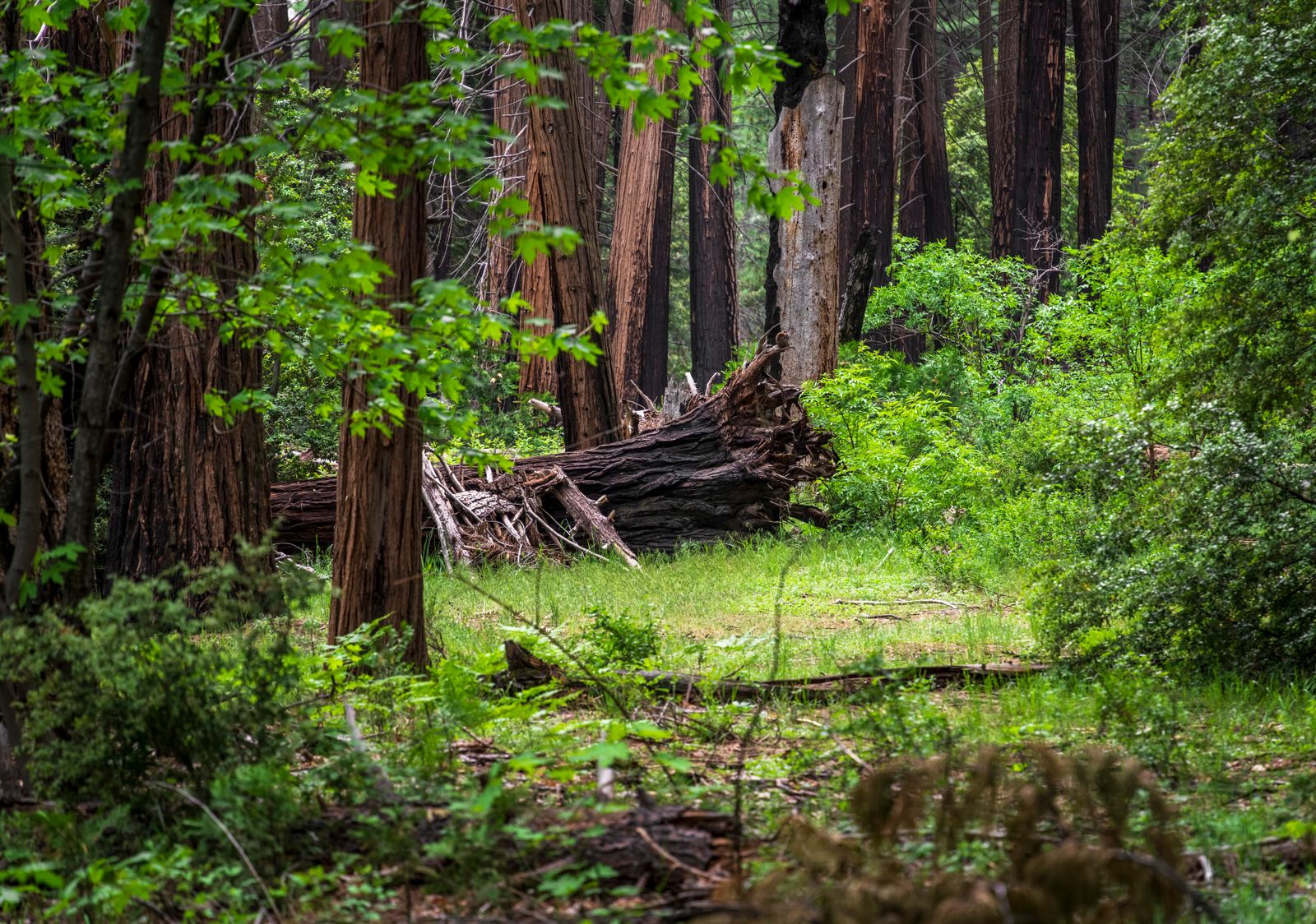
Hyperion is named for one of the Titans of Greek mythology. Coast redwoods make the name feel less grandiose than it reads on the page. Standing under a mature one, the trunk disappears upward into a canopy you cannot see from the ground.
Sequoia sempervirens grows only in a narrow strip of coastal fog belt from southern Oregon to central California. The fog matters. Redwoods take up moisture directly through their needles, which is part of how they push water so high against gravity. A 115-metre tree is close to the theoretical limit for how tall a tree can be, set by the physics of pulling water from roots to leaves.
Most of the original old-growth redwood forest was logged between the mid-19th century and the 1960s. The trees that survive at Hyperion’s scale exist because a handful of drainages were too steep, too remote, or too legally tangled to cut before conservation caught up.
What the closure is actually protecting
The tree itself is probably not what visitors would damage most. Hyperion has thick, fire-resistant bark and has stood through droughts, storms, and at least one major wildfire cycle. What visitors damage is the ground beneath it, and the specific fungal, invertebrate, and understory community that a mature redwood shapes around itself.
An old redwood is a habitat, not just an object. The canopy holds soil mats where huckleberries and even other trees grow. The base supports salamanders and specialised fungi. The root network exchanges carbon and water with the trees around it. Removing a tree of this age from the forest is not like removing a lamp post from a street. The absence keeps working for centuries.
This is the argument the Park Service is quietly making by refusing to publish coordinates. The tallest tree is not a monument to visit. It is a node in a system, and the system is fragile in ways that a five-minute selfie stop cannot see.
The tree hunters and the map they will not publish
A small community of amateur and professional dendrologists still measures redwoods systematically, climbing with ropes and dropping fibreglass tapes from the crown. Their internal records include several redwoods within a metre or two of Hyperion’s height, and there is a plausible case that a slightly taller tree exists somewhere in the same drainage system, unmeasured.
None of them are publishing coordinates anymore. The lesson of Stratosphere Giant, and now Hyperion, is that the location is the vulnerability. In 2023, when researchers in Taiwan announced the tallest tree on that island, an 84.1-metre Taiwan fir they named Heaven Sword of the Da’an River, they described the expedition to reach it, and then followed the same convention the Redwood National Park team now uses: the specific location was kept vague.
The convention has become the norm for record trees. If you find one, you do not tell.
What the fine really means
Five thousand dollars is a serious penalty for walking somewhere in a national park. The Park Service is not enforcing it because Hyperion is precious in the sentimental sense. It is enforcing it because the previous management approach, which was to hope people would behave, did not work.
Bloggers wrote directions. Travel writers filmed themselves at the base. GPS coordinates appeared on hiking sites. The tree the Park Service now protects by silence is protected because the earlier era of openness produced measurable damage that photographs, before and after, made undeniable.
There is a version of this story that reads as a defeat, the internet finding one more thing and ruining it. The version the Park Service seems to be telling is simpler. A tree that took centuries to reach its current height is worth keeping alive for the next several. If that means it is no longer a destination, that is the trade.
Hyperion is still standing, roots intact, in a drainage the map will not show you. In another decade, if the closure holds, the trampled ground around the base should start to recover. The ferns will come back. The soil will loosen. And the tree, which was already tall when the printing press was invented, will keep growing at the rate redwoods grow, which is very slowly, and unbothered.