

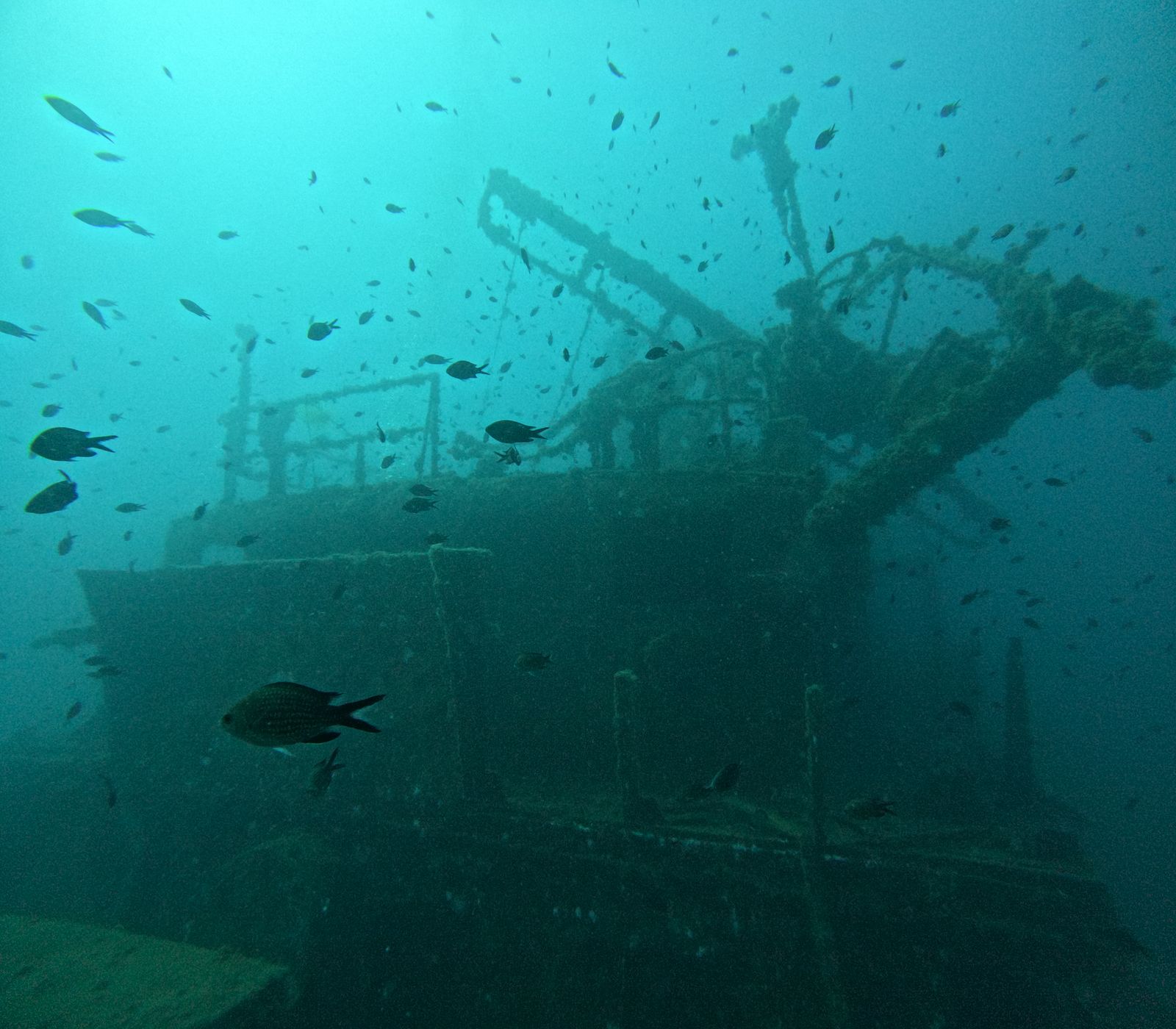
In the deep water of the Black Sea, below roughly 150 metres, oxygen simply runs out. Not low. Not stressed. Zero. And in that lightless, oxygen-free layer, a Greek merchant ship recorded by remote camera in 2017 and announced to the world the following year lies on the seabed with its mast still standing, its rudder in place, and the benches where rowers once sat still recognisable after roughly 2,400 years.
The ship is about 23 metres long. It is thought to date to around the fourth century BCE, the era of Plato and Aristotle. It lies over on its side, and in the released ROV footage it looks less like a wreck than a ship someone forgot to sail home.
The reason it survives is chemistry.
Why the deep Black Sea has no oxygen
The Black Sea is the largest body of permanently anoxic water on the planet. Freshwater from the Danube, the Dnieper and, by way of the Sea of Azov, the Don floats on top. Denser, saltier water from the Mediterranean sinks beneath. The two layers barely mix. Oxygen from the surface never reaches the bottom in any meaningful quantity, and below roughly 150 metres the water contains, for practical purposes, none at all.
That threshold has been documented in detail by biogeochemists. A Frontiers in Microbiology study of the Crimea margin found that the chemocline meets the seafloor at roughly 150 to 170 metres, and that a belt of whitish sulphur-bacteria mats runs along it. Below that boundary, the water is dominated by hydrogen sulphide, the compound that gives rotten eggs their smell.
Wood-boring molluscs cannot live there. Neither can the bacteria that normally digest ship timbers on the seafloor. The organisms that break down a wreck in the Aegean or the Atlantic within a few decades are, in the deep Black Sea, absent.
So the wood stays.
What the discovery actually showed
The vessel was surveyed with remotely operated vehicles roughly 50 miles off the Bulgarian coast, in more than two kilometres of water. It was located during the final season of the Black Sea Maritime Archaeology Project’s three-year survey — Smithsonian reported that the ship was found in the summer of 2017 — and the find was announced publicly on 23 October 2018. A small sample of wood was carbon-dated, returning a date of around 400 BCE.
The ship resembles vessels painted on Greek pottery of that era, including the famous Siren Vase in the British Museum, which shows Odysseus lashed to a mast of the same general design. The wreck lies on its side, mast and rudders still in place. The benches for the rowers are visible in the ROV imagery.
The vessel was not raised. Lifting waterlogged ancient wood out of an anoxic environment tends to destroy it, and the project’s principal investigator has said the ship will stay where it is. Two kilometres down, it is beyond the reach of divers and of anyone who might be tempted to salvage it.
The chemistry that preserves the wood
The preservation is not magic. It is the absence of the usual decay pathway. In oxygenated seawater, aerobic microbes and shipworms consume cellulose and lignin within decades. In the anoxic deep Black Sea, those organisms cannot survive. What lives down there instead are anaerobic microbes that run their metabolism on sulphate and other compounds, and their appetite for old ship timbers is limited.
The chemistry has other consequences. Anoxic basins are active producers of nitrous oxide, the greenhouse gas better known as laughing gas. Research published in Limnology and Oceanography in 2025 measured active nitrous oxide production in the Black Sea’s suboxic zone, and noted that the basin is nonetheless reckoned only a minor emitter of the gas — because other microbes consume it before it can reach the surface. The same layered chemistry that preserves a rudder is also filtering a potent greenhouse gas.
The Black Sea is not an inert tomb. It is a chemically active column with distinct biological zones stacked on top of one another. Sunlight penetrates the surface. A narrow band of low-oxygen water sits below. Then the anoxic mass begins, and continues to more than 2,000 metres.
Even that anoxic mass contains life. A 2019 paper in The ISME Journal reported picocyanobacteria of the genus Synechococcus — normally a surface-water organism — living at 750 metres in anoxic Black Sea water, and isolated two strains from it. The finding complicated a global assumption about where certain deep fluorescence signals in the ocean come from. The dead zone, in other words, is not entirely dead.
Why this is not an isolated case
The Greek vessel is the oldest intact shipwreck documented in the Black Sea’s anoxic zone, but it is not alone. The same project mapped some 60 wrecks off the Bulgarian coast, from Roman trading ships carrying amphorae to a 17th-century Cossack raiding fleet. Rigging still coiled. Cargo still stacked where it was stowed.
Similar preservation shows up elsewhere in the Mediterranean when conditions cooperate. In August 2026, off Mazara del Vallo in western Sicily, a free-diver scanning the seabed with sonar found hundreds of Roman wine amphorae lying undisturbed at about 46 metres, more than two thousand years after the ship that carried them went down. There the cargo is what survived intact; the hull itself has not yet been fully surveyed. Different circumstances, related outcome: the sea, under the right conditions, keeps things that the sea usually destroys.
The Black Sea’s mechanism is the more unusual one, because it works on any organic material that sinks below the oxygen line. Wood. Rope. Textile fragments. Human remains. Grain in an amphora. The seabed at two kilometres depth is, in preservation terms, closer to a peat bog than to a normal ocean floor.
What ocean deoxygenation means for the rest of the sea
The chemistry that makes the Black Sea an archaeological freezer is also, in a diluted form, spreading elsewhere. Oxygen-minimum zones, regions of the ocean where dissolved oxygen falls to levels that most fish cannot tolerate, have been expanding for decades. A Nature Climate Change commentary noted that while global ocean oxygen is projected to decline under warming, tropical trends are dominated by regional dynamics that can push in either direction.
A 2021 review in Frontiers in Microbiology describes the same trend from the microbial side: deoxygenation is expected to extend oxygen-minimum zones whose growth has been tracked since the 1960s, reshaping the biology of large mid-water regions off Peru and Chile and in the Arabian Sea. Closer to shore, nutrient runoff produces the same effect faster, stripping oxygen from coastal and estuarine water on timescales that matter to fisheries.
None of these regions is likely to become a wooden-ship museum. But the direction of travel is the same one that built the Black Sea’s anoxic mass over thousands of years: less oxygen at depth, more sulphide, less life of the kind we tend to notice.
What the wreck tells us, and what it does not
The ship at the bottom of the Black Sea is one vessel. Its date rests on a single carbon-dated wood sample and on the morphological match with fourth-century BCE Greek merchant designs. That is enough to describe it as ancient with some confidence, and enough to make the design identification interesting. It is not enough to make claims about, say, ancient trade routes on the basis of this one hull.
What the wreck does show, plainly, is what happens when you remove oxygen from the equation. Wood becomes a durable material on geological timescales. Rope survives. A steering oar left in place stays in place.
The ROV footage released by the project is worth watching for one detail in particular. The ship went down heavily enough to settle onto its flank, and then nothing further happened to it. The mast is still attached, still angled out across the sediment, pointing through two kilometres of black, motionless, oxygen-free water toward a surface it has not seen since Aristotle was alive underneath it.