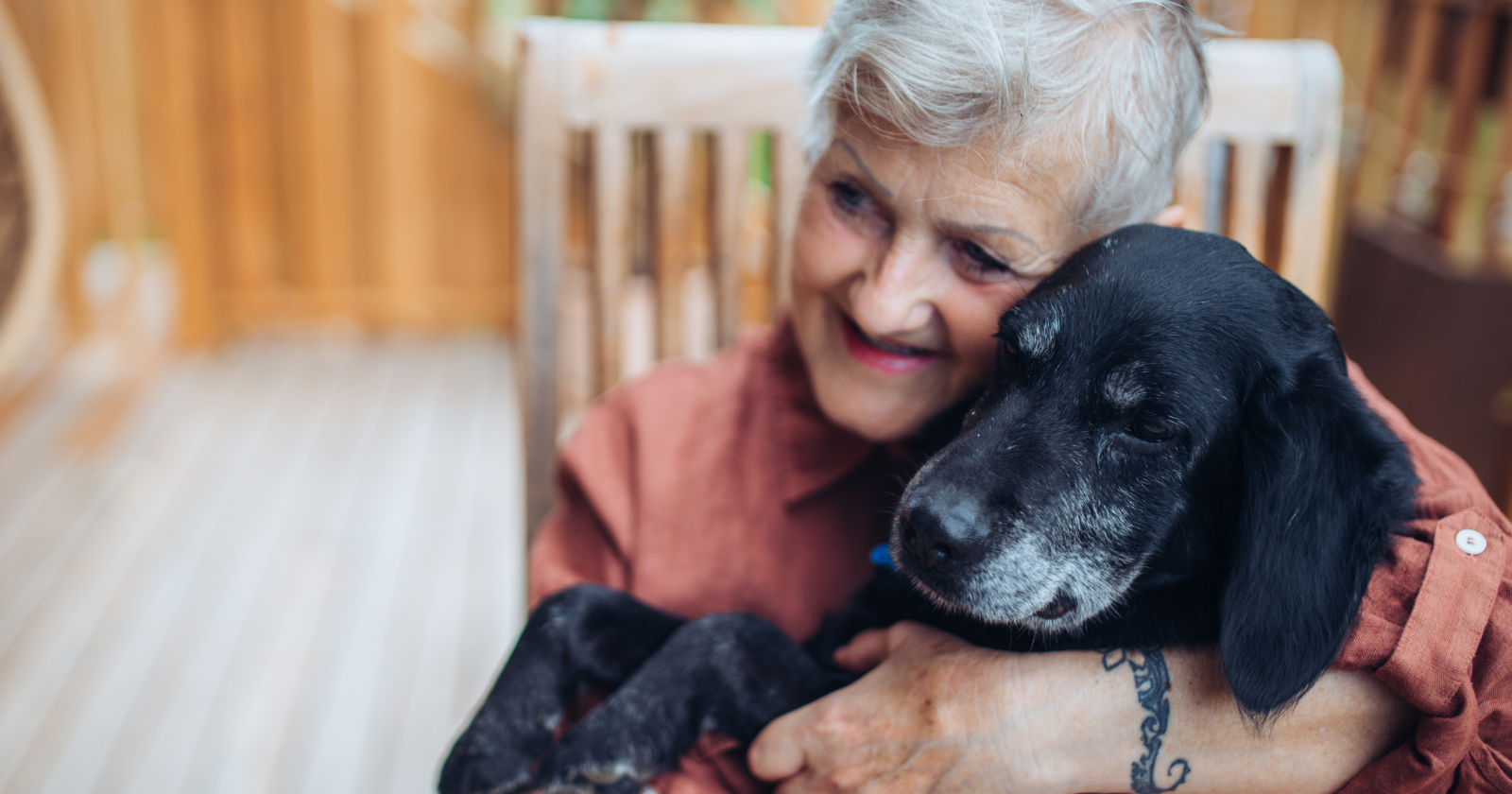
Somewhere right now an eighty-year-old is getting out of bed because a cat is standing on her chest, and tiredness is not going to win that argument.
Small daily obligations turn out to be load-bearing. Two decades of ageing research have circled that idea from the animal side, and the data has grown detailed enough to move past “pets are nice”.
What older pet owners actually say
In September 2025, researchers running the University of Michigan National Poll on Healthy Aging surveyed 2,698 American adults aged 50 to 95 about their animals. Just over half had a pet, mostly dogs and cats. Among owners, 83 per cent said their pet gave them a sense of purpose, 70 per cent credited it with connecting them to other people, and 64 per cent said it made them feel loved.
That purpose figure deserves a second look, because it moved. Seven years earlier the same poll put it at 73 per cent, according to Michigan Medicine’s coverage of the update.
Living alone changes the maths
Yanzhi Li and colleagues at Sun Yat-sen University went looking for something harder to self-report. Tracking 7,945 people through the English Longitudinal Study of Ageing, they found pet owners declined more slowly on verbal memory and verbal fluency over eight years. Split by living arrangement, the effect concentrated almost entirely in people who lived on their own. Their paper in JAMA Network Open put it carefully: pet ownership appeared to offset the penalty that living alone otherwise carried.
That is a single cohort study, and nobody randomised anybody into owning a labrador.
Still, it rhymes with earlier findings. In work published in Aging & Mental Health, Ian Stanley and co-authors surveyed 830 older primary care patients and found owners were 36 per cent less likely to describe themselves as lonely, with the gap widest among those living alone. Separately, a team drawing on the Baltimore Longitudinal Study of Aging documented in Scientific Reports that naming ability held up better in pet owners than in non-owners as they aged, with dog walking linked to slower losses in short-term recall.
Which direction the arrow runs
The cheerful version of this story has a hole in it. Jitka Pikhartova, Ann Bowling and Christina Victor used the same British ageing dataset to ask whether pets protect against loneliness or whether lonely people go out and get pets. Their answer, published in BMC Geriatrics, was both, and the traffic ran in both directions at similar strength. Women who described persistent loneliness across a decade were more likely to be pet owners by the end of it.
Reverse causation is the quiet problem underneath most of this literature. A German review team led by Benedikt Kretzler pooled 24 studies on pets, loneliness and social isolation, published in Social Psychiatry and Psychiatric Epidemiology. The isolation studies were consistent: owning a pet tracked with less social isolation. The loneliness studies split by era, showing a link mainly in research done after the pandemic began, with little association beforehand. Owning an animal reliably puts a person in front of other humans. Whether it reliably makes them feel less alone still depends on when you ask.
The bill arrives as well
Nobody bills you for love. They bill you for the emergency visit. Thirty-one per cent of older American pet owners in the 2025 poll agreed that their animal strained their budget, up from 18 per cent in 2018. Cost was the reason a third of non-owners gave for staying petless, and 46 per cent simply did not want to be tied down.
Financial pressure was not the only thing that shifted. Compared with 2018, owners in 2025 were markedly less likely to say their pet helped them enjoy life, with that figure sliding from 88 per cent to 70. Feeling loved dropped from 86 to 64, stress relief from 79 to 63, physical activity from 64 to 44, and sticking to a routine from 62 to 43. Every warm-glow measure sagged, several by more than twenty points.
What survived the drop
Purpose went up.
Read those two trends side by side, and something odd emerges. Older owners are enjoying their animals less, feeling less soothed by them, feeling less loved by them, and finding them more expensive. Yet more of them than ever say the animal gives them a reason.
That points to purpose and pleasure running on separate circuits. A dog that needs a walk at six in the morning does not require its owner to be delighted, or rested, or even fond of it that particular day. It requires the owner to get up. For someone whose calendar has thinned out and whose phone has gone quiet, that daily non-negotiable claim on their attention may be doing more structural work than any amount of companionship.
Poll figures cannot prove that, and the Michigan team is appropriately cautious about why the benefit numbers slid. Broader financial strain, changing household composition, longer working lives and the rising cost of veterinary care all sit in the frame, alongside the plain fact that animals and their owners are both getting older and needing more care.
But the pattern points somewhere useful for anyone weighing up a rescue cat for a widowed parent. The pitch is usually affection, and affection is where the evidence has grown shakiest. Obligation is what held.