

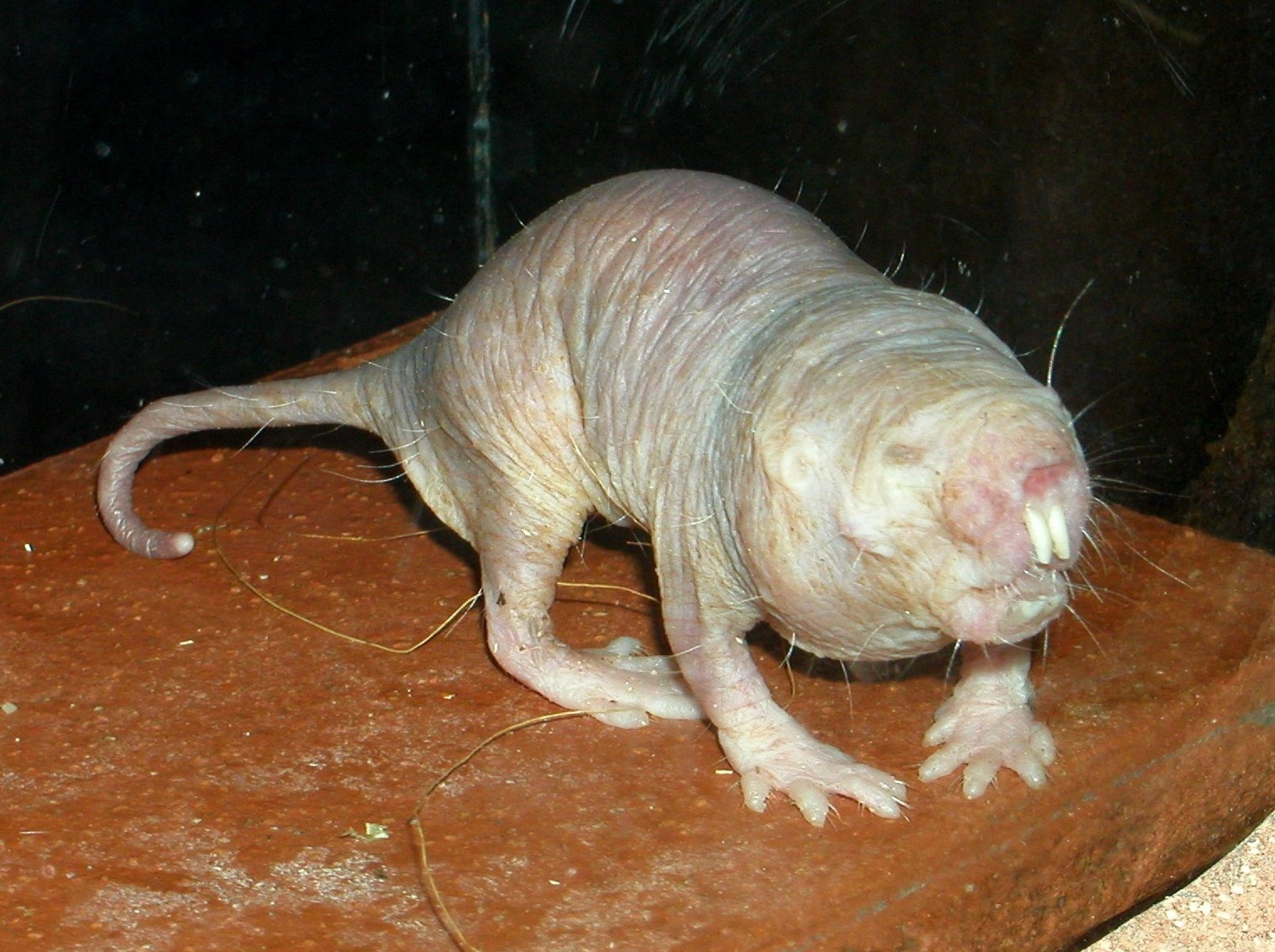
University of Rochester researchers genetically engineered mice to make the naked mole-rat version of an enzyme called HAS2. The altered mice lived modestly longer and developed fewer visible cancers in old age than control mice. This was an animal experiment, not a test in people.
The headline number is striking but needs its denominator. Among mice older than 27 months, the paper reported cancer in 83 percent of 81 control animals and 49 percent of 74 mice carrying the naked mole-rat gene. Across the full lifespan cohort, median survival increased by 4.4 percent.
I am a writer, not a clinician. This is a close reading of one peer-reviewed mouse study, not settled consensus or medical advice.
The result was in genetically engineered mice
Zhihui Zhang and colleagues published the study in Nature in 2023. They inserted naked mole-rat Has2, the gene for hyaluronan synthase 2, into mice under a promoter intended to work throughout the body. The gene was switched on with tamoxifen injections when the animals were two to three months old. Control mice received the same injections without carrying the naked mole-rat transgene.
This was not a simple swap of one ordinary mouse gene for a superior rodent equivalent. It was a deliberately engineered system that drove expression of the naked mole-rat gene across many tissues. Even then, the increase in hyaluronan was mild in several organs because mice break the molecule down more actively than naked mole-rats do.
The distinction matters.
The experiment asks whether one biological feature from a long-lived species can still have an effect inside another mammal. It does not show that the gene is the single reason naked mole-rats live so long.
Why hyaluronan size matters
Hyaluronan, often called hyaluronic acid, is a long sugar molecule in the extracellular matrix, the material surrounding cells. Its behavior depends heavily on chain length. The naked mole-rat makes an exceptionally large form known as high-molecular-mass hyaluronan, or HMM-HA.
A 2013 Nature paper from the same Rochester group reported that naked mole-rat cells accumulated HMM-HA molecules more than five times larger than the versions found in mice and humans. Removing that material made the cells easier to transform into tumor-forming cells. That cell work supplied the premise for the later whole-animal experiment.
The 2023 mouse paper also found lower expression of inflammation-related pathways in several old tissues, less frailty, better performance on a rotating rod and stronger grip. Old female transgenic mice showed better bone connectivity. Experiments in cells and intestinal tissue suggested that HMM-HA could influence immune signaling, oxidative stress and the gut barrier.
Those are several related observations, not one fully proven chain from gene to molecule to longer life. The authors’ proposed mechanism is plausible within their data, but the study does not reduce aging to hyaluronan alone.
The cancer comparison was an old-age subgroup
The absolute cancer figures are important. Across the aging cohorts, 57 percent of transgenic mice died with cancer compared with 70 percent of controls. The larger separation in the title appeared after the researchers restricted the comparison to animals older than 27 months: 49 percent versus 83 percent.
That old-age analysis pooled males and females. It included 74 transgenic mice and 81 controls, and the paper says the pattern was similar in both sexes. The researchers also ran a much smaller chemical skin-cancer experiment. After exposure to DMBA and TPA, the transgenic mice developed fewer papillomas than controls.
There is a measurement limitation that the headline cannot carry. The aging study assessed cancer largely through visible tumors found when dead mice were opened and examined. Some bodies could not be assessed because they had decomposed or been disturbed by cage mates. That is less complete than a standardized microscopic examination of every organ in every animal.
The result is still evidence from the experiment. It is simply evidence with a narrower definition and a specific mouse strain, housing system and genetic construction.
The lifespan gain was modest
The survival analysis included 84 transgenic mice and 91 controls. Median lifespan rose by 4.4 percent, while the paper’s maximum-lifespan measure rose by 12.2 percent. The sex-specific pattern differed: females had a nine percent increase in median lifespan, while males had a 16 percent increase in maximum lifespan.
The University of Rochester announcement accurately reported the 4.4 percent median increase, although its phrase “longevity gene” is more compact than the biology. Has2 makes an enzyme. The enzyme helps produce a particular extracellular molecule, and the downstream effects varied by tissue and sex.
I find the modest median change more informative than treating the study as a life-extension story. A small shift in survival accompanied by less cancer and better function suggests the experiment may have affected several features of late life. It did not turn a mouse into anything remotely resembling a 40-year-old naked mole-rat.
What the naked mole-rat comparison can tell us
Naked mole-rats are close to mouse-sized yet have survived beyond 40 years in captivity. A large demographic analysis published in eLife in 2018 found that their observed risk of death did not rise with age in the usual mammalian pattern across the available data. That unusual life history makes them useful for asking which protective systems evolution has already tested in a mammal.
They are highly resistant to cancer, but not immune. A 2022 review of naked mole-rat cancer biology cataloged several rare tumors found in captive animals. The more defensible claim is that cancer appears uncommon in the species, not impossible.
HMM-HA is also unlikely to be the whole explanation. Work on naked mole-rats has identified unusual patterns in cell-growth control, inflammatory responses, DNA maintenance and metabolism. Transferring one component to mice tests whether that component can travel across species. It does not recreate the evolutionary package.
This is not a human longevity treatment
No person received the gene, and the study did not test a drug, supplement, injection or skin product. Commercial hyaluronic acid products are not equivalent to body-wide production of carefully sized HMM-HA inside a transgenic mouse. Chain length, tissue location, dose and breakdown all affect what hyaluronan does.
The open full paper points toward possible future approaches such as slowing HMM-HA degradation or increasing its production. Those are research directions. Before any human claim could be made, a proposed intervention would need toxicology work, dose studies and clinical trials that measure both benefit and harm.
Questions about cancer risk, treatment or products marketed for longevity belong with a qualified physician. This mouse experiment is not a basis for changing medical care or taking hyaluronic acid.
The next useful result would be an independent replication that separates the effects of molecule size, tissue location and gene expression, followed by a defined intervention that can be tested without permanently engineering an animal.
