

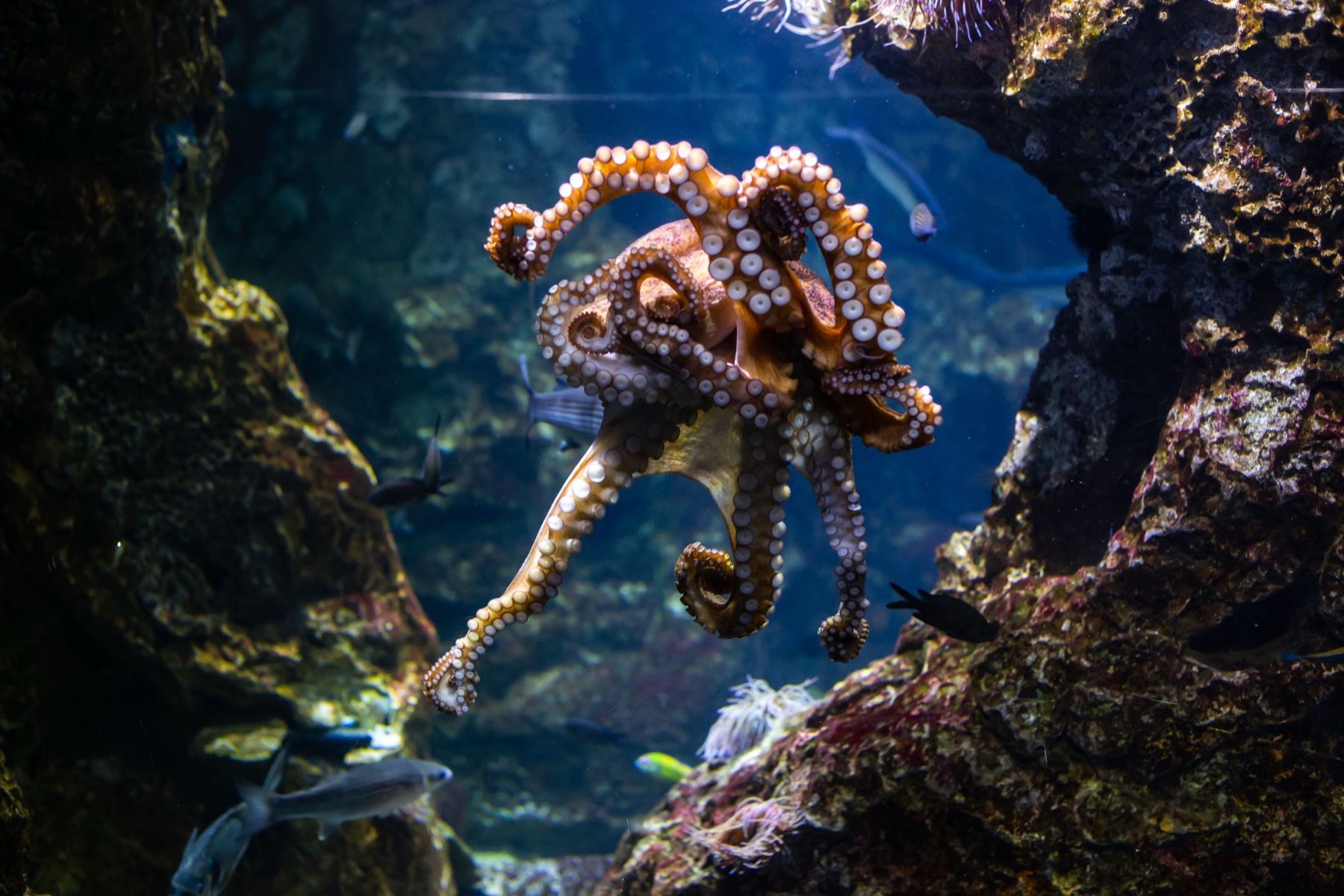
An octopus’s three hearts are not three copies doing the same job. Two branchial hearts push oxygen-poor blood through the gills. The larger systemic heart receives the oxygenated blood and sends it through the rest of the body.
In the common octopus, that main pump can briefly stop during jet-propelled swimming. The clearest evidence comes from a 1987 study in the Journal of Experimental Biology, whose authors recorded pressure and blood flow in freely moving animals. They found that ordinary crawling raised flow, while propulsive jets temporarily interrupted it.
The paper’s explanation was mechanical: squeezing the mantle to make a jet raises pressure around the veins and gill hearts, making it difficult for blood to return. The evidence supports that pressure-gradient mechanism, but did not directly image every vessel as it collapsed. The distinction matters because the popular version often turns a measured, brief interruption into the claim that an octopus switches off a heart for its entire swim.
The three hearts form one connected circuit
Blood returning from the head, arms and organs travels toward the two branchial, or gill, hearts. Each pumps blood through one gill, where the pigment hemocyanin binds oxygen. The two oxygenated streams then enter the systemic heart, whose job is to distribute blood through the body.
The arrangement means the systemic heart depends on the pumps and vessels upstream. In a 1980 Journal of Experimental Biology paper on nervous control of the octopus heartbeat, M. J. Wells reported that the systemic heart contracts only when it is filled. Disconnecting the nerve supply did not stop the trio by itself; disrupting the gill-heart machinery reduced filling, heart frequency and arterial pressure.
This is a closed circulatory system, unlike the more open circulation of many molluscs. A modern anatomical account of blood passing through the gills shows the sequence clearly: veins, branchial hearts, gills, systemic heart, then arteries back to the tissues.
The experiment followed freely moving octopuses
Wells and four colleagues recorded pressure and flow in the dorsal aorta of Octopus vulgaris at rest and during activity. Their 1987 paper found that mean blood pressure, pulse amplitude and blood flow roughly doubled as the animals walked around. Heartbeat frequency changed little, so most of the increase came from the systemic heart ejecting more blood with each beat.
The traces looked different when an octopus produced a jet. Aortic pulses and flow were briefly interrupted. The authors described jet propulsion as being accompanied by cardiac arrest, meaning a temporary cessation in this physiological record. It was not a permanent injury, and the heartbeat resumed after the jet.
That makes “during swimming” a little too broad if read literally. Octopuses can change direction, glide between jets and move in ways that do not demand one continuous high-pressure contraction. What the experiment captured was a pause associated with the forceful jet itself.
The mantle creates a pressure problem
An octopus jets by drawing water into its mantle cavity, sealing the opening and contracting the mantle muscles. Water is driven through the funnel in one direction, pushing the animal in the other. The same muscular chamber contains the gills, gill hearts and important venous pathways.
The researchers compared mantle pressures during jetting with the much smaller pressure pulses available in the large veins. Slow jets in octopuses and related animals produced mantle pressures of roughly 4 to 8 kilopascals; faster escape responses could be higher. Resting venous pressures were only a fraction of that.
The authors inferred that venous blood could not reliably move back into the mantle against the larger external pressure. Too little blood would reach the branchial hearts, too little would cross the gills, and the systemic heart would stop filling well enough to beat. When the mantle relaxed, the pressure gradient eased and circulation could resume.
Crawling lets blood flow rise with activity
Arm-powered crawling avoids this particular conflict because it does not require repeated high-pressure mantle contractions. In the 1987 experiment, common octopuses could walk around their enclosure while cardiac output increased to support the exercise. During a jet, the demand for rapid movement rose just as central blood flow was interrupted.
The team estimated that O. vulgaris could tolerate an oxygen debt of about 22 milliliters of oxygen per kilogram. On that basis, they argued that jet-propelled travel could not be sustained for more than a few meters. That figure is a physiological inference for the studied animals, not a stopwatch record or a fixed limit for every species.
Not every octopus lives by the same rule
This work concerned the common octopus, a bottom-dwelling species whose arms are well suited to moving across rock and sediment. It should not be stretched into a claim about every cephalopod. Squid sustain active swimming with different body plans, and pelagic octopuses do not live like animals that spend much of the day on the seafloor.
For a benthic common octopus, though, the trade-off is coherent. Crawling allows circulation to increase with exercise. Jetting offers rapid escape while briefly working against venous return. Three hearts solve much of the challenge of supplying an active mollusc, but they cannot remove the pressure cost of turning the mantle into a pump for movement.