

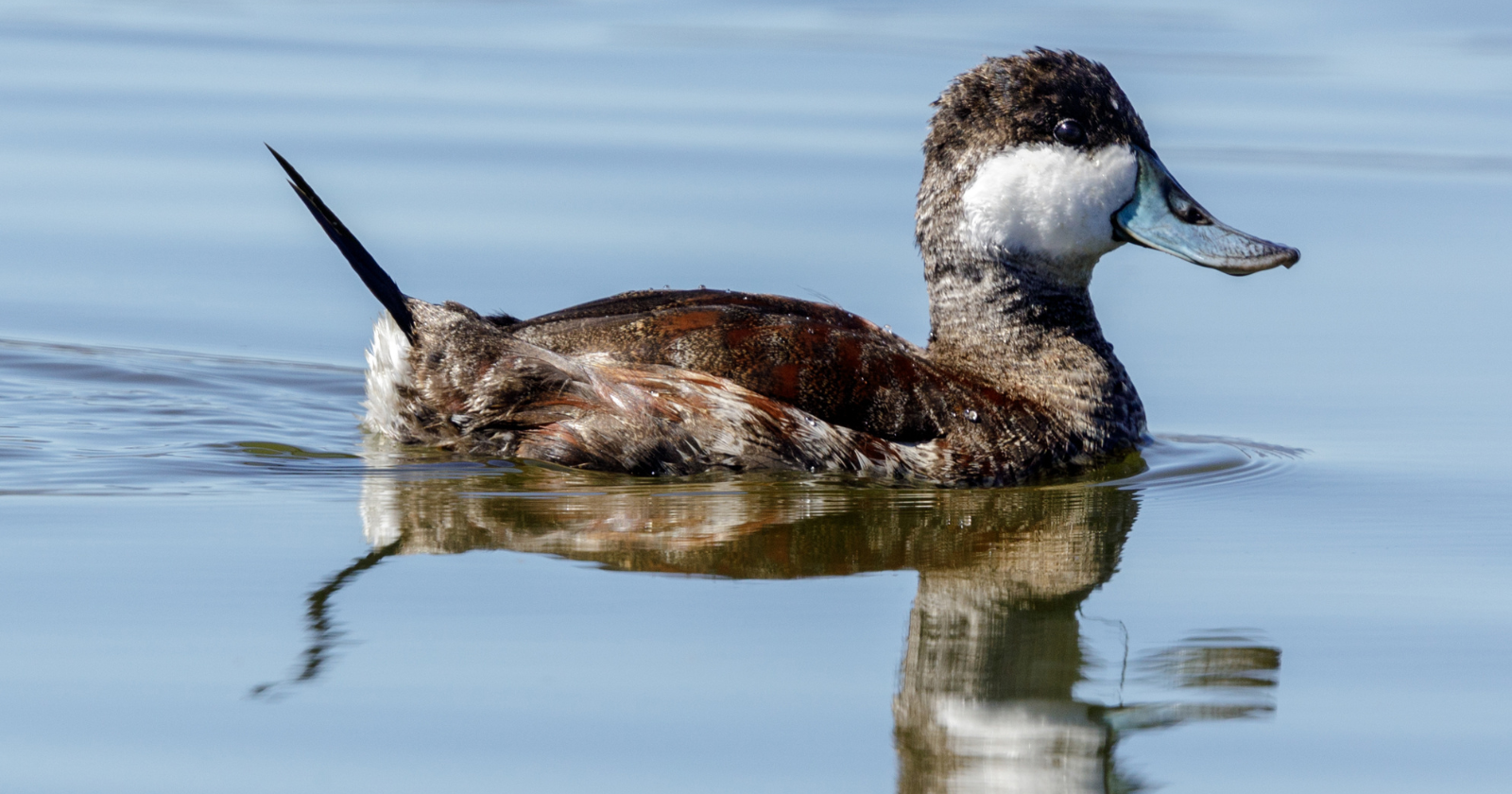
At Slimbridge in Gloucestershire, some time between 1956 and 1963, keepers at the wildfowl collection Sir Peter Scott had founded raised around seventy ruddy duck chicks and left them unpinioned, meaning their wing feathers were never clipped to stop them flying. Pinioning was standard practice for exotic waterfowl kept in open collections. Without it, a duck that fledges is a duck that can leave.
Those seventy birds did.
Ruddy ducks (Oxyura jamaicensis) are small, stiff-tailed diving ducks native to North America, the males distinctive in breeding plumage for a chestnut body and a sky-blue bill. They had been imported into British wildfowl collections since the 1940s and bred readily in captivity. The first confirmed sighting of one in the wild in Britain came in 1952, and by 1960 a pair had nested in Avon. The Slimbridge escapees, along with others that got out of smaller collections over the following years, found the flooded gravel pits and reservoirs of lowland England to their liking.
A booming population, and a problem it created
For most of the rest of the twentieth century, the ruddy duck’s spread looked like an unremarkable naturalisation story, the kind told about little owls or Canada geese before it. Between 1976 and 1996 the British population grew at roughly 24 per cent a year, according to figures compiled by the GB Non-native Species Secretariat, and by the late 1980s the species was breeding widely across England and Wales, with smaller populations established in eastern Scotland, Northern Ireland and the Republic of Ireland. By 2000 the feral population had reached an estimated 6,000 birds, a striking figure for a species with no wild presence in the country fifty years before.
The trouble, though, played out in Spain, where the ruddy duck’s closest relative, the white-headed duck (Oxyura leucocephala), had been reduced by hunting and wetland drainage to a few dozen birds by the 1970s. A long conservation effort, centred on the Laguna de Zoñar reserve in Córdoba, where the last birds had survived, had begun rebuilding the population. Ruddy ducks dispersing from Britain and France started turning up among them and interbreeding, producing fertile hybrids; the first was documented in Spain in 1991. Most of the ruddy ducks reaching Spain are thought to have originated in Britain, which left conservationists trying to save one duck species confronting a problem created, several hundred kilometres away, by another that Britain itself had let loose.
The cull, and the argument over it
Britain’s first attempt to remove ruddy ducks came in 1997, when the Department of the Environment proposed a mass cull. Animal Aid, a UK animal-rights group, publicised welfare problems from trial shootings that had already taken place, including one bird that reportedly took two hours to die and another recovered alive from the water after being shot thirteen times, and the resulting protests led the department to shelve the plan that spring. Further government culling trials ran from 1999, and their results supported the case that eradication was achievable, so ministers proceeded.
The full national programme began in September 2005, funded jointly by the UK government’s Department for Environment, Food and Rural Affairs (Defra) and the European Union’s LIFE-Nature fund, and carried out through what is now Defra’s Animal and Plant Health Agency (APHA). Marksmen shot birds at more than 140 sites across England, Scotland and Wales, mainly in winter when ruddy ducks gather on open water. The RSPB and the Wildfowl and Wetlands Trust, the charity Peter Scott founded and the one whose own collection had let the birds out in the first place, both supported the cull as necessary to prevent the white-headed duck’s extinction.
Not everyone accepted that the end justified the means. Critics argued that Britain was killing a bird that had done nothing more than adapt successfully to a landscape it had been introduced into, in order to solve a problem whose causes in Spain, continued habitat loss and hunting pressure on the white-headed duck among them, were not solely down to hybridisation. Others doubted a species so adept at hiding in reedbeds could ever be fully eradicated, or questioned whether the disturbance caused by shooting parties at wetland reserves in winter did more harm to other wildfowl than the programme was worth. The disagreement never really got resolved; it got overtaken by results.
What is left
The population fell quickly once the full programme began. From an estimated 4,400 birds in 2005, the UK total dropped to around 200 adults by July 2010, according to AEWA reporting from that period, and to roughly 100 the following year. The decline continued through the 2010s: a wintering peak of just 23 birds in 2018-19, and by 2019 only two breeding pairs remained, neither of which fledged young, the first breeding failure of its kind recorded in fifty years.
The most recent formal assessment, reported to the Bern Convention, November 2024, put the entire British population at around 11 birds, with survey estimates ranging from as few as six to as many as fifteen depending on conditions, split between two breeding pairs in south-west England. No ruddy duck-white-headed duck hybrid has been recorded in Spain since 2007, and the Spanish white-headed duck population has since recovered into the thousands. Britain’s original target of “functional extinction” for the ruddy duck by 2020 slipped to 2023 and has slipped again since; a handful of wary, well-hidden survivors have proven harder to find than the thousands of birds that came before them.
The Slimbridge collection that started it all still keeps ruddy ducks on the same site. This time, their wings are clipped.