

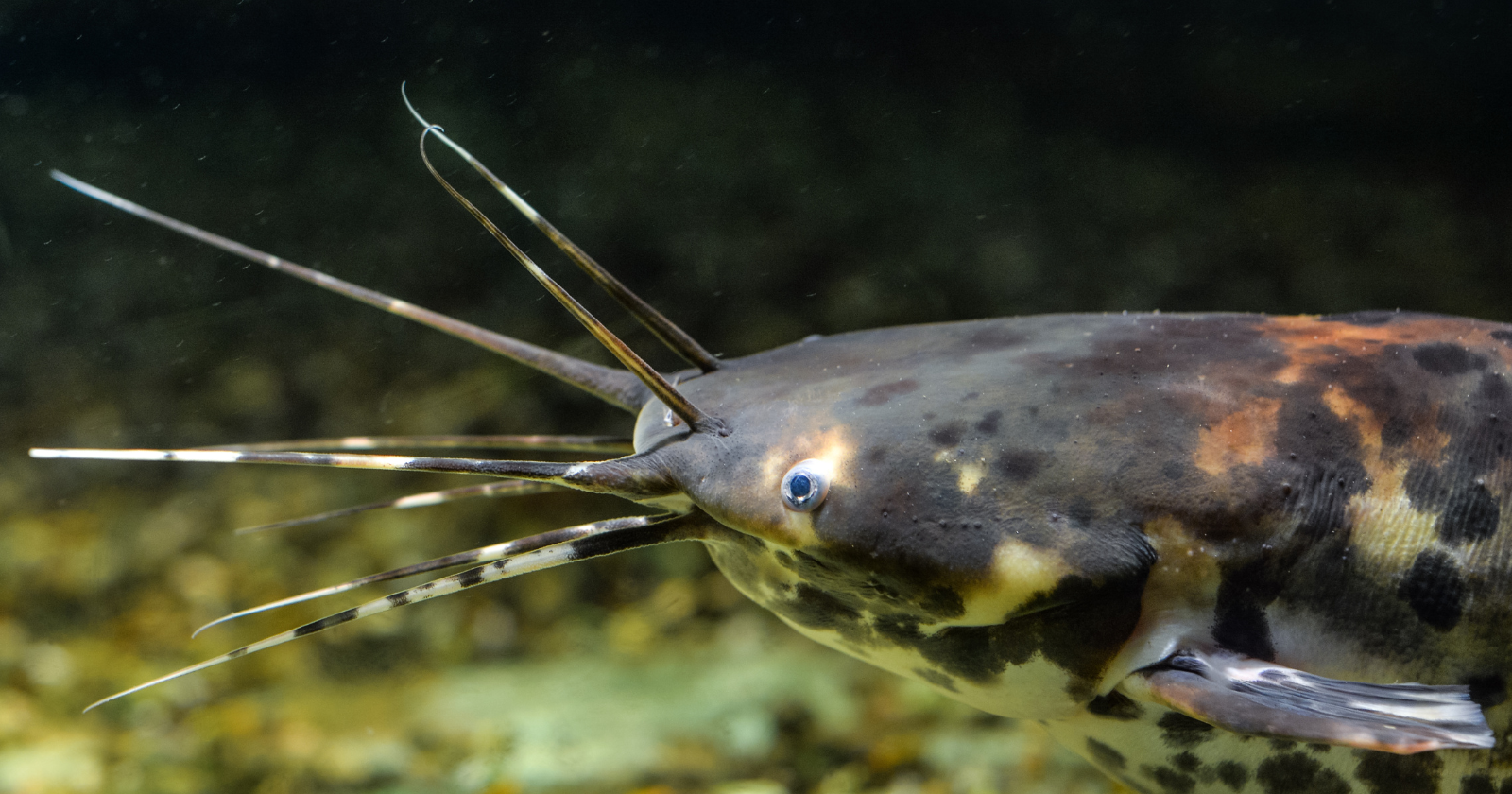
Sometime in the mid-1960s, a Southeast Asian catfish got loose in south Florida and never left.
The walking catfish (Clarias batrachus) had been brought in early that decade for the aquarium and fish-farming trade. Its first wild populations trace back to breeding stock escaping, either from a fish farm in northeastern Broward County or from a truck moving fish between Dade and Broward counties.
Whichever version you prefer, the outcome was the same. A tropical fish that could move across land found itself sitting on top of one of the most connected networks of canals in North America.
What makes this fish worth a second look is not that it escaped. Plenty of species escape. This one could walk to the next escape.
Fins as legs, wet nights as highways
The name is not a marketing flourish. The Florida Museum of Natural History describes how it works: “They use their pectoral fins to stay upright and wriggle in a snake-like movement to flop across land, usually during wet weather.” Collection manager Rob Robins, writing for the museum, adds that the fish is “named for its habit of moving over land, alternating the use of the left and right pectoral fins in tandem with body twists and flops.”
Florida’s own wildlife agency reaches for a more military image. The FWC species profile notes the catfish is “noted for ability to breath air and make short overland movements by pulling themselves along with their pectoral fins much like an infantry-man scooting under barbed wire.” The air-breathing part matters as much as the fins. A fish that can gulp air survives a trip across a road that a normal fish could not, and it can wait out water so low in oxygen that its competition dies off.
Put the two traits together and you get a species that treats a rainy night as an open door. When the ground floods and canals merge, the catfish can leave one body of water, cross the gap on its fins, and drop into the next. The canals did the long-distance work. The fins handled the last few meters the canals could not.
Three counties, then twenty
The spread is where the numbers get interesting. According to the USGS, in 1968 the fish was found in just three south Florida counties. By 1978, roughly a decade later, it had spread to 20 counties across the southern half of the peninsula.
That is the old picture: a fast-moving frontier, a species doing something novel enough that fish scientists tracked it county by county. The museum’s own collection holds the record, with 168 collections totaling 1,170 specimens documenting the fish’s spread in Florida between 1968 and 2017. The dread that came with it was just as vivid. Early on, the fear was that this air-breathing invader would eat its way through native fish and hollow out Florida’s waterways.
That fear did not pan out. The FWC now states that “early accounts that this fish would eliminate native fishes were erroneous, and it has not had major detrimental effects.” The Florida Museum’s own materials note that the ecological impact remains poorly understood, and that even the species identification as Clarias batrachus may not be correct. The picture sits somewhere between “harmless” and “unknown,” not a clean verdict either way.
The 1970s frontier vs. the flooded driveway
In the 1970s, the walking catfish was a story about a boundary moving across a map. Today it is a story about a driveway. The fish is no longer pushing into new territory so much as reappearing, predictably, whenever the weather cooperates.
When Hurricane Debby flooded Florida in August 2024, making landfall as a Category 1 hurricane, the catfish did what it has done for sixty years. Gulfport resident Luis Bardach filmed one on his driveway and offered the flattest possible narration, telling CBS News: “Very weird catfish, I guess, on our driveway during a tropical storm.”
The scale of the road-crossings has long been part of the lore. Robins, describing the fish for the museum’s 100 Years exhibit, writes that “so plentiful is the Walking Catfish in some locations in South Florida, that catfishes traversing roads on rainy nights have been run over by cars by the score.” “By the score” is colorful shorthand, not a head count, but it captures the texture of the thing: a fish common enough to become roadkill on dry land.
What sticks after the frontier stops moving
What we take from the walking catfish is less about the drama of arrival and more about what comes after it. The apocalyptic version of this story, the one where a foreign fish wipes out a native ecosystem, mostly did not happen. Neither did the reassuring version where an introduced species fades away. Instead you get a third outcome that is easy to miss: it stayed, without disaster.
The fish stopped being news around the same time it became a fixture. Its numbers dropped, its range held, and it settled into the background of south Florida life, surfacing on roads and driveways every time the water rises. A species that arrives with a bang and then simply persists is probably the more common outcome than either extreme the headlines reach for.
Sixty years on, the walking catfish is neither a monster nor a footnote. Just another thing that turns up on the pavement after a storm, wriggling on its fins toward the next stretch of water, the way it has since the ponds first spilled over.