

The word “maggot” usually evokes decay. Many familiar blowfly larvae develop in carrion, manure or decomposing material, but the New World screwworm is built around a more damaging strategy. Its larvae are obligate parasites: during that stage of life, they must feed on living tissue.
The US Centers for Disease Control and Prevention says a female Cochliomyia hominivorax can deposit 200 to 300 eggs at one time beside a wound or body opening. A superficial scratch or a break in the skin as small as a tick bite may attract her. Once the eggs hatch, the larvae enter the wound, feed head-down and enlarge it as they grow.
This article is reporting, not medical or veterinary advice. New World screwworm infestation is uncommon in people, but a suspected case requires prompt professional assessment and public-health or animal-health reporting.
The biological details have become newly urgent. After being eradicated from the United States in 1966, the parasite began moving north again through Central America and Mexico in 2023. USDA confirmed the first US animal detection in the current outbreak on June 3, 2026. Understanding the threat begins with a distinction that the blunt word “maggot” tends to hide.
“Maggot” is a life stage, not one way of feeding
A maggot is the legless larval stage of a fly, not a taxonomic group with one diet. Fly larvae occupy an enormous range of ecological niches. Many of the blowflies people encounter around dead animals or food waste feed on decaying organic matter. Others cause facultative myiasis, entering a living host opportunistically and often remaining around damaged or dead tissue.
New World screwworm is different. Its larva is an obligate parasite, meaning that feeding on a living host is not an occasional accident but a required part of development. The condition it causes is called wound or traumatic myiasis. An unrelated species, the Old World screwworm, evolved a strikingly similar way of life in Africa, Asia and parts of the Middle East.
The title’s contrast is therefore useful shorthand, but “most fly maggots” should not be read as a census of every fly species. The defensible distinction is narrower: unlike the familiar carrion-feeding blowflies and facultative wound invaders, New World screwworm larvae actively consume viable tissue and continue moving deeper into it.
A wound can be almost too small to notice
An adult female is attracted by odors from a wound or a moist body opening. She can place an egg mass at the edge of a cut, scratch, bite or surgical site, or near the eyes, nose, mouth, ears, genitals or the navel of a newborn animal. The skin break does not have to look severe before the infestation starts.
That is the context for the tick-bite comparison. It does not mean every tick bite is likely to attract screwworm. The fly must be present, the site must be accessible, and exposure matters. It means only that a very small break in the skin cannot rule out an egg-laying site in a place where the species occurs.
The 200 to 300 figure describes one batch, not a lifetime maximum. CDC says a female can lay as many as 3,000 eggs across a lifespan of roughly 10 to 30 days. Females normally mate once, a detail that later becomes crucial to controlling the population.
From an egg mass to a deepening wound
The eggs hatch within about 12 to 24 hours, according to the World Organisation for Animal Health. Newly emerged larvae push into the wound together and orient head-down. Their hook-like mouthparts tear tissue as they feed, while their rear ends remain positioned toward the opening for air.
Over roughly five to seven days, they pass through three larval stages, growing and molting as they consume tissue and wound fluid. This makes the lesion larger and deeper. The characteristic packed, burrowing behavior gave the insect its screwworm name; it does not mean the larvae are literal worms or that each one moves like a screw.
A severe wound can also become a feedback loop. Odor from the damaged tissue may attract more gravid females, which can add further egg batches. Secondary bacterial infection may compound the injury. Without treatment, extensive infestation can kill an animal and has occasionally been fatal in people.
After feeding, mature larvae leave the host and fall to the ground. They burrow into soil and pupate. Adult emergence can take from about seven to 54 days, depending strongly on temperature and humidity. In warm conditions, the entire generation can turn over in less than three weeks.
Livestock bear most of the burden, but not all of it
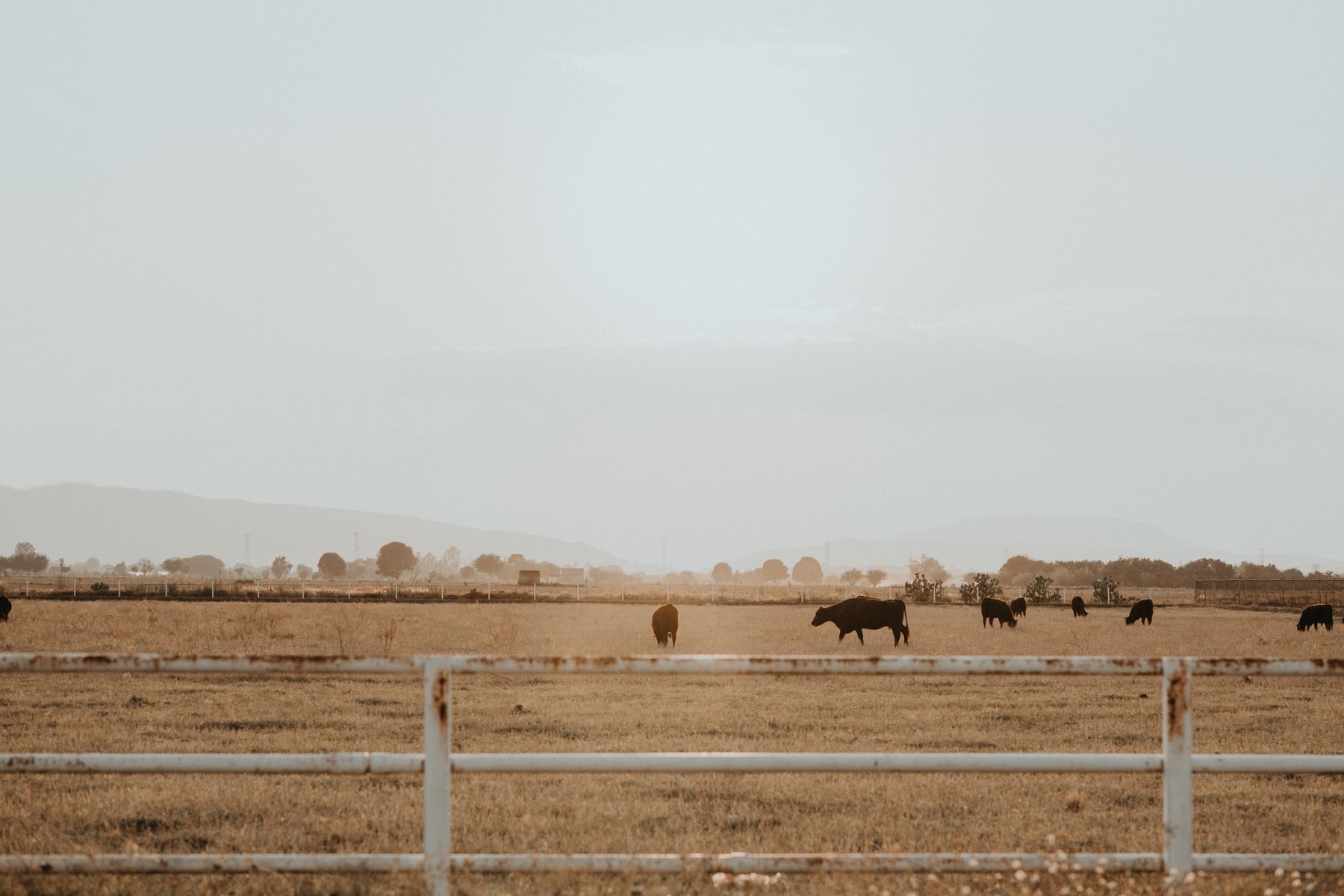
Any warm-blooded animal can serve as a host. Cattle, sheep, goats, pigs and horses account for much of the agricultural concern because wounds can follow ordinary husbandry, birth, fighting, thorns, insect bites and predation. Dogs, wildlife and birds can also be infested. People are less commonly affected, but human myiasis can involve wounds or mucous membranes and may be medically serious.
The infestation is not contagious in the ordinary sense. It does not pass directly from a person to another person, or from an animal to a person. An adult fly must lay eggs. An infested animal can nevertheless move developing larvae into a new location, and wildlife movement makes a biological boundary harder to police than a fence or checkpoint.
Newborn animals can be particularly vulnerable because an unhealed umbilical site offers the fly an entry point. More generally, risk follows access to exposed wounds and exposure to adult flies in an affected region. The seriousness of the parasite should not be translated into the idea that every person or animal with a cut is in danger everywhere.
Why this old livestock threat returned to US attention in 2026
New World screwworm remains endemic in parts of South America and the Caribbean. A regional resurgence that began in 2023 carried it through areas of Central America and into Mexico that had previously eliminated it. The CDC’s situation summary dated August 11, 2026 said Central America and Mexico had reported more than 209,400 animal cases and 2,500 human cases.
On June 3, USDA confirmed the first US animal case associated with the current outbreak. More animal detections followed in southern Texas and one county in New Mexico, prompting movement controls, surveillance and expanded sterile-fly dispersal. CDC activated its lowest-level emergency response on June 11 to support the wider federal and state operation.
The same August CDC summary described the US risk to the public and animals as very low and said there had been no locally acquired human infestation in the country. Both statements matter. An emergency response can be warranted because establishment would have serious consequences even while the risk to an individual member of the public remains low.
Case locations, active zones and trade controls can change quickly. USDA therefore maintains a current-status dashboard. Any fixed number in an article should be read with its date attached, not as a permanent account of the outbreak.
The fly’s one mating became the key to eradication
The reproductive behavior that helps a single female place thousands of eggs into the environment also supplies an unusually precise control point. Female New World screwworm flies normally mate only once. If that mating is with a sterile male, her eggs do not hatch.
The sterile insect technique turns this fact into an area-wide program. Screwworm flies are mass-reared, their pupae are exposed to radiation that leaves the adults able to compete for mates but unable to produce viable offspring, and enormous numbers are released across the affected region. With repeated releases, sterile males outnumber fertile wild males and the next generation shrinks.
The US Department of Agriculture credits this method with helping eradicate established New World screwworm from the United States in 1966 and eliminating a Florida Keys outbreak in 2017. The joint US-Panama production facility at Pacora can generate more than 100 million pupae per week.
Sterile flies cannot cause an infestation because their offspring never become larvae. The program is not a vaccine and it does not treat an animal already carrying maggots. It is population control conducted at a scale large enough to interrupt reproduction across a landscape.
Not every larva in a wound is a screwworm
A rapidly worsening, painful or foul-smelling wound may raise suspicion, particularly after exposure in an affected area. Other signs can include swelling, bleeding or discharge, an egg mass at the wound edge, visible larvae, or a sensation of movement. None of these signs alone identifies C. hominivorax.
Other flies can cause myiasis, and a deteriorating screwworm wound can later attract species that normally feed on damaged tissue. Confirmation therefore depends on collecting larvae and having trained specialists identify their morphology, or using an approved laboratory. The distinction affects both patient care and the public response because a confirmed screwworm case may signal that reproductive flies have reached a new area.
CDC clinical guidance calls for removing and killing every visible larva and egg in a suspected human case, sometimes through surgical removal, and checking the site again after 24 to 48 hours. Secondary bacterial infection may also require treatment. Evidence for ivermectin in human screwworm myiasis is limited to anecdotal reports, and CDC notes that controlled trials are lacking.
This is why identification and treatment are not sensible do-it-yourself tasks. Anyone who suspects a human infestation should seek immediate medical care and contact public-health authorities; a suspected animal case needs prompt veterinary attention and reporting to animal-health officials. Deep larvae or eggs left behind can allow tissue damage to continue.
The small wound is an entrance, not a forecast
The most disturbing fact about New World screwworm is not simply that a female can lay hundreds of eggs beside a tiny wound. It is that the larvae transform that opening into an expanding source of living food. Wound size at the start is therefore a poor guide to how serious an untreated infestation can become.
The balancing fact is that this is a known organism with a vulnerable reproductive system. Surveillance, rapid treatment, movement controls and sterile-fly release have eliminated it over large regions before. The 2026 detections deserve careful reporting because re-establishment would matter greatly to livestock, wildlife and occasionally human health, not because casual exposure makes infestation likely.
A tick bite can be enough of an opening where the fly is present. It does not make infestation inevitable. The difference between those two statements is the difference between understanding a parasite’s biology and turning that biology into fear.